
12 Signs of a Healthy Relationship: A Clinical Perspective on Lasting Connection

Updated: Jun 19
What if the most reliable indicator of a lasting bond isn't the absence of conflict, but rather the way you return to one another after a disagreement? It's common to feel a sense of unease when the initial "spark" transitions into something more quiet, or to worry that a difficult conversation signals the end of your compatibility. Many people struggle to distinguish the high-octane buzz of relational anxiety from the steady, grounded warmth of true intimacy. Understanding the specific signs of a healthy relationship is essential for moving beyond these fears and building a partnership that actually feels like a safe harbor.
This article provides a clinical perspective on the foundational pillars of relational health. You'll learn how to identify the subtle, restorative behaviors that signal a secure and thriving partnership, even during seasons of stress. We'll examine twelve clinical markers of connection, such as the "5:1 ratio" of positive to negative interactions during conflict. By exploring these signs, you'll gain the clarity needed to validate your emotional needs and find a path toward a more resilient, intentional bond.
Key Takeaways
Understand why "felt safety" is the neurological cornerstone of a secure partnership and how it fosters ongoing mutual growth.
Identify the specific signs of a healthy relationship through the lens of earned trust and the consistent micro-actions that build long-term security.
Discover the essential balance between maintaining a strong individual identity and fostering a deep, collaborative connection with your partner.
Learn how to master the art of repair and fair fighting, ensuring that conflict becomes a catalyst for understanding rather than a source of disconnection.
Recognize the value of proactive professional support as a form of preventative maintenance for navigating complex relational transitions.
Table of Contents
Understanding the Foundation: What Defines a Healthy Relationship?
A healthy relationship is not a static destination or a box to be checked once achieved. Instead, it's a dynamic state of mutual growth and safety that requires consistent, intentional practice. When we look at What Defines a Healthy Relationship?, we see that it's less about the absence of problems and more about how two individuals integrate their lives while maintaining their own resilience. This perspective shifts the focus from a "perfect" partnership to one that normalizes human struggles, viewing them as opportunities for deeper understanding rather than threats to the bond.
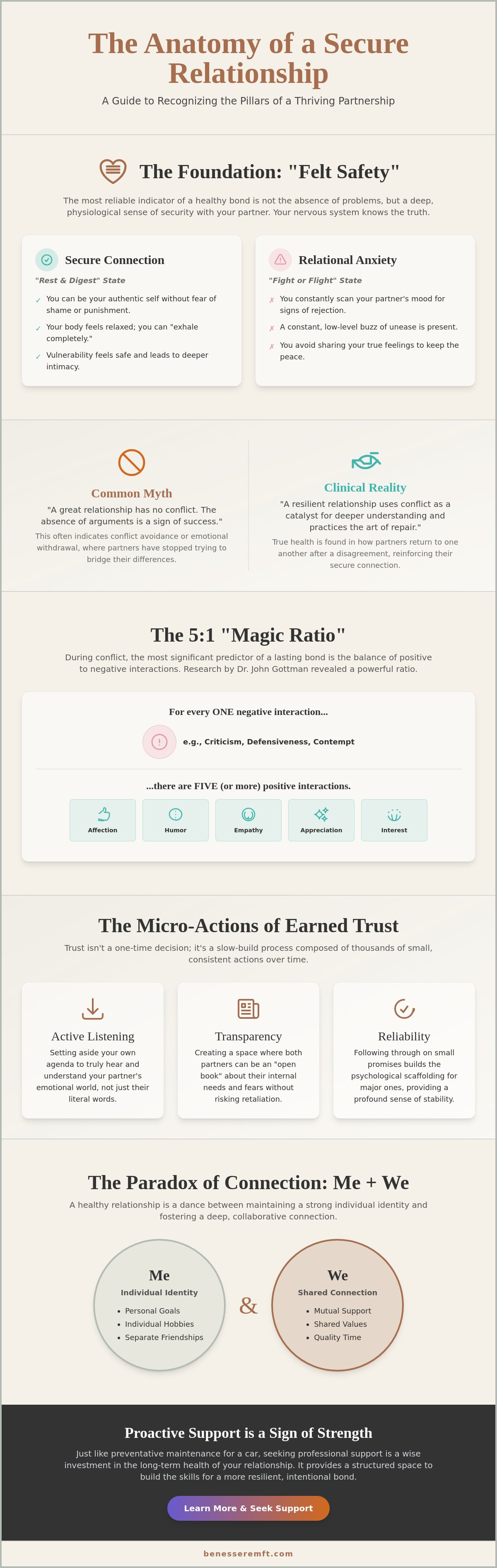
One of the most profound signs of a healthy relationship is the presence of "felt safety" within the body. While many articles focus on external behaviors, your nervous system provides the most honest assessment of your connection. In a secure partnership, your body generally remains in a state of "rest and digest" rather than "fight or flight." You don't feel a constant, buzzing need to scan your partner's mood for signs of rejection. Instead, there's a physiological settling, a sense that you can exhale completely because you're in a space where you're truly seen and accepted.
The Role of Psychological Safety
Psychological safety is the bedrock of intimacy. It's the internal conviction that you can show up as your most authentic self, complete with flaws and uncertainties, without the fear of being shamed or punished. This baseline of security allows for genuine vulnerability. When you know your partner is a safe harbor, you're more likely to share your deeper fears and aspirations. This transparency doesn't just happen; it's cultivated through thousands of small interactions where your partner responds with curiosity rather than judgment.
Moving Beyond the Absence of Conflict
It's a common misconception that a lack of arguments indicates a thriving bond. In reality, total silence can often be a sign of emotional withdrawal or conflict avoidance, where partners have simply stopped trying to bridge the gap between them. True relational health is found in secure connection, which often involves navigating disagreements with respect and empathy. A partnership that can weather life's inevitable transitions, from career shifts to family grief, demonstrates far more resilience than one that remains "peaceful" only by staying on the surface. Identifying the signs of a healthy relationship means looking for the presence of repair, not just the absence of friction.
The Essential Communication and Trust Checklist
Trust is often mistakenly viewed as a binary state, something you either have or you don't. In reality, trust is a methodical "slow-build" process composed of consistent micro-actions over time. It's the cumulative effect of being reliable in mundane moments. When we analyze the signs of a healthy relationship, we look for transparency that extends beyond surface-level facts to include an open dialogue about internal needs and fears. This level of honesty requires a partner who listens for emotional subtext rather than just the literal words spoken. It's about creating a space where you can share the full truth of your experience without the looming fear of retaliation or judgment.
Active listening involves a deep engagement with your partner's internal world. It means setting aside your own defensive responses to truly grasp their perspective. For many, this is where the work of couples therapy can be most transformative, as it provides a structured environment to practice these high-level communication skills. True transparency allows both individuals to be an "open book," which minimizes the cognitive load of wondering what the other is thinking or feeling. When communication is clear, the relationship functions with a sense of ease that isn't possible when information is withheld or obscured.
Reliability and the "Small Things"
Following through on minor promises creates the psychological scaffolding for major ones. If you can count on your partner to pick up the groceries or call when they say they will, your baseline anxiety within the relationship remains low. In a high-stress world, having a "predictable" partner provides a profound sense of stability. This predictability is a key component in a clinical perspective on relationship dynamics, as it reinforces the sense of felt safety. Being reliable means your partner doesn't have to spend emotional energy wondering if you'll show up for them.
Vulnerability as a Strength
Vulnerability is frequently misunderstood as weakness, yet it is the primary engine of intimacy. Healthy honesty is the courage to say, "I am struggling," or "I made a mistake," without the fear of being shamed. The health of a bond is often measured by how a partner responds to these moments. Validation, which is acknowledging the feeling without necessarily agreeing with the logic, builds connection, while dismissal creates distance. One of the most vital signs of a healthy relationship is emotional accessibility, the knowledge that your partner is reachable when you're at your most tender. It's the difference between being alone in your struggle and having a witness who remains steady by your side.
Autonomy and Boundaries: The Paradox of Connection
The paradox of a lasting connection lies in the fact that the closer two people become, the more vital their individual boundaries become. We often mistake "oneness" for health, yet losing oneself in a partner is a hallmark of codependency rather than secure attachment. One of the clearest signs of a healthy relationship is the ability to maintain a distinct individual identity. This includes pursuing separate hobbies, maintaining external friendships, and holding personal goals that exist outside the shared life of the couple. When both partners feel empowered to exist as individuals, the relationship becomes a choice made daily rather than a tether born of necessity.
Interdependence represents the healthy middle ground between total independence and codependency. It's a state where you rely on your partner for emotional support while remaining responsible for your own well-being. From a somatic perspective, notice how your body reacts when you spend time away from your partner or pursue a solo interest. In a secure bond, this space feels restorative and safe. If the distance triggers a sense of panic or a "tightening" in the chest, it may indicate that the connection is leaning toward codependency. True health allows for a rhythmic expansion and contraction of closeness, where both partners feel secure enough to let the other grow.
Respecting the "No"
A partner’s response to a boundary is a primary indicator of the relationship's overall health. When you express a limit, whether it's a need for physical space or a refusal of a specific request, a healthy partner responds with respect rather than guilt or pressure. Notice the physical sensation in your chest or stomach when you say "no." In a restorative partnership, that sensation is one of relief and safety, not the bracing of a defensive posture. Boundaries are the gates that keep intimacy safe. Without them, the relationship can become a source of resentment rather than a source of comfort.
Encouraging Personal Evolution
A secure relationship acts as a "secure base," a psychological term for a home port that allows an individual to explore the world with confidence. Your partner should be the person who celebrates your evolution, even when that growth shifts the status quo of the relationship. Whether you're navigating a career change or exploring a new facet of your identity, a healthy partner offers support rather than resistance. Supporting a partner through these shifts is a key part of navigating life transitions together, ensuring that the bond evolves alongside the individuals within it. Recognizing this mutual support for growth is one of the most encouraging signs of a healthy relationship.
Healthy Conflict and the Vital Art of Repair
Conflict is an inevitable facet of any long term partnership, yet it doesn't have to be a destructive force. In fact, one of the most resilient signs of a healthy relationship is not the total absence of arguments, but the presence of intentional repair. Research by Dr. John Gottman indicates that successful couples maintain a specific balance during disagreements, known as the "5:1 ratio." This means that for every one negative interaction during conflict, there are at least five positive ones. These positive moments, such as a brief touch, a shared joke, or a softening of tone, act as emotional buffers that prevent the relationship from being consumed by hostility.
Fair fighting requires a commitment to protecting the bond even when emotions are high. It involves avoiding "below the belt" tactics like name-calling, contempt, or stonewalling, which can predict relationship dissolution with over 90% accuracy. Instead, healthy partners focus on the specific problem at hand rather than attacking each other's character. If you find that your disagreements frequently devolve into these damaging patterns, seeking support through couples therapy can help you establish a safer, more restorative way to communicate.
The Anatomy of a Productive Argument
A productive argument is characterized by the use of "I" statements, which allow you to express your feelings without casting blame. This shift in language moves the conversation from "You always do this" to "I feel overwhelmed when this happens." It's also vital to recognize when your nervous system has reached its limit. When you feel your heart racing or your thoughts becoming flooded, taking a "timeout" is a sign of strength. These breaks allow both individuals to self-regulate, ensuring that the conversation remains a collaborative effort to find a solution rather than a battle to be won.
The Repair Process: 5 Steps to Reconnection
Repair is the bridge that leads partners back to one another after a rupture. It's an active process that requires both humility and a willingness to prioritize the relationship over being right. Following these steps can help transform a disagreement into a moment of growth:
Step 1: De-escalation and self-regulation. Pause the conflict to allow your physical and emotional intensity to subside.
Step 2: Acknowledging the hurt. Validate your partner's experience without becoming defensive or trying to explain away your actions.
Step 3: Taking responsibility. Identify and own your specific role in the disagreement, no matter how small it may seem.
Step 4: Offering a genuine apology. Focus on the impact your words or actions had on your partner rather than just your original intent.
Step 5: Creating a plan. Discuss practical ways to avoid the same cycle in the future, reinforcing the signs of a healthy relationship through shared commitment.
When Awareness Leads to Action: Seeking Professional Support
Recognizing the signs of a healthy relationship is a vital first step, but awareness alone doesn't always bridge the gap between where you are and where you wish to be. Even the most secure partnerships encounter seasons of transition that test their existing skillsets. Seeking professional support isn't a confession of failure; rather, it's a commitment to "preventative maintenance." To explore how clinical support can strengthen your bond, you can discover Hope Therapy Center and their range of specialized services. Just as we prioritize physical health through routine checkups, proactive relational care ensures that your bond remains resilient against the inevitable pressures of life. It's about building a toolkit that serves you long before a crisis emerges.
There are specific moments when a healthy relationship may benefit from an outside clinical perspective. When you find yourselves cycling through the same "unsolvable" problems or facing a major life transition, such as parenthood or a significant career shift, the guidance of a professional provides the clarity needed to move forward. For those seeking specialized family support, you can learn more about the approach taken by De Relatiespecialist. At Benessere, we focus on unique stories and evidence-based interventions to help Roseville couples deepen their connection. By integrating these skillsets, partners can transition from merely surviving a challenge to thriving within it, ensuring their partnership remains a safe harbor for both individuals.
Therapy as a Tool for Growth, Not Just Crisis
It's helpful to reframe the concept of couples therapy as a form of intimacy coaching or connection building. A third-party perspective offers a neutral ground where complex emotions are handled with precision and warmth. This process isn't about assigning blame but about identifying the patterns that hinder closeness and replacing them with restorative behaviors. Clinical interventions provide a methodical path toward resolution, allowing both individuals to feel heard and supported. This collaborative environment fosters a sense of security that is essential for long-term relational health and personal peace.
Your Next Steps Toward Lasting Peace
A meaningful way to begin this journey is by having a collaborative conversation with your partner about the points discussed in this checklist. Use this as an invitation to validate each other's emotional needs and celebrate the strengths you already possess as a team. If you're looking for personalized, restorative care in Roseville, our practitioners are here to guide you through the process of strengthening your relational foundation. Growth is always possible when approached with intention, empathy, and the right support. You don't have to navigate these complexities alone; professional guidance is a steady, non-judgmental resource for those seeking a more profound and lasting connection. We invite you to reach out and begin the process of intentional growth today.
Cultivating a Resilient Partnership
Building a partnership that thrives requires more than just the absence of conflict; it involves the active cultivation of psychological safety and the intentional art of repair. By recognizing the signs of a healthy relationship, you can move away from a place of uncertainty toward a grounded, secure connection. This process honors both the individual's need for autonomy and the couple's shared desire for deep, restorative intimacy. True relational health is a dynamic practice, one that welcomes evolution and treats every challenge as an opportunity for deeper understanding.
If you're ready to deepen your bond, we invite you to explore how our Roseville therapists can help you strengthen your connection. We offer evidence-based treatment tailored to your unique story, providing specialized clinical care for couples and families in Roseville. Our restorative approach to mental health and relationship growth is designed to provide you with the tools needed for lasting stability. Remember that every relationship is a living entity, capable of profound healing and growth. You don't have to navigate the path toward connection alone; steady, expert support is available to guide you toward the lasting peace you deserve.
Frequently Asked Questions
How do I know if my relationship is healthy or if I am just comfortable?
A healthy partnership is defined by active growth and a proactive interest in one another's well-being, while being "just comfortable" often involves a passive avoidance of deeper issues. If you feel a sense of "felt safety" that allows for vulnerability and evolution, you are likely in a healthy space. However, if your comfort is built on a foundation of emotional withdrawal or a lack of meaningful connection, it may be time to reassess your relational needs.
Can a relationship be healthy if we fight a lot?
Frequent conflict doesn't automatically mean a relationship is failing, provided the arguments are productive and respectful. The key indicator is the ability to repair after a rupture and the maintenance of a high ratio of positive interactions. If you find that disagreements lead to greater understanding rather than deep-seated resentment, your bond remains resilient despite the friction. It's the quality of the repair, not the absence of the fight, that matters most.
What is the number one sign of an unhealthy relationship?
Clinical research identifies contempt as the most significant predictor of relationship dissolution. This involves treating your partner with disrespect, mocking them with sarcasm, or using body language like eye-rolling to signal superiority. While many signs of a healthy relationship involve positive communication, the presence of contempt actively erodes the foundation of trust and safety necessary for a lasting connection. It creates a hierarchy that is incompatible with mutual respect.
Is it healthy to spend every moment with my partner?
Maintaining a distinct individual identity is essential for a thriving partnership, as spending every moment together can lead to codependency. Healthy couples prioritize personal time alongside shared time, allowing each person to pursue individual interests and friendships. This autonomy actually strengthens the bond by ensuring that both individuals bring fresh energy and a sense of self back into the relationship. Space is often the oxygen that allows intimacy to breathe.
How can I bring up the need for boundaries without hurting my partner’s feelings?
You can introduce boundaries by framing them as a way to protect the intimacy you share rather than as a restriction on your partner. Use "I" statements to explain how a specific limit helps you feel more present and secure within the connection. For example, saying "I need an hour of quiet time after work so I can be fully engaged with you later" focuses on a restorative outcome that benefits the entire partnership.
When should a healthy couple consider marriage and family therapy in Roseville?
Couples should consider seeking professional support when they encounter recurring communication cycles they can't break or when facing major life transitions. In Roseville, proactive care offers a neutral space to practice evidence-based skills before a crisis occurs. Seeking couples therapy is a sign of strength, demonstrating a shared commitment to maintaining the long-term health and resilience of your partnership. It provides a methodical path toward deeper understanding.
Can a relationship become healthy again after trust is broken?
It is possible for a relationship to become healthy again after trust is broken, but it requires a methodical process of accountability and transparency. The partner who broke trust must be willing to engage in the "slow-build" of earned trust through consistent, reliable actions over time. This restorative journey often requires professional guidance to ensure that the underlying causes of the rupture are fully addressed and that both partners feel safe to move forward.
What does "repair" look like in a daily context?
Daily repair often takes the form of small "olive branches" or attempts to reconnect after a minor misunderstanding. This might look like a gentle touch, a sincere apology for a sharp tone, or using humor to de-escalate a tense moment. Recognizing and responding to these subtle signals is one of the most vital signs of a healthy relationship, as it prevents small frustrations from growing into resentment. It's the consistent practice of returning to one another.



Comments