
Coping with Trauma Symptoms: A Restorative Guide to Reclaiming Your Peace
- Eddie Posadas
- 3 days ago
- 12 min read

What if the physical exhaustion and constant vigilance you feel today aren't signs that you're broken, but evidence that your body is working exactly as it should to protect you? When you're living with the aftermath of a difficult experience, it's natural to feel as though you're permanently stuck in the past or that your nervous system has lost its ability to rest. Searching for trauma therapy Roseville often begins with a simple, quiet hope; it's the desire to feel normal again and to finally put words to an experience that feels impossible to explain.
We understand that the road to recovery can feel daunting, especially when your daily life is overshadowed by emotional distress. You deserve a space where your story is respected and held with care. This article provides a restorative path forward, offering evidence-based strategies and practical skillsets to help you manage both the emotional and physical impacts of traumatic stress. You'll gain a clearer understanding of the biology behind your symptoms and discover how to build a sense of agency over your own story, moving toward a future defined by peace rather than survival.
Table of Contents
Understanding Trauma Symptoms: Why the Past Stays Present
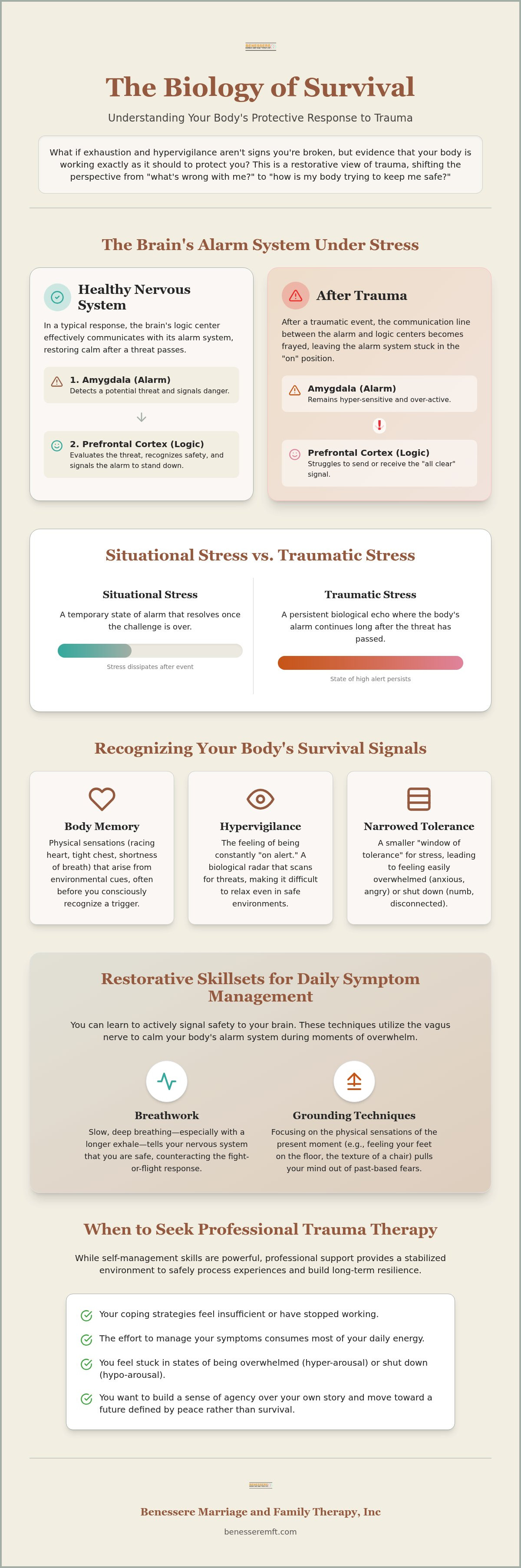
Trauma is rarely just a memory of a difficult event; it's a physiological legacy that remains active within the body. When an individual experiences psychological trauma, the nervous system often becomes stuck in a state of high alert. While standard situational stress typically dissipates once a specific challenge is resolved, traumatic stress persists. It functions as a biological echo, where the body continues to deploy protective measures long after the actual threat has passed. This persistent state of readiness is not a sign of emotional fragility; it is a profound testament to your body's commitment to your survival.
Validating this experience is the first step toward restoration. Many people feel a sense of shame or frustration when they can't simply "move on" from the past, yet these reactions are deeply rooted in our biology. Your symptoms represent the brain's attempt to ensure you are never caught off guard again. By shifting the perspective from "what is wrong with me" to "how is my body trying to protect me," we open the door to a more compassionate and effective healing process. This is the foundation of restorative mental health, a structured approach that seeks to integrate these experiences into a cohesive and peaceful present.
The Spectrum of Traumatic Stress
Traumatic experiences exist on a diverse spectrum, and no two stories are processed in exactly the same way. Some individuals may struggle with acute stress following a single, isolated incident, while others face the weight of complex trauma stemming from prolonged exposure to adversity. Whether the origin is a specific accident or years of relational conflict, the impact is valid. Your unique history dictates how these experiences are stored, and recognizing the specific nature of your stress is essential for creating a path toward resolution.
When Coping Becomes Overwhelming
There is often a specific tipping point where self-management strategies begin to feel insufficient. This frequently occurs when your "window of tolerance" narrows, leaving you feeling either perpetually overwhelmed or completely shut down by daily life. When the effort required to manage your symptoms consumes all your energy, professional clinical support becomes necessary. Seeking trauma therapy in Roseville offers a stabilized environment where you can safely explore these layers. Engaging with trauma therapy Roseville allows you to work with a guide who understands the nuances of the nervous system, helping you regain the agency you need to reclaim your story.
The Biological Logic of Traumatic Stress
To understand why trauma feels so pervasive, we must look at the sophisticated mechanics of the human brain. At the center of this experience is the amygdala, a small structure that functions as your body's internal alarm system. Its primary role is to detect danger and initiate a survival response. In a healthy state, the prefrontal cortex, or the brain's logic center, evaluates the threat and signals the amygdala to stand down once the danger passes. However, after a significant ordeal, this communication line can become frayed. The alarm remains active, and the logic center struggles to regain control, leaving you in a state of perpetual readiness.
This biological shift explains why physical sensations often precede conscious thoughts during a trigger. You might feel your heart race or your breath shorten before you even realize what has reminded you of the past. This is known as body memory. It's a reflexive response where the nervous system reacts to environmental cues it perceives as threatening. Gaining insight into these patterns through Coping With Traumatic Events helps normalize the experience; your body isn't failing you, it's simply following a survival script that hasn't been updated. Professional individual psychotherapy in Roseville provides the specific tools needed to bridge this gap between your physical reactions and your conscious mind.
Hypervigilance is often the most exhausting result of this process. It acts as a biological radar that's constantly scanning for threats, even in safe environments. Because the system hasn't been recalibrated, it treats every shadow as a predator. Recognizing that this is a physiological state rather than a personality flaw is essential for healing. If you find yourself constantly on edge, reaching out for specialized clinical support can help you begin the unhurried process of returning your system to a state of rest.
The Nervous System and Emotional Regulation
Your nervous system operates on two primary tracks: the sympathetic system, which acts as the gas pedal for action, and the parasympathetic system, which serves as the brake for rest. Trauma often causes dysregulation, where the balance between these two essential systems is lost. You might find yourself "wired," stuck in a state of high anxiety, or "numb," feeling disconnected and heavy. The goal of trauma therapy Roseville is to restore this equilibrium, teaching your body how to safely move between engagement and relaxation once again.
Physical Symptoms Linked to Trauma
The body often holds what the mind cannot process, manifesting as chronic physical markers. These can include persistent digestive issues, unexplained muscle tension, or profound exhaustion that sleep doesn't seem to touch. Sleep disturbances and night terrors are also common, as the brain continues to process the threat during its most vulnerable state. Somatic experiencing is the body's way of releasing this stored stress, allowing the physical self to finally complete the survival cycles that were interrupted during the traumatic event.
A Checklist for Recognizing Your Trauma Responses
Identifying trauma responses is often a process of self-discovery rather than a simple clinical labeling. It involves noticing the subtle and overt patterns that have emerged as your body attempts to maintain a sense of safety. These responses are the evidence of your resilience, yet they can become heavy burdens when they persist long after the initial event. Recognizing these signs is the first step toward reclaiming your peace, as it allows you to move from confusion toward a structured path of restoration. Engaging with trauma therapy Roseville offers a professional space to decode these signals and understand their origin within your unique story.
Trauma responses typically manifest in several distinct categories. Reviewing this checklist can help you determine if your current experiences are linked to past traumatic stress:
Intrusive Thoughts: These are uninvited memories that disrupt your daily life. They may appear as vivid flashbacks, distressing nightmares, or looping thoughts that feel impossible to silence.
Avoidance Behaviors: You might find yourself gradually shrinking your world to stay safe. This often looks like avoiding certain Roseville landmarks, such as Vernon Street or the busy areas near the Galleria, or steering clear of specific people and conversations that feel "too close" to your experience.
Negative Changes in Mood: Trauma often colors your worldview. You may carry a persistent sense of guilt or shame, or feel a deep, underlying conviction that the world is inherently unsafe.
Hyperarousal: This is the feeling of being constantly "on edge." It includes a heightened startle response, irritability, or the habit of scanning every room for exits before you can even sit down.
Emotional vs. Cognitive Responses
The impact of trauma is often split between how we feel and how we think. Emotional responses might include sudden bursts of anger or waves of depression that seem to arrive without an immediate cause. On the cognitive side, you may experience persistent brain fog, memory gaps, or significant difficulty concentrating on complex tasks. It's helpful to ask yourself: are these symptoms interfering with your professional life or your ability to be present with your family in Placer County? When cognitive and emotional distress begin to overlap, the weight can feel insurmountable without clinical guidance.
Social and Relational Impacts
Trauma doesn't exist in a vacuum; it ripples through your closest connections. These internal struggles often manifest as family conflict, where your distress creates unintended friction with those you love most. You might notice a tendency to isolate or pull away from loved ones, perhaps out of a desire to protect them from your pain or a fear that they won't understand. Recognizing how these symptoms affect your role as a partner or parent is not about assigning blame, but about acknowledging that your story deserves a space for healing and restoration. Specialized trauma therapy Roseville provides the tools to bridge these relational gaps, helping you move back toward connection and harmony.
Restorative Skillsets for Daily Symptom Management
Managing trauma symptoms in real-time requires a toolkit of restorative skillsets that address both the mind and the body. These aren't just distractions; they're evidence-based methods to downregulate the nervous system when it's stuck in a survival loop. One of the most accessible tools is the 5-4-3-2-1 grounding technique. By identifying five things you see, four you can touch, three you hear, two you can smell, and one you can taste, you force the brain to disengage from internal distress and return to the safety of the present environment.
Breathwork serves as another vital pillar of daily regulation. By intentionally slowing your exhale, you stimulate the vagus nerve, which acts as a direct line to the brain's "brake" system. This simple biological shift signals to the amygdala that the immediate threat has passed. When these skills are practiced regularly, they create a foundation of stability that makes deeper work in trauma therapy Roseville more effective and sustainable over time.
Beyond physical regulation, narrative reframing allows you to shift your internal identity. Moving from a mindset of "I am broken" to "I am a person who survived a significant challenge" changes your relationship with your history. This shift is solidified through a personalized safety plan. By identifying your specific triggers and predetermining your restorative responses, you regain a sense of agency over your daily experience, ensuring you're no longer at the mercy of sudden emotional waves.
The Power of Narrative Therapy
Narrative therapy is a collaborative process that allows you to externalize your trauma, treating it as something you've experienced rather than who you are. This clinical approach focuses on rewriting the story of your life to highlight your inherent resilience and agency. Narrative therapy is a collaborative process to reclaim one's unique story, ensuring that the trauma doesn't remain the sole author of your future.
Mindfulness and the Body
Re-engaging with the body must be done with careful pacing to avoid flooding the system with too much sensory information at once. Mindfulness in this context isn't about forced relaxation; it's about gently noticing physical sensations without becoming overwhelmed by them. These evidence-based skillsets create a foundation for long-term stability and growth. If you're ready to move beyond survival and begin the work of true restoration, reaching out for specialized trauma treatment in Roseville can provide the guidance you need to navigate this journey safely through trauma therapy Roseville.
When to Seek Professional Trauma Therapy in Roseville
While the grounding techniques and self-regulation skills discussed earlier are essential for daily management, there are moments when the weight of traumatic stress requires more than individual effort. Recognizing the threshold where self-coping is no longer sufficient is a vital part of the restorative process. If you find yourself in a state of severe isolation, unable to participate in the activities you once enjoyed, or if your symptoms are consistently interfering with your professional and personal life, it's likely time to consider professional trauma therapy Roseville. Seeking help is a proactive choice to prioritize your restoration and reclaim the peace that has been overshadowed by the past.
Choosing a trauma-informed approach offers distinct advantages over general counseling. While general therapy is valuable for many life transitions, trauma-informed care specifically addresses the neurobiological impact of stress on the nervous system. It prioritizes safety and stabilization, ensuring that you aren't retraumatized during the therapeutic process. A local clinician who understands the Roseville environment can provide care that feels grounded and relevant to your daily life. Much of this work involves psychoeducation, which helps reduce the mystery and fear surrounding your symptoms by explaining exactly how your brain and body are responding to past events. When you understand the "why" behind your reactions, the path to "how" you heal becomes much clearer.
What to Expect in Clinical Psychotherapy
Clinical psychotherapy provides a safe, non-judgmental sanctuary where you can process complex emotions at a pace that feels secure. You'll work with evidence-based modalities like Cognitive Behavioral Therapy (CBT) and Narrative Therapy to dismantle the power of traumatic memories. These sessions aren't just about revisiting the past; they're about building the resilience needed for the present. The objective isn't just to manage symptoms but to move from a state of survival to one where you're truly thriving within your unique life story.
Taking the Next Step Toward Healing
We encourage you to reach out for a consultation to determine if the therapeutic relationship feels like the right fit for your specific needs. For those whose experiences have created friction within their home environment, a specialized Marriage and Family Therapy approach can help restore connection and harmony with your loved ones. Healing is a deliberate, unhurried process, and you don't have to walk this path alone. Engaging with trauma therapy Roseville is an invitation to begin a new chapter, one defined by resilience and a renewed sense of agency over your own future.
Embracing the Path to Lasting Restoration
Reclaiming your peace isn't a matter of erasing the past; it's about integrating your experiences into a story where you hold the agency. We've explored how your symptoms are biological responses designed for protection and how restorative skillsets can begin to steady your nervous system. By acknowledging the biological logic of your distress and identifying specific triggers, you've already taken the first steps toward a more regulated life. Seeking trauma therapy Roseville represents a profound commitment to your future, moving beyond simple survival toward a state of genuine flourishing.
At Benessere Marriage and Family Therapy, Inc, we offer a compassionate, personalized approach to healing. Our focus on specialized trauma and PTSD care utilizes evidence-based clinical skillsets to help you navigate the complexities of your journey with precision and warmth. You deserve a space where your unique story is handled with the respect and expertise it requires. Ready to reclaim your story? Explore Trauma Therapy in Roseville at Benessere Marriage and Family Therapy, Inc and begin the unhurried process of coming home to yourself. You don't have to navigate this transition alone; support is available whenever you're ready to take that next step.
Frequently Asked Questions
Is it normal to have trauma symptoms years after an event?
Yes, it's entirely normal for trauma symptoms to persist or even emerge many years after the initial experience. Traumatic memories are often stored in the nervous system's survival centers rather than the brain's narrative memory center. This means they can remain dormant until a life transition, a specific sensory trigger, or a period of high stress reactivates the body's protective responses. This persistence is a biological signal that your system is still seeking a sense of safety.
Can trauma symptoms go away on their own without professional help?
While some people experience a natural reduction in acute stress over time, clinical trauma symptoms often require professional intervention to resolve completely. Without a structured approach to process the experience, the nervous system may remain stuck in a state of dysregulation or hypervigilance. Engaging in trauma therapy Roseville provides the clinical framework necessary to move toward lasting restoration, allowing you to address the root causes of your distress rather than just managing surface symptoms.
How do I know if I have PTSD or just a normal reaction to stress?
The primary difference lies in the duration and the pervasive nature of the symptoms you're experiencing. Standard situational stress usually lessens once a specific challenge has passed, but PTSD involves symptoms like flashbacks and avoidance that persist for more than a month. When your reactions begin to narrow your life, cause persistent exhaustion, or interfere with your closest relationships, it indicates that your body is struggling to return to a state of equilibrium on its own.
What is the difference between active and passive coping for trauma?
Active coping involves taking intentional, direct steps to manage your emotional state and process the trauma, such as practicing grounding techniques or attending therapy. Passive coping often looks like avoidance, numbing through substances, or withdrawing from social connections to escape painful feelings. While passive strategies might provide temporary relief from distress, active coping builds the long-term resilience and agency needed to truly reclaim your story and move forward with peace.
Can trauma symptoms cause physical pain or illness?
Yes, traumatic stress frequently manifests as physical ailments such as chronic muscle tension, digestive distress, and persistent headaches. Because the nervous system remains in a state of high alert, the body can become physically exhausted by the constant production of stress hormones. Addressing these physical markers is a standard part of restorative care, as it acknowledges that the body and mind must heal in tandem to achieve a full sense of wellness.
How can I help a family member who is struggling with trauma symptoms?
The most effective way to help is to provide a calm, non-judgmental presence while gently encouraging them to seek professional support. Avoid pressuring them to share details before they're ready, as this can increase their sense of overwhelm. Instead, validate their feelings and offer to assist them in finding specialized trauma therapy Roseville to ensure they have access to the clinical tools and safe environment needed for a sustainable and healthy recovery.
What should I look for in a trauma-informed therapist in Roseville?
You should prioritize a clinician who emphasizes safety, transparency, and a collaborative approach to your care. A truly trauma-informed therapist will have specific training in evidence-based modalities and will focus on stabilizing your nervous system before attempting to process deeper memories. It's essential to find a professional whose personality and clinical style make you feel profoundly respected, heard, and secure throughout the entire therapeutic process.
Is it possible to fully recover from trauma, or just manage it?
Full recovery is possible, though it's often viewed as a process of integration rather than erasing the past. Healing means that the traumatic event no longer dictates your emotional state, your physical health, or your daily choices. Through a methodical and restorative process, you can reach a point where the memories of the past no longer carry their original charge, allowing you to live with a renewed sense of hope and agency.


Comments