
Anxiety Management Techniques: A Clinical Guide to Reclaiming Your Peace

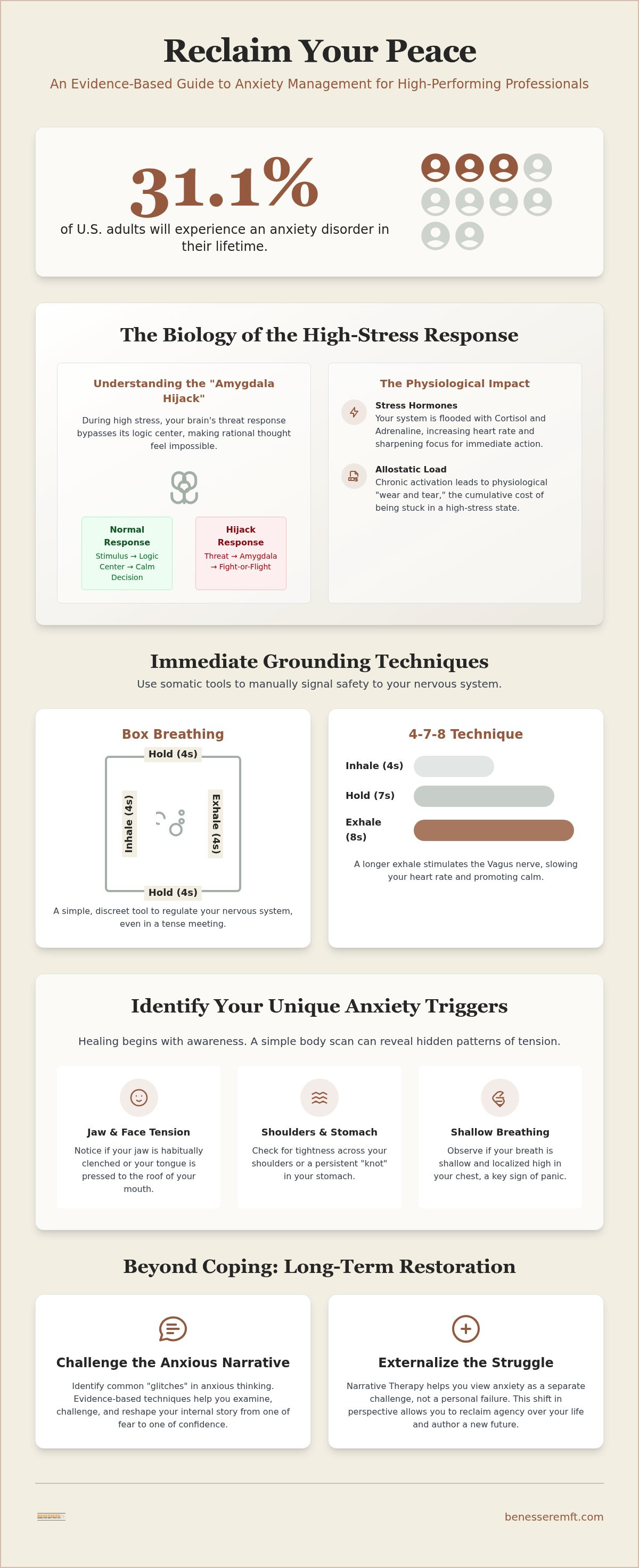
Your professional success shouldn't feel like a fragile mask for a racing heart and a mind trapped in endless "what-if" loops. While research indicates that 31.1% of U.S. adults will experience an anxiety disorder at some point in their lives, knowing the statistics doesn't make the physical chest tightness any easier to bear. You've likely spent years perfecting the art of "powering through," yet you still find yourself searching for sustainable anxiety management techniques that actually work when the pressure mounts. It's exhausting to maintain a polished exterior while feeling a profound lack of agency over your own internal state.
At Benessere MFT in Roseville, we believe that true peace isn't found by suppressing your symptoms, but by understanding their unique narrative. This article promises to bridge the gap between immediate grounding tools for high-stress moments and the long-term emotional regulation required for restorative healing. We'll examine how evidence-based clinical skillsets can help you reclaim your peace; we'll also explore how identifying the origins of your distress allows you to rewrite your story with clarity and confidence. You don't have to navigate this journey toward resilience alone.
Table of Contents
Understanding the Mechanics of Anxiety and Chronic Stress
Anxiety is often misunderstood as a sign of personal failure; however, it's actually an overactive biological survival mechanism. It's the brain's way of protecting you from perceived threats. In our modern environment, these threats aren't physical predators but complex social pressures, digital noise, and professional deadlines. When your brain senses danger, it triggers an "Amygdala Hijack." This process bypasses the prefrontal cortex, which is the area responsible for logic, executive function, and calm decision-making. This is why logical reasoning often feels impossible during high-stress moments. While many people attempt to ignore these symptoms, learning effective anxiety management techniques starts with understanding the biological "why" behind the feeling. Recognizing this reality is the foundation of psychoeducation, providing the first step toward reclaiming your emotional agency.
The Biology of the High-Stress Response
When the threat response activates, your adrenal glands flood your system with cortisol and adrenaline. These hormones prepare you for immediate action by increasing your heart rate and sharpening your focus. While this is helpful for short-term survival, chronic activation leads to a high allostatic load. Allostatic load represents the cumulative physiological wear and tear resulting from chronic overexposure to stress hormones, which can lead to significant long-term health complications if left unaddressed. For professionals in Roseville's competitive medical and business sectors, this biological trigger can become a constant baseline rather than a temporary reaction. Understanding how your body responds to persistent pressure is essential before implementing specific relaxation techniques to soothe the nervous system.
Identifying Your Unique Anxiety Triggers
Healing begins with awareness. Clinical anxiety differs from normal stress when the worry becomes persistent, excessive, and begins to interfere with your daily quality of life. To begin identifying your unique triggers, try a simple body scan to locate where you hold tension. This physical awareness often reveals patterns you might otherwise miss. Consider the following common indicators:
Notice if your jaw is habitually clenched or if your tongue is pressed against the roof of your mouth.
Check for tightness in your shoulders or a persistent "knot" in your stomach.
Observe if your breath is shallow or localized high in your chest.
Distinguishing between situational triggers, like a specific meeting, and generalized anxiety helps you choose the most appropriate anxiety management techniques for your needs. Normalizing these human struggles is not about making excuses. It's about acknowledging your internal experience with compassion so you can move toward lasting restoration and growth.
Immediate Grounding Techniques for Physiological Relief
Somatic grounding serves as a physiological "back door" into your nervous system. When your mind is trapped in a loop of intrusive thoughts, logical reasoning often feels out of reach. Somatic interventions bypass the cognitive centers of the brain entirely, communicating directly with the Vagus nerve. This nerve is the primary conduit of the parasympathetic nervous system, which is responsible for the "rest and digest" response. By intentionally stimulating this pathway, you manually signal to your body that the immediate threat has passed. These anxiety management techniques offer a restorative reset for a system stuck in a state of high alert. According to the National Institute of Mental Health, addressing these biological responses is a vital component of a comprehensive treatment plan.
Advanced Breathing Patterns for Rapid De-escalation
The way you breathe dictates the signals your brain receives. Shallow breathing, localized in the upper chest, keeps the "fight-flight" loop active by mimicking a state of panic. To break this cycle, high-performance individuals often utilize Box Breathing. This method follows a simple 4-4-4-4 pattern: inhale for four seconds, hold for four, exhale for four, and hold the empty lungs for four. It's a discreet tool that can be used during a tense boardroom meeting without drawing attention. Another clinical favorite is the 4-7-8 technique. By making the exhale significantly longer than the inhale, you force the heart rate to slow down and encourage the nervous system to settle. This rhythmic control provides a sense of agency when your internal environment feels chaotic.
Somatic Grounding: The 5-4-3-2-1 Method
When "thought spiraling" begins, sensory engagement can pull you back to the present moment. The 5-4-3-2-1 method is a structured way to interrupt the anxious narrative by forcing the brain to process external data. Follow these steps slowly:
5 things you can see: Look for small details, like the texture of a fabric or the way light hits a surface.
4 things you can touch: Feel the weight of your feet on the floor or the cool surface of a desk.
3 things you can hear: Listen for distant traffic, the hum of an air conditioner, or your own breath.
2 things you can smell: Notice the scent of coffee or the crispness of the air.
1 thing you can taste: Focus on the lingering flavor of a mint or simply the inside of your mouth.
For those in office environments, Progressive Muscle Relaxation (PMR) is another effective anxiety management technique that remains invisible to others. You can curl your toes tightly for five seconds and then release them, feeling the tension drain away. This process of intentional contraction and release reminds the body how to relax. If you find that these self-applied tools aren't enough to quiet the noise, seeking individual psychotherapy can help you build a more personalized toolkit for long-term peace.
Cognitive Strategies: Challenging the Anxious Narrative
While somatic grounding addresses the immediate physiological surge, cognitive strategies provide the mental architecture needed to dismantle persistent worry. Cognitive Behavioral Therapy (CBT) stands as a primary evidence-based skillset for those seeking sustainable relief. Rather than engaging in an exhausting battle with your thoughts, CBT invites you to observe them with clinical precision and human warmth. This process of externalizing the internal dialogue is a core component of the individual psychotherapy Roseville professionals utilize to help clients move from reactive distress to proactive agency. By identifying Cognitive Distortions, which are the common "glitches" in anxious thinking, you can begin to separate objective reality from the distorted lens of fear.
Identifying and Reframing "What-If" Loops
Anxious thinking often falls into predictable patterns that amplify stress. Two of the most common distortions include "catastrophizing," where you jump to the worst possible outcome, and "all-or-nothing" thinking, which leaves no room for nuance or middle ground. These "what-if" loops can feel like an inescapable cycle. To counter these, a Thought Record framework provides a structured path toward clarity. When a distressing thought arises, document the Situation, the specific Thought, the Evidence for and against it, and finally, a Balanced Perspective. Anxiety is a storyteller, but it isn't always a truth-teller. These anxiety management techniques help you act as a neutral investigator of your own mind, ensuring that your narrative is grounded in facts rather than fears. This methodical approach validates your feelings while providing a broader context for resolution.
The Power of Scheduled "Worry Time"
One of the most effective ways to manage intrusive thoughts is the practice of "Worry Time." This technique acknowledges the reality of your concerns without allowing them to dominate your entire day. Rather than attempting to suppress anxiety, which often causes it to return with greater intensity, you can choose to postpone it. By designating a specific 15-minute window each day for active worrying, you create a clinical container for your stress. During this time, you can write down every concern without judgment or self-criticism. When the window closes, you consciously redirect your focus back to the present. This practice helps you reclaim the remaining 23 hours of your day for productive life and work. It transforms anxiety from an all-encompassing presence into a manageable, time-bound task, providing the psychological space required for long-term restoration and emotional regulation.
Anxiety Management for Professionals and High-Stress Roles
High-achieving individuals often navigate a unique paradox: the more professional success they achieve, the more intense the internal pressure becomes. Maintaining a "professional mask" requires a significant amount of emotional labor, which often leads to profound mental exhaustion and a sense of being out of control. In Roseville’s competitive corporate and medical sectors, this anticipatory anxiety frequently manifests as the "Sunday Scaries," a heavy sense of dread that begins long before the work week actually starts. Integrating specialized anxiety management techniques into your daily routine is not a sign of weakness; rather, it's a clinical necessity for maintaining long-term resilience. For those whose self-help efforts have reached a plateau, clinical psychotherapy Roseville offers a path toward deeper, personalized support that respects your professional context.
Managing Performance Anxiety and Imposter Syndrome
Imposter Syndrome is often a byproduct of high standards combined with clinical anxiety. It creates a persistent fear of being "found out" despite consistent evidence of your competence and success. To manage this, we utilize Narrative Externalization, a process that helps you separate your professional value from your anxious thoughts. By viewing anxiety as an external force rather than a character flaw, you can observe it without letting it dictate your professional identity. Before high-stakes meetings or presentations, try "pre-performance" grounding. This involves brief, sensory-focused tasks that pull your attention away from future-oriented "what-if" loops and back into the present moment. This shift allows you to lead from a place of clarity rather than reactivity.
Establishing Sustainable Emotional Boundaries
For the "over-functioner," the word "No" is one of the most effective anxiety management techniques available. It functions as a psychological boundary that prevents your allostatic load from becoming unmanageable. Sustainable health in a high-stress role also requires intentional digital detox strategies. Managing the "always-on" culture of modern business means setting firm times to disconnect from notifications to allow your nervous system to fully de-escalate. It's essential that self-care for professionals remains restorative rather than purely indulgent. While a temporary distraction provides a brief escape, true restoration involves clinical interventions that build your internal capacity to handle stress. If you are ready to move beyond temporary fixes and reclaim your agency, you can schedule an individual psychotherapy session to begin your restorative journey.
Beyond Coping: Narrative Therapy and Long-Term Restoration
Managing symptoms is a necessary first step; however, true healing often requires a deeper shift in how you relate to your own identity. Narrative therapy offers a restorative framework that moves beyond basic anxiety management techniques by focusing on the stories you tell about your life. In this clinical approach, we work to externalize the struggle. Instead of viewing anxiety as a character flaw or an inherent part of your personality, we see it as an external influence that has attempted to take the lead in your life's narrative. This distinction is vital. It transforms you from a person defined by a disorder into an agent of change who is reclaiming their unique story. By partnering with a professional for anxiety counseling Roseville residents can begin to see their struggles through a lens of resilience rather than defeat.
Externalizing the Problem: You Are Not Your Anxiety
When you name the anxiety, you begin to reduce its power over your daily life. In a therapeutic setting, you might choose to label the anxiety as "The Critic" or "The Fog." This shift in language immediately lowers the heavy burden of shame, as it's much easier to address a separate entity than a perceived personal failure. This process allows us to apply clinical interventions with more objectivity and precision. We also focus on identifying "Unique Outcomes." These are specific moments in your history where you successfully resisted the influence of the anxiety, even in small or subtle ways. Recognizing these instances provides concrete evidence that you already possess the inherent capacity for growth and emotional regulation.
When to Seek Professional Support in Roseville
While self-applied anxiety management techniques are valuable, there are times when a collaborative partnership is necessary to achieve sustainable peace. A professional perspective can help you navigate complexities that feel overwhelming when faced alone. Consider seeking professional support if you notice any of the following patterns in your life:
Anxiety is consistently interfering with your sleep quality or overall physical health.
Your professional performance or career progression feels stalled by persistent fear.
Personal relationships are becoming strained by your internal distress or withdrawal.
You feel a sense of being "stuck" despite your consistent efforts to improve.
For those whose anxiety is rooted in past experiences or high-stress environments, trauma therapy Roseville provides a specialized path to address deep-seated triggers. Therapy is not just for "fixing" a crisis. It is a collaborative, unhurried process designed to help you flourish and reclaim a sense of quiet optimism. You deserve a life that feels steady, safe, and entirely your own.
Reclaiming Agency Over Your Internal Narrative
Reclaiming your peace is a deliberate process of integrating biological understanding with practical action. We've explored how somatic grounding and cognitive reframing serve as foundational anxiety management techniques to steady the nervous system and quiet the mind. By moving beyond basic coping toward the externalization of your struggles through narrative therapy, you're no longer defined by your distress but by your resilience. This transition allows you to view your challenges with clinical precision while maintaining the human warmth necessary for true healing.
Whether you are navigating the high-pressure demands of a professional role or seeking a deeper understanding of long-standing triggers, you don't have to walk this path alone. Benessere MFT offers evidence-based trauma-informed care and specialized expertise for high-stress roles at our convenient Roseville, CA location. Reclaim your peace and rewrite your story; schedule a restorative consultation with Benessere MFT today. You possess the inherent capacity for growth, and a more steady, optimistic future is within your reach.
Frequently Asked Questions
What are the most effective anxiety management techniques for immediate relief?
Somatic grounding and controlled breathing patterns are the most effective anxiety management techniques for immediate physiological relief. These methods work by stimulating the Vagus nerve to trigger your body's natural "rest and digest" response. For example, the 5-4-3-2-1 sensory engagement method forces the brain to process present-moment data, effectively interrupting an "Amygdala Hijack." These tools are particularly useful for professionals in Roseville who need discreet ways to de-escalate stress during high-stakes meetings.
Can anxiety be managed without medication?
Anxiety can be managed effectively through evidence-based psychotherapy and lifestyle interventions. While some individuals utilize pharmacological support, many find long-term restoration through individual psychotherapy and trauma treatment. At Benessere MFT in Roseville, we focus on equipping clients with clinical skillsets and narrative strategies to reclaim their agency. Our approach emphasizes the inherent possibility of growth and the development of sustainable emotional regulation without the need for psychiatric medication management, which is outside our scope.
How do I know if my stress has turned into clinical anxiety?
Stress is typically a temporary response to an external pressure, whereas clinical anxiety is characterized by persistent, excessive worry that interferes with your daily functioning. You might notice physical symptoms like chest tightness or mental exhaustion from constant "what-if" loops. If these feelings impact your sleep, professional performance, or personal relationships for an extended period, it's a sign that professional intervention is needed. Seeking a clinical assessment in Roseville provides clarity on your specific mental state.
What is the 3-3-3 rule for anxiety management?
The 3-3-3 rule is a specific grounding technique used to manage acute moments of distress by redirecting your focus to the physical environment. To practice this, you name three things you can see, identify three distinct sounds you can hear, and move three parts of your body, such as your fingers, ankles, or shoulders. This simple, unhurried process helps lower your defenses and build a sense of security by anchoring your awareness in the present moment rather than future fears.
How does narrative therapy help with chronic anxiety?
Narrative therapy helps with chronic anxiety by allowing you to "externalize" the problem, viewing the anxiety as a separate entity rather than a personal character flaw. This shift in language reduces the burden of shame and opens space for clinical intervention. By identifying "Unique Outcomes," which are moments where you were stronger than the distress, you can begin rewriting your life story. This restorative process empowers Roseville residents to reclaim agency over their unique experiences and move beyond symptom management.
Are there local therapists in Roseville who specialize in high-stress roles?
Yes, Benessere Marriage and Family Therapy, Inc in Roseville specifically specializes in supporting individuals in high-stress professional roles. Our therapists are trained to handle the unique pressures of maintaining a professional "mask" while experiencing internal distress. We provide a calm, safe space where complex emotions are handled with scientific precision and human warmth. Our evidence-based skillsets are tailored to help local professionals navigate performance anxiety, imposter syndrome, and the "always-on" culture of modern business.
How long does it take for anxiety management techniques to start working?
The timeline for progress varies depending on the specific anxiety management techniques being utilized. Immediate grounding tools, such as box breathing or sensory engagement, can provide physiological relief within minutes. However, achieving long-term emotional regulation and restorative healing typically requires a more deliberate, unhurried progression through psychotherapy. Most clients in our Roseville practice begin to notice a shift in their internal narrative and a greater sense of agency after several weeks of consistent clinical engagement.
Is it possible to completely 'cure' anxiety through therapy?
While the biological capacity for anxiety is a permanent part of the human survival mechanism, therapy can effectively "cure" the sense of being controlled by it. The goal of individual psychotherapy is not to eliminate all future stress but to build the resilience and skillsets necessary to handle it without distress. Through a collaborative process, you can reach a state of flourishing where anxiety is no longer a dominant force, allowing you to live with quiet optimism and stability.


Comments