
Healing the Past: Specialized Therapy for Adult Children of Alcoholics in Roseville

What if the hyper-vigilance that once kept you safe is the very thing preventing you from feeling secure in your own life today? For many who grew up in homes shaped by addiction, the "waiting for the other shoe to drop" feeling doesn't simply vanish once you reach adulthood. It often transforms into chronic people-pleasing, a lack of firm boundaries, or a deep-seated difficulty trusting others in close relationships. Seeking specialized therapy for adult children of alcoholics Roseville provides a restorative space to process these complex experiences with both clinical precision and human warmth. You've likely spent years perfecting the art of survival; however, you may still feel anchored to a past that wasn't your choice to make.
We understand that the patterns you developed as a child were necessary then, but they don't have to define your future. This article explores how professional, evidence-based therapy helps you break cycles of dysfunction and reclaim your emotional agency. By moving through a collaborative and methodical process, you'll discover how to transition from childhood survival roles into a life defined by healthy relationships and improved self-compassion. We'll preview the specific ways narrative and trauma-informed care can help you finally lower your guard and find lasting stability in your daily life.
Table of Contents
The Silent Inheritance: How Childhood Dysfunction Shapes Adult Life
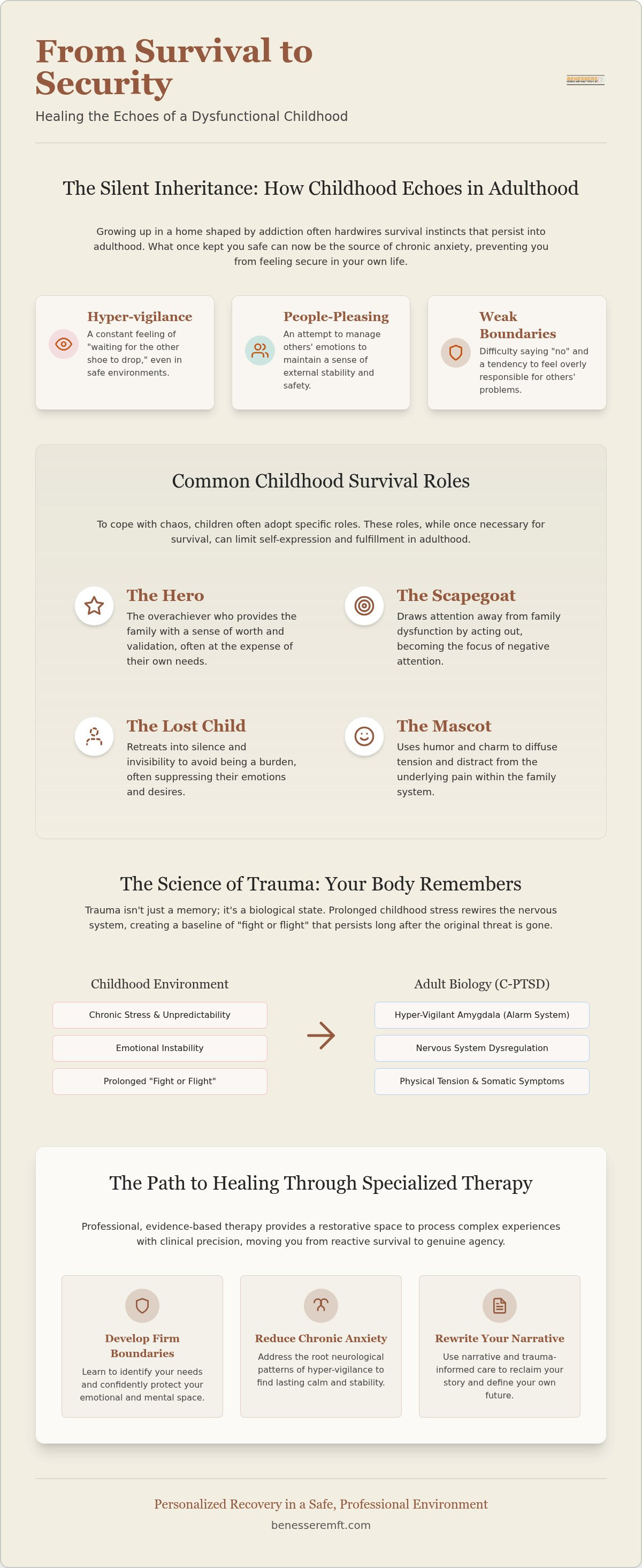
The experience of being an adult child of an alcoholic is rarely about the substance itself; instead, it is about the environment of unpredictability that substance use creates. Growing up in a high-stress home forces the developing nervous system into a state of chronic arousal, where the "fight or flight" response becomes a permanent baseline rather than a temporary reaction. When we analyze Alcoholism in family systems, we find that children often internalize the surrounding chaos as a personal failing. The identity of an "Adult Child" is essentially a collection of adaptive survival strategies that were once necessary for safety but now create barriers to fulfillment.
Many individuals first recognize these patterns through the "Laundry List," a set of fourteen traits that describe the common ACOA experience. You might notice a persistent sense of hyper-responsibility, where you feel obligated to fix everyone's problems, or a harsh inner critic that never seems satisfied with your achievements. These aren't character flaws. They are the echoes of a nervous system that learned to stay small or stay perfect to avoid conflict. Specialized therapy for adult children of alcoholics Roseville provides a structured environment to identify these traits and understand their origins without judgment.
Common Roles in Dysfunctional Family Systems
In a home shaped by addiction, children often adopt specific roles to maintain a fragile sense of balance. The Hero becomes the overachiever to provide the family with a sense of worth, while the Scapegoat draws attention away from the parent by acting out. The Lost Child retreats into silence to avoid being a burden, and the Mascot uses humor to diffuse tension. These roles don't stay in the past; they often persist in the Roseville workplace or modern adult relationships. The transition from childhood survival to adult exhaustion occurs when these roles no longer serve their original purpose, leaving you feeling drained and disconnected from your true self.
The Impact on Adult Relationships and Intimacy
Relational struggles are often the primary reason individuals seek therapy for adult children of alcoholics Roseville. The instability of a childhood home can lead to profound trust issues and a paralyzing fear of abandonment in romantic partnerships. You might find yourself drawn to partners who require "saving," a pattern often described as codependency. In this context, codependency is actually a relational survival mechanism; it's the attempt to gain security by managing the emotions of others. Over time, this lack of boundaries contributes to clinical anxiety or depression, as the effort to maintain external stability overrides your internal needs. Recognizing these patterns is the first step toward building a life rooted in genuine agency rather than reactive survival.
Beyond Survival: The Science of Trauma and Emotional Regulation
While many adults view their childhood experiences as something they've simply "grown out of," the nervous system often tells a different story. For those raised in homes with addiction, the result is frequently Complex Post-Traumatic Stress Disorder (C-PTSD), a condition rooted in prolonged exposure to emotional instability. Trauma isn't just a memory. It's a biological state where the amygdala, the brain's alarm system, remains stuck in a loop of hyper-vigilance. Choosing specialized therapy for adult children of alcoholics Roseville allows you to address these neurological patterns with scientific precision, moving beyond the limitations of willpower alone.
The physical body preserves the physiological memory of childhood family conflict, often manifesting as chronic tension or autoimmune responses long after the environment has changed. Because these experiences are etched into the nervous system, "just getting over it" is biologically impossible without proper clinical processing. These biological markers often manifest as Common Patterns Adult Children of Alcoholics May Experience, such as an exaggerated startle response or an inability to relax even in safe environments. This is why evidence-based therapy for adult children of alcoholics Roseville is so vital; it moves beyond talk therapy to address the somatic roots of distress.
Restorative Mental Health and the Nervous System
Recalibrating a taxed system requires moving away from "chemical coping"—the reliance on stress hormones or external substances to manage internal states—and toward genuine human connection. Emotional regulation techniques serve to restore balance, teaching the brain that it's finally safe to disarm. Developing this level of psychological literacy is a core component of individual psychotherapy, helping you identify triggers before they lead to emotional exhaustion. By understanding the "why" behind your reactions, you can replace reactive survival with conscious, restorative action.
Narrative Therapy: Rewriting the Story of Your Past
Transformation begins when you shift from being a victim of circumstances to becoming the active author of your life. Through narrative therapy, individuals learn to view their past through a clinical lens that emphasizes resilience rather than deficit. This clinical process involves externalizing problems, which means treating the trauma as something you experienced rather than something you are. By separating your identity from the dysfunction of your upbringing, you reclaim the agency needed to make conscious choices today. This restorative approach ensures that your history informs your wisdom without dictating your future.
Navigating the Journey: Therapy vs. Peer Support Groups for ACOAs
Breaking the isolation of a dysfunctional upbringing often begins in the rooms of peer support groups. Organizations like Adult Children of Alcoholics (ACA) or Al-Anon provide a vital sense of fellowship and a shared language for experiences that were once kept secret. These groups offer a powerful validation that you aren't alone, which is a necessary first step in any restorative process. However, while peer groups excel at providing community, they aren't designed to provide the clinical stabilization required for deep-seated trauma. Seeking specialized therapy for adult children of alcoholics Roseville allows you to move beyond the shared experience into a personalized, evidence-based treatment plan tailored to your unique history.
A common misconception is that professional therapy is "just talking," especially when compared to the structured "work" of 12-step programs. In reality, clinical psychotherapy is a methodical and targeted intervention. While meetings provide a broad framework for recovery, a professional therapeutic relationship offers a safe, confidential space to address specific triggers that may be too complex or private for a group setting. It's the difference between hearing a general map of a territory and having a Wise Guide walk beside you through your specific terrain. This professional partnership ensures that your progress is measured, safe, and grounded in psychological literacy.
The Clinical Advantage: Evidence-Based Skillsets
The primary advantage of a clinical setting is the application of specialized interventions like Trauma-Informed CBT and Narrative Therapy. These aren't just discussions; they're skill-building processes designed to recalibrate your nervous system. In our Roseville office, we provide a professional environment where you can explore the nuances of family conflict therapy without the pressure of group dynamics. This level of care is particularly important for those dealing with severe C-PTSD or complex family dynamics that require a high degree of clinical precision to untangle. Professional guidance ensures that you don't just identify your survival traits but actually develop the tools to transform them.
Integrating Peer Support and Professional Therapy
Many individuals find that therapy and peer support work best when used in tandem. It's common for a meeting to "open up" deep emotional wounds or memories; therapy provides the structured container to process those revelations safely. By integrating both, you can enjoy the community of a 12-step program while using individual sessions to deepen your personal work. This balanced approach allows for long-term healing that addresses both the need for social connection and the requirement for clinical expertise. Ultimately, the goal is to create a comprehensive support system that respects your pace and honors the complexity of your journey toward emotional agency.
What to Expect in Therapy for Adult Children of Alcoholics
Entering a clinical space for the first time often feels like a significant threshold, especially when you've spent years maintaining a facade of self-sufficiency. The intake process is designed to be a gentle, non-judgmental introduction where you can share your unique story at your own pace. Choosing therapy for adult children of alcoholics Roseville means entering an environment where your history is handled with both scientific precision and profound human respect. We begin by identifying the specific survival patterns that no longer serve you, creating a roadmap for a life defined by choice rather than reaction.
Goal setting in this restorative framework focuses on practical outcomes like establishing firm boundaries and reducing the clinical anxiety that often accompanies a history of family dysfunction. The rhythm of this work is steady and unhurried, reflecting a therapeutic process that prioritizes safety over speed. We understand that deep healing requires a consistent, reliable cadence to allow the nervous system time to integrate new ways of being. The therapist and client function as collaborative partners in a shared process of discovery and restoration.
Breaking the Cycle of Family Conflict
A central component of healing involves learning to navigate current relationships with living parents or siblings. This often requires setting healthy boundaries that protect your emotional well-being while processing the inevitable grief for the childhood you didn't have. While our work is personalized, you may find additional context in our resources regarding family therapy Roseville CA, which explores strengthening relational bonds. Acknowledging these losses is not an act of weakness; instead, it is a necessary step toward emotional maturity and freedom.
Practical Skills for Emotional Wellness
Beyond insight, we focus on equipping you with tangible tools for daily stability. Grounding techniques are essential for those moments when hyper-vigilance takes over, helping you return to the present when your body reacts to old triggers. We also work on effective communication strategies that allow you to express needs clearly in modern adult relationships. Your personalized mental health treatment plan will always respect your individual pace, ensuring that growth feels sustainable rather than overwhelming. To begin this collaborative work, you can explore our options for individual psychotherapy and schedule an initial consultation at our Roseville office.
Personalized Recovery at Benessere Marriage and Family Therapy in Roseville
Choosing a therapist is a deeply personal decision, especially when the work involves untangling the complex threads of a childhood shaped by addiction. At Benessere Marriage and Family Therapy, our Roseville-based team operates from a restorative philosophy that honors your individual story while applying rigorous, evidence-based interventions. We believe that true healing occurs when scientific precision meets human warmth, creating a collaborative environment where you feel both understood and professionally supported. Our therapists are mentored in specialized skillsets designed to address the specific needs of those seeking therapy for adult children of alcoholics Roseville, ensuring that your care is as nuanced as your experience.
The importance of local, community-focused care cannot be overstated. We understand the specific cultural and social landscape of Placer County, providing a steady presence for residents who are ready to move beyond survival. Our commitment to psychoeducation means that you won't just receive support; you'll gain a deeper psychological literacy that empowers you to manage your mental wellness independently. This specialized therapy for adult children of alcoholics Roseville ensures that the lessons learned in the clinic translate into real-world stability in your daily life. By focusing on narrative therapy, we help you rewrite your history, transforming it into a story of resilience and conscious adult agency.
A Safe Space for Healing in Roseville
Our clinical office is designed to be a sanctuary, offering an atmosphere that is professional, warm, and restorative. Located conveniently for residents of Roseville, Rocklin, and Granite Bay, we provide a physical space that mirrors the stability we aim to help you build internally. It's a setting where the defenses you've carried for decades can finally begin to soften. We offer steady, guiding support through every stage of your recovery, ensuring that the process remains methodical and grounded in your personal goals for emotional wellness. Our local presence allows us to offer a level of continuity and reliability that is essential for long-term trauma recovery.
Take the Next Step Toward Agency
Reclaiming your life from the shadows of the past is a courageous undertaking, and you don't have to navigate it alone. As we move through 2026, the opportunities for integrated, trauma-informed care are more accessible than ever. We invite you to step into the role of the author of your own life, supported by the expertise of a Wise Guide who respects your pace and your history. Scheduling an initial consultation is a straightforward process designed to lower the barrier for those ready for change. For those seeking a comprehensive, evidence-based path forward, we encourage you to explore our approach to Individual Psychotherapy Roseville and begin your journey toward lasting restoration today.
Reclaiming Your Emotional Agency and Future
The journey from childhood survival to adult agency is a methodical process of unlearning and restoration. We've explored how specialized therapy for adult children of alcoholics Roseville addresses the neurological roots of hyper-vigilance while providing the clinical tools necessary to set healthy boundaries. By moving beyond the shared experiences of peer support and into evidence-based trauma treatment, you can finally begin to separate your identity from the dysfunction of the past.
At Benessere Marriage and Family Therapy, we provide a compassionate, collaborative therapy environment where your unique story is handled with scientific precision. Our specialized trauma-informed care in Roseville offers the stability needed to process old wounds and build a life rooted in genuine self-compassion. You don't have to carry the weight of the "Silent Inheritance" alone any longer.
Start your restorative journey today with Benessere MFT and discover the freedom that comes with professional, evidence-based clinical expertise. Your past may have shaped your survival, but it doesn't have to dictate your future.
Frequently Asked Questions
Is therapy for adult children of alcoholics different from regular counseling?
Specialized therapy for adult children of alcoholics Roseville focuses specifically on the developmental trauma and family system dynamics unique to homes with addiction. While general counseling addresses broad symptoms, this restorative approach targets the survival roles and nervous system dysregulation common in ACOAs. We use evidence-based interventions like narrative therapy to help you understand the clinical why behind your current behaviors, providing a clearer path toward lasting emotional agency.
How do I know if I need professional therapy or just a support group?
Support groups like ACA are excellent for breaking isolation through fellowship, but professional therapy is necessary when symptoms like chronic anxiety or C-PTSD interfere with your daily functioning. If you find yourself stuck in repetitive relational patterns or overwhelmed by hyper-vigilance, a clinical environment provides the stabilization that peer groups cannot offer. A Wise Guide can tailor evidence-based skillsets to your unique story, ensuring your recovery is both safe and methodical.
Can therapy help me if I am still in contact with my alcoholic parent?
Yes, therapy is highly effective for individuals who remain in contact with their parents by focusing on boundary setting and emotional regulation. Our goal isn't necessarily to dictate your relationship status but to provide you with the psychological literacy needed to protect your own well-being. By processing the grief of the childhood you didn't have, you can interact with family members from a place of conscious choice rather than reactive survival.
What is the "Laundry List" and how does therapy address it?
The "Laundry List" is a set of fourteen traits, such as chronic self-criticism or a fear of abandonment, that characterize the ACOA experience. In therapy, we use these traits as a starting point to identify the survival mechanisms you developed in childhood. By externalizing these problems, we help you see that these behaviors aren't character flaws; they're adaptive responses that can be transformed through professional, trauma-informed care.
How long does it typically take to see progress in ACOA therapy?
Progress varies depending on your specific history and goals, but many clients report a sense of initial stabilization within the first few months of consistent sessions. Deeply ingrained patterns often require a more unhurried, steady rhythm of growth to ensure the nervous system can integrate changes safely. We focus on sustainable progress that prioritizes your pace, helping you move from childhood survival roles into a more restorative and empowered adult life.
Do I have to talk about my childhood in every session?
No, you don't have to dwell on the past in every session. While understanding your childhood provides necessary context, much of our work focuses on how those early experiences influence your current Roseville life and modern relationships. We balance exploration of the past with practical, present-focused skills for emotional wellness. This ensures that therapy remains a productive space for building the future you want rather than just revisiting old pain.
Is therapy at Benessere MFT covered by insurance in Roseville?
Benessere Marriage and Family Therapy provides accessible care by participating in several networks. We currently accept Partnership Healthplan of California, Anthem Blue Cross Medi-Cal, and we're part of the Kaiser Permanente NorCal network. It's always best to verify your specific coverage details during the intake process. Our Roseville office is committed to providing professional, evidence-based therapy for adult children of alcoholics Roseville while navigating the practicalities of insurance and session costs.
What is the goal of narrative therapy for adult children of alcoholics?
The primary goal of narrative therapy is to help you move from being a victim of your circumstances to becoming the author of your life. This clinical process involves externalizing the dysfunction you experienced, allowing you to view your history with scientific precision and human warmth. By separating your identity from the chaos of an alcoholic family system, you reclaim the agency needed to build healthy relationships and a resilient sense of self.


Comments