
Anxiety Treatment for Trauma Survivors in Roseville: A Path to Restorative Healing

Your constant state of high alert isn't a sign that you're broken; it's evidence that your nervous system is working exactly as it was designed to after a period of threat. For many, the standard advice to just breathe or think positive feels dismissive because it ignores the deep physiological roots of post-traumatic stress. You may find yourself searching for anxiety treatment for trauma survivors Roseville because you need more than just coping skills. You need a space where your unique history is respected rather than bypassed.
It's exhausting to live in a body that refuses to relax, especially when you feel stuck in a loop of hyperarousal that traditional methods don't seem to reach. This article explores the profound connection between past trauma and current anxiety, offering a roadmap for restorative healing. We'll examine how specialized clinical psychotherapy can help you lower the volume on your internal alarm system. By understanding the mechanics of your survival response, you can begin to find a local path in Roseville that leads toward a genuine, lasting sense of safety.
Table of Contents
Why Trauma Survivors Experience Anxiety Differently
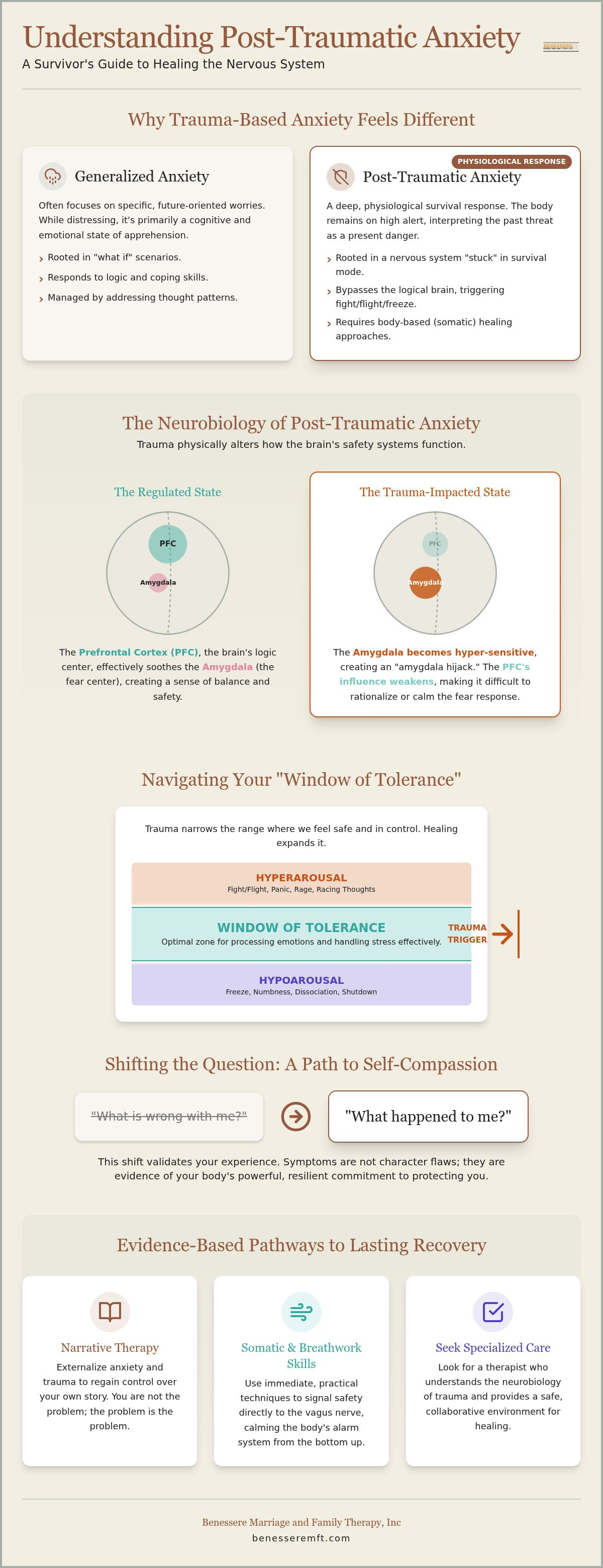
Anxiety following a distressing event isn't a cognitive choice; it is a physiological residue. For those seeking anxiety treatment for trauma survivors Roseville, the experience often feels like living in a body that won't stop screaming "danger" even in safe rooms. Unlike generalized anxiety, which might focus on specific future worries, post-traumatic anxiety manifests as a persistent state of hyperarousal. Your brain has essentially recalibrated its baseline to a state of high alert. This chronic tension "stains" the lens through which you view the world, making the future seem inherently threatening. It creates a filter where neutral situations are interpreted as potentially catastrophic, leaving little room for a sense of genuine peace.
This state significantly narrows what clinicians call the "window of tolerance." When you are within this window, you can process emotions and handle stress effectively. Trauma often pushes you outside these boundaries, either into hyperarousal (panic, rage, racing thoughts) or hypoarousal (numbness, dissociation). Finding your way back to this window requires a specialized approach that respects the biological reality of your experience. It's about slowly expanding your capacity to feel safe in the present moment without the past constantly intruding.
The Survival Response vs. Clinical Anxiety
Traditional anxiety advice often falls short because trauma-based anxiety is not just about "overthinking." It is about a nervous system that has been physically altered by past events. When a trigger occurs, it bypasses the logical brain and activates the survival centers instantly. This is why you can't simply reason your way out of a physiological response. Post-traumatic stress disorder (PTSD) involves these deep-seated biological shifts that prioritize survival over comfort. The trauma-anxiety link is a biological adaptation to past danger that has outlived its original purpose, making specialized anxiety treatment for trauma survivors Roseville essential for a nervous system "reset."
The Normalization of Human Struggles
We believe in the normalization of human struggles. Feeling "on edge" or hyper-vigilant was once a necessary survival skill that kept you safe during a period of threat. Our approach to individual psychotherapy Roseville emphasizes this shift in perspective. We move away from asking "What is wrong with me?" and instead explore "What happened to me?" This validation is the first step toward restorative healing. It allows you to view your symptoms not as failures of character, but as evidence of your resilience and your body's commitment to your protection.
The Neurobiology of Post-Traumatic Anxiety: Understanding Your Alarm System
To understand why your body responds with such intensity, we must look at the physical architecture of the brain. Research regarding the neurobiological impact of psychological trauma reveals that distressing experiences can fundamentally alter how our internal alarm system functions. The amygdala, often described as the brain's smoke detector, becomes hyper-sensitized. It stays in a constant state of "on," scanning for threats even when none are present. Simultaneously, the prefrontal cortex, which is the logical area responsible for self-soothing, can "thin" or weaken in its influence. This biological shift makes it incredibly difficult to talk yourself down from a state of fear when the alarm is ringing.
Trauma also impacts the hippocampus, the region responsible for date-stamping memories. When this area is affected, your brain struggles to recognize that a past event is actually over. Instead, it feels like the trauma is happening in the current moment. This confusion triggers the autonomic nervous system, leading to the physical fight-flight-freeze sensations that characterize post-traumatic anxiety. It's a full-body experience that requires specialized care. Seeking anxiety treatment for trauma survivors Roseville provides the necessary framework to address these biological shifts with precision and care.
The Amygdala-Hijack in Daily Life
An amygdala-hijack can occur without warning during routine activities. You might be walking through a grocery store in Roseville when a specific sound or scent triggers a sudden wave of panic. Your logical brain knows you're safe, but your survival brain has already taken over. This often leads to a "freeze" response, where you feel paralyzed or unable to think clearly. This is a primary focus of trauma therapy Roseville. By working to quiet the overactive amygdala, we help you regain a sense of agency in your daily environments.
Neuroplasticity and the Path to Regulation
While these biological changes are profound, they aren't permanent. The concept of neuroplasticity offers a hopeful perspective: the brain has an inherent ability to re-wire itself for safety. Clinical work focuses on strengthening the connection between the logical prefrontal cortex and the emotional amygdala. Through guided psychotherapy, you can learn to regulate your nervous system and build new neural pathways that favor calm over chaos. If you're ready to begin this collaborative process, our clinicians are here to provide a restorative path toward healing.
Evidence-Based Treatment Modalities for Lasting Recovery
Recovery from post-traumatic anxiety requires a structured yet flexible roadmap that prioritizes your sense of safety. While the neurobiological shifts we've explored create significant challenges, clinical psychotherapy offers a suite of tools designed to recalibrate the nervous system. We utilize several Evidence-based treatments for PTSD and anxiety to ensure that every survivor has access to a protocol that respects their specific needs. Trauma-Informed Cognitive Behavioral Therapy (CBT) serves as a foundational skillset, providing the cognitive scaffolding needed to challenge the distorted safety filters created by past distress. When seeking anxiety treatment for trauma survivors Roseville, it's vital to find a practitioner who understands that these interventions must be applied with clinical precision and deep empathy.
Narrative Therapy: Rewriting Your Unique Story
A cornerstone of our restorative approach is narrative therapy, which focuses on the powerful act of externalizing anxiety. Often, survivors begin to view their identity through the lens of their trauma, feeling as though they're defined by their symptoms. Narrative work helps you separate your core self from the anxiety that's currently impacting your life. By viewing these challenges as external forces rather than internal flaws, you move from being a passive victim of your history to being the active author of your recovery. This process isn't just about recounting events; it is about finding new meaning and reclaiming agency over your future.
Integrating Evidence-Based Skillsets
Effective clinical work balances cognitive insights with somatic, or body-based, awareness. Since trauma carries a physical weight, we integrate techniques that address the tension held in the muscles and the autonomic nervous system. This holistic approach ensures that healing isn't just intellectual. We prioritize a collaborative relationship where you and your therapist work as partners to determine the right speed for your work. Pacing is essential to avoid re-traumatization. We don't rush into deep wounds until you have the stability to handle them. For many, this healing extends beyond the individual. In cases where past events have strained domestic bonds, marriage and family therapy Roseville CA provides a path to restore connection for the entire household. Our practice remains dedicated to providing specialized anxiety treatment for trauma survivors Roseville that honors the complexity of your story.
Practical Somatic and Cognitive Skillsets for Daily Resilience
Healing from post-traumatic anxiety isn't limited to the time spent in a clinical session. It's about the tools you carry with you into the streets of Roseville and the quiet corners of your home. Developing daily resilience involves a dual approach: managing the body's immediate survival response and reframing the thoughts that keep the alarm system active. By integrating somatic and cognitive skillsets, you can move from a state of constant reaction to one of mindful presence. These practices aren't just distractions; they are deliberate interventions designed to communicate safety to your nervous system.
Bottom-Up Processing: Calming the Body First
When your nervous system is in a state of hyperarousal, your logical brain is effectively offline. Somatic regulation is the first step toward cognitive clarity. Bottom-up processing focuses on signaling safety to the body before attempting to change your thoughts. The "5-4-3-2-1" technique is a grounding tool that uses your five senses to anchor you in the present. Identify five things you see, four you can touch, three you hear, two you smell, and one you can taste. For high-stress Roseville professionals, this can be done discreetly during a commute or between meetings to interrupt a panic spiral. Breathwork also plays a vital role. Specific patterns, such as extending your exhale, send a biological signal to the vagus nerve that the threat has passed. Progressive muscle relaxation helps you systematically release the physical "armor" or tension often held by survivors, allowing the body to finally soften.
Top-Down Processing: Challenging Anxious Thoughts
Once the body is sufficiently regulated, top-down processing can address the cognitive distortions created by a "trauma lens." Catastrophizing, or predicting the worst possible outcome, is a common survival mechanism that often outlives its original purpose. Clinical work helps you learn to "fact-check" your anxiety's predictions by asking if a fear is a current reality or a past memory. Developing a "Compassionate Observer" perspective allows you to view your struggles with the same intelligence and warmth you would offer a friend. Interestingly, depression counseling Roseville often utilizes these same cognitive resilience skills, as these conditions frequently overlap in the aftermath of trauma. Replacing a harsh inner critic with a restorative voice is a clinical tool that fosters long-term stability.
Building these skills is a collaborative process that requires professional guidance and steady practice. If you're ready to reclaim your sense of agency through specialized anxiety treatment for trauma survivors Roseville, we invite you to begin your restorative journey with our clinicians today.
Choosing Specialized Anxiety Treatment in Roseville, CA
Selecting the right provider for anxiety treatment for trauma survivors Roseville is a significant decision that requires a careful balance of clinical vetting and personal intuition. It isn't enough to find a general practitioner; survivors need someone who understands the intricate relationship between memory and the nervous system. When searching for a therapist, prioritize those with specialized training in trauma modalities and a restorative tone that feels both authoritative and safe. This ensures that your specific history remains the primary guide for your care, rather than a rigid protocol. A trauma-informed specialist understands that building trust is a slow, methodical process where your sense of safety is the absolute priority.
The Clinical Difference at Benessere Marriage and Family Therapy, Inc
At Benessere Marriage and Family Therapy, Inc, we provide a sophisticated clinical environment designed to serve as a sanctuary for restorative work. Our focus is on evidence-based care that honors the complexity of your experience through a narrative-informed lens. We recognize that post-traumatic anxiety doesn't just affect the individual; it often impacts the entire household dynamic. This is why our family therapy Roseville CA is structured to support the survivor's support system, fostering a home environment where healing can be shared. We maintain a professional distance that inspires confidence while offering the human warmth required for genuine transformation.
Reclaiming Your Peace in Placer County
Living in Roseville often involves managing high-stress careers and the complex demands of modern family life. These external pressures can easily exacerbate the internal state of hyperarousal that many trauma survivors face daily. Investing in specialized anxiety treatment for trauma survivors Roseville is a commitment to your long-term resilience and holistic health. During an initial clinical consultation, you can expect a transparent discussion about your goals and a gentle introduction to our collaborative approach. We aim to lower your defenses by providing a predictable, unhurried space where you feel heard without being rushed. Healing is a tangible possibility when you have the right guide to navigate the path with you.
Reclaiming Agency and Safety in Your Recovery
Understanding that your persistent state of alert is a physiological survival response is the first step toward genuine restoration. Throughout this exploration, we've seen how neurobiological shifts in the brain's alarm system can be recalibrated through specialized evidence-based skillsets. By integrating somatic regulation with cognitive reframing, you can move from a state of constant reaction to one of mindful presence. Finding specialized anxiety treatment for trauma survivors Roseville allows you to work within a professional, clinical framework that respects the unique pace of your restorative journey.
At Benessere Marriage and Family Therapy, Inc, we combine clinical expertise with a narrative-informed lens to help you navigate these complex emotional landscapes. Our local office provides the stability and safety needed for the collaborative work of individual psychotherapy. If you're ready to reclaim your peace, schedule a restorative psychotherapy session at our Roseville office today. You don't have to carry the weight of the past alone; there is a steady path toward a calm and secure future, and we're here to guide you every step of the way.
Frequently Asked Questions
How is anxiety for trauma survivors different from regular anxiety?
Trauma-based anxiety is a persistent state of hyperarousal rather than simple cognitive worry. While general anxiety involves future-oriented stress, post-traumatic responses are rooted in a nervous system that remains on high alert due to past events. This physiological difference means that standard relaxation techniques often feel insufficient. Specialized care focuses on recalibrating the internal alarm system, allowing survivors to distinguish between past threats and current safety through a methodical, clinical process.
Will I have to talk about my trauma in detail during anxiety treatment?
You are never required to recount every detail of a distressing event to experience healing. Effective psychotherapy prioritizes stabilization and the development of grounding skillsets before exploring deeper narratives. Our clinicians use a collaborative approach, ensuring you maintain control over the pacing of your sessions. This prevents re-traumatization and allows you to build a foundation of safety before addressing the specific complexities of your unique story.
What are the most effective therapies for trauma-related anxiety in Roseville?
Evidence-based modalities like Trauma-Informed CBT and Narrative Therapy are highly effective for these challenges. At Benessere Marriage and Family Therapy, Inc, we integrate these with somatic awareness to address the physical weight of trauma. When seeking anxiety treatment for trauma survivors Roseville, it's important to find a practice that combines clinical precision with a restorative lens to ensure all aspects of your mental and physical health are addressed.
How long does it typically take to see results in trauma therapy?
The timeline for recovery varies based on your history and current stressors, but many clients report a reduction in physical hyperarousal within the first few weeks. Rebuilding neural pathways for safety is a gradual process that relies on consistent clinical work. Because our approach at Benessere Marriage and Family Therapy, Inc is collaborative, we regularly assess your progress to ensure the treatment remains aligned with your personal goals for lasting resilience.
Can anxiety after trauma cause physical health problems?
Chronic anxiety after trauma can lead to significant physical health issues, including digestive distress, chronic pain, and sleep disturbances. These are not separate from your mental state; they are manifestations of a nervous system under constant stress. By addressing the root cause through specialized psychotherapy, we help lower the biological burden on your body. This holistic focus is essential for restoring your overall well-being and preventing long-term physical exhaustion.
Is it possible to fully recover from post-traumatic anxiety?
While the past cannot be erased, it is entirely possible to reach a state where it no longer dictates your daily life. Recovery involves integrating your experiences into a new narrative where you reclaim your agency and sense of peace. Through specialized anxiety treatment for trauma survivors Roseville, you can move from a state of survival to one of restorative growth, where your internal alarm system only rings when a genuine threat is present.
Do you offer family support for trauma survivors in Roseville?
We provide comprehensive Family Therapy at Benessere Marriage and Family Therapy, Inc to support the survivor’s support system. Trauma often ripples through domestic relationships, creating patterns of conflict or withdrawal that affect everyone in the home. By offering a safe, clinical space for family members to understand the mechanics of post-traumatic anxiety, we help restore harmony and strengthen the relational bonds necessary for a sustainable, long-term recovery for the entire family.
How do I know if I need a trauma specialist or just a general therapist?
A trauma specialist is necessary when your symptoms involve physiological hyperarousal, flashbacks, or a profound sense of being "stuck" that general therapy hasn't reached. While general therapists handle life transitions and standard worry, trauma specialists possess the clinical literacy to handle the neurobiological impacts of past distress. Seeking a specialist ensures your treatment plan is specifically designed to reset your nervous system and respect the complexities of your survival response.


Comments