
Coping With Empty Nest Syndrome: A Restorative Guide

Updated: Aug 20
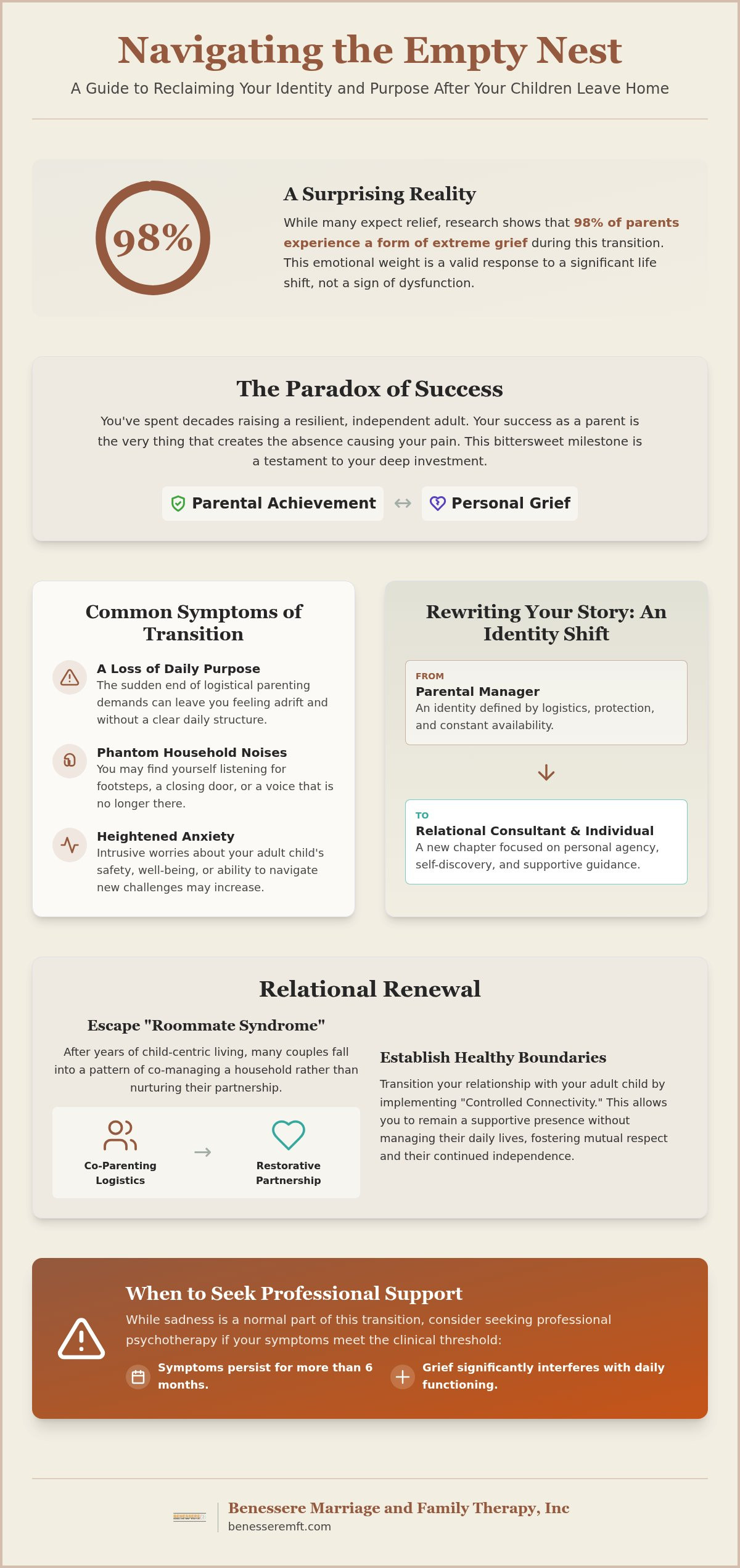
What if the sudden silence in your home isn't a sign of an ending, but a necessary clearing for your own evolution? While many anticipate a sense of relief when their children reach independence, research from 2021 indicates that 98% of parents actually experience a form of extreme grief during this transition. It's natural to feel unmoored when the daily rhythms of caretaking vanish, leaving you to wonder how to cope with empty nest syndrome while your sense of purpose feels temporarily lost. This emotional weight is a valid response to a significant life shift, not a sign of clinical dysfunction.
This guide provides evidence-based psychological strategies and restorative practices to help you navigate this transition and reclaim your individual identity. We will examine how to move from being a parental manager to a relational consultant, ensuring your connection with your adult child remains strong and healthy. You'll also discover ways to address the "roommate syndrome" that can affect marriages after years of child-centric living, allowing you to restore intimacy and find new meaning in your partnership. By viewing this stage as a developmental invitation, you can transform the pain of loss into a foundation for personal growth and renewed vitality.
Table of Contents
Understanding the Psychological Landscape of Empty Nest Syndrome
Empty nest syndrome is not a formal clinical diagnosis, yet it describes a profoundly real psychological condition that many parents face when their last child leaves home. It is a period of transition characterized by a complex mix of grief, loneliness, and identity confusion. While the world may congratulate you on your child's independence, your internal reality might feel more like a quiet, unsettling void. This shift requires a methodical recalibration of your emotional landscape as you move from a life defined by caretaking to one defined by individual agency.
The distress you feel often stems from the "Paradox of Success." You've spent two decades cultivating resilience and autonomy in your child. When they finally step out into the world, your very success as a parent creates the absence that causes your pain. It's a bittersweet milestone where your achievement necessitates a difficult departure. Understanding this paradox helps normalize the heavy emotions that surface, allowing you to view your grief as a testament to the depth of your investment rather than a personal failure.
Common symptoms of this transition include:
A loss of daily purpose: The sudden removal of the logistical demands of parenting can leave you feeling adrift.
Phantom household noises: You might find yourself listening for a door slam or a specific voice that is no longer there.
Heightened anxiety: Worries about your child's safety or their ability to navigate adult challenges can become intrusive.
It's vital to distinguish between normal transitional sadness and clinical depression. Sadness is a standard part of learning how to cope with empty nest syndrome, usually allowing for moments of joy and a gradual return to functioning. Clinical depression, however, involves a persistent inability to feel pleasure or a total withdrawal from life. If your grief feels stagnant or prevents you from daily tasks, it may indicate a need for professional support to restore your equilibrium.
The Biological and Emotional Shift
The transition is physiological as much as it is emotional. For years, daily caregiving interactions triggered consistent oxytocin releases in the brain. When these interactions cease, you may experience a literal "oxytocin drop," leaving you feeling physically and emotionally depleted. This is compounded by "Role Loss," where the primary identity of "parental manager" is suddenly removed. Validating this grief as a necessary part of the restorative process is the first step toward healing.
Normalizing the Experience for Roseville Parents
In communities like Roseville, where parenting often centers around high-pressure school and youth sports schedules, the transition can feel particularly abrupt. Many parents in Placer County have spent years coordinating carpools and attending weekend tournaments, making their identity inseparable from their child's activities. Transition stress is a specific type of pressure felt by those who have centered their lives on these rigid schedules. Adopting a perspective of restorative mental health allows you to see this new silence as a space for self-integration rather than just a loss of role.
Rewriting Your Story: From Parenting to Personal Agency
This shift into self-integration is an ideal time to prioritize personal care goals that were previously sidelined by the demands of parenting. For many, this includes investing in long-term wellness and grooming, such as the permanent hair removal services offered by North Bay Electrology, which can help restore a sense of confidence and individual identity as you embrace this new chapter.
Transitioning into a life without children at home often requires more than just time; it necessitates a fundamental reconstruction of your identity. For two decades, your sense of self was likely anchored in the "Parental Manager" persona, a role defined by logistics, protection, and constant availability. Relinquishing this persona is difficult because it feels like a loss of professional purpose. By utilizing narrative therapy, you can begin to rewrite the story of your life, moving from a supporting character in your child's narrative back to the protagonist of your own.
This process involves understanding that your worth is not tied to your child's presence or their daily needs. Individuation is a developmental milestone usually attributed to adolescents, yet it is equally vital for parents at this stage. You're entering a period of self-discovery where you can explore who you are outside of the caregiving context. This shift allows you to view the quiet house not as a void, but as a restorative space for personal agency and new creative pursuits.
Externalizing the Grief
In clinical practice, we often use externalization to help clients separate their identity from their struggles. Rather than seeing yourself as "empty" or "lost," you can view the empty nest as a temporary guest or a specific seasonal transition. This perspective shift prevents the grief from becoming your entire identity. Practical strategies for coping often begin with this psychological distancing, helping you recognize that your current distress is a phase, not a permanent state of lack. To begin this work, list three personal values or interests you held before you became a parent. This simple exercise helps anchor your identity in your historical self rather than your parental role.
Reclaiming Agency and Purpose
The absence of school runs and sports schedules creates a significant opening for "dormant" interests. These are the passions or curiosities you sidelined to meet the demands of active parenting. Reclaiming these interests is a core component of discovering how to cope with empty nest syndrome effectively. It's about setting "Agency Goals," which are objectives entirely independent of your family's needs or your child's success. Whether it's picking up a forgotten hobby or focusing on a professional milestone, these goals provide a new scaffolding for your daily life.
If you find that your identity feels too deeply entwined with your past roles to untangle alone, individual psychotherapy in Roseville offers a structured environment to explore these new chapters. Working with a clinician can help you process the grief while methodically building a future that reflects your current values and aspirations. This restorative work ensures that you don't just survive the transition, but thrive within your newfound autonomy.
Relational Renewal: Strengthening Your Partnership and Family Bonds
The departure of children often removes the emotional buffer that has mediated a marriage for decades. For many couples, this structural shift exposes "Roommate Syndrome," a state where daily interactions have become purely logistical and child-centric. Without the shared task of active parenting, you may find that silence between you feels heavy rather than peaceful. Learning how to cope with empty nest syndrome within a partnership requires a deliberate transition from "co-parents" back to "partners." This process involves re-evaluating the foundational connection that existed before the demands of child-rearing took precedence.
Addressing this shift isn't just about filling time; it's about restoring the intimacy that may have been sidelined. When your primary focus has been the success and safety of your children, your relationship with your spouse can become a secondary priority. Reclaiming that bond requires a methodical approach to communication and a willingness to explore who you are as a couple in this new, quieter environment.
The Marital 'Second Honeymoon' vs. 'The Void'
While some couples embrace this phase as a "second honeymoon," others find themselves staring into a relational void. It's common for partners to experience unequal grief. For instance, one might feel a sense of liberation and readiness to travel, while the other is struggling with a profound sense of loss. This discrepancy can create tension if it's not handled with deep-seated empathy. Utilizing principles from marriage and family therapy Roseville CA can help you rediscover shared interests that aren't tied to your roles as parents. Navigating this new household hierarchy often requires the support found in family therapy Roseville CA to ensure the transition doesn't lead to chronic resentment or emotional distance.
The Consultant Phase: Your New Role With Adult Children
Strengthening family bonds at this stage requires a shift in your parental posture from "manager" to "consultant." As a manager, you were responsible for daily outcomes and safety; as a consultant, you provide expertise and support primarily when it's requested. Adopting the "Wait to be Asked" rule is essential for respecting your child's autonomy and preventing the friction that often comes from unsolicited advice. This transition from "doing for" to "being with" allows your relationship to evolve into a mature, peer-like connection. The consultant role is a position of influence rather than control, grounded in mutual respect rather than parental authority. By establishing these healthy boundaries, you provide the space for your adult child to thrive while ensuring your connection remains restorative and resilient. This shift is a core component of how to cope with empty nest syndrome while maintaining the integrity of the family unit.
Practical Strategies for Navigating the Transition
Moving from the theoretical understanding of grief into the practical application of restorative habits is a necessary progression. Discovering how to cope with empty nest syndrome involves moving from a reactive state, where you are responding to the void left by your child, to a proactive state of self-governance. This transition is methodical and requires intentionality in how you structure your time and space. By implementing specific, evidence-based steps, you can create a scaffolding that supports your emotional well-being during this period of flux.
Step 1: Establish a New Normal. Reclaim the hours previously dedicated to school runs or youth sports. Use this time for personal development or restorative rest rather than allowing it to remain an empty slot on your calendar.
Step 2: Practice Controlled Connectivity. Transition from constant texting to scheduled weekly calls. This respects your child's autonomy while ensuring your connection remains consistent and meaningful.
Step 3: Engage in Sensory Grounding. If the quietness of the home feels overwhelming, use soundscapes, intentional lighting, or textured comforts to recalibrate your environment.
Step 4: Audit Your Social Circle. Connect with other empty nesters in Placer County who understand the specific nuances of this transition. Peer validation is a powerful tool for normalization.
Step 5: Monitor Clinical Markers. Be vigilant for signs of "Perfectly Hidden Depression," where you might maintain a high-functioning exterior while struggling internally. If these feelings persist, seeking depression counseling Roseville can provide the clinical support needed to move forward.
Daily Habits for Emotional Regulation
Emotional regulation is often challenged by the sudden shift in household energy. When the house feels too quiet, mindfulness techniques can help you stay present with the silence rather than fearing it. Incorporating physical movement, such as walking the trails at local Roseville parks, helps process the physiological stress associated with life transitions. A restorative routine is a structured sequence of daily actions that builds future resilience by prioritizing your holistic health. These habits serve as an anchor, providing stability when your internal landscape feels unmoored.
Social and Community Re-engagement
The first semester after a child leaves is the most critical time to avoid the social withdrawal trap. Re-engaging with the Roseville community offers a way to externalize your focus and find new avenues for purpose. You might consider volunteering at the Maidu Museum or joining local interest groups that align with your dormant passions. Peer support helps normalize the transition, reminding you that your experience is a shared human milestone. Engaging with others prevents the isolation that can lead to chronic anxiety or depression. If you find that these steps feel insurmountable, reaching out for individual psychotherapy in Roseville can help you navigate this transition with professional guidance.
When to Seek Professional Support in Roseville
While the initial weeks after a child leaves are often marked by a natural period of mourning, there is a distinct clinical threshold where professional intervention becomes essential. If your feelings of emptiness persist beyond six months or begin to significantly obstruct your daily responsibilities, it indicates that the transition has moved from a standard life event to a more complex psychological challenge. Understanding how to cope with empty nest syndrome involves recognizing when the weight of the transition exceeds your current internal resources. Professional support provides the methodical framework needed to process this grief and prevent it from evolving into chronic depression or anxiety.
For some parents, the departure of a child acts as a psychological catalyst, resurfacing unresolved abandonment issues or past family wounds that were previously masked by the busyness of caretaking. When these deeper layers are triggered, trauma therapy Roseville offers a specialized path to healing. A clinical environment provides a safe, restorative space where these complex emotions are handled with both scientific precision and human warmth, allowing you to integrate your past experiences into your new identity as an individual agent.
Signs You Might Benefit from Psychotherapy
Differentiating between transitional sadness and a clinical need for support requires honest self-reflection. While earlier sections explored the normal "phantom" noises of a quiet home, certain indicators suggest a need for deeper exploration. You may benefit from psychotherapy if you experience the following:
Persistent lack of interest: A total withdrawal from activities you once enjoyed that lasts for several months.
Unresolvable marital conflict: Strained communication with your spouse that feels circular or increasingly hostile without the logistical distractions of children in the home.
Intrusive anxiety: Excessive worry about your adult child's safety or success that prevents you from focusing on your own life chapters.
Feelings of worthlessness: An inability to see value in yourself now that the role of "parental manager" has shifted.
The Restorative Path Forward
Benessere Marriage and Family Therapy, Inc supports Roseville families through a lens of restorative care, focusing on the normalization of these struggles while providing evidence-based skillsets. During a clinical session, we work collaboratively to deconstruct the "Parental Manager" persona and identify the dormant interests that provide a new sense of purpose. Our approach is unhurried and methodical, ensuring you feel secure as you navigate the nuances of your changing family dynamics. By engaging in this therapeutic process, you move toward a state of resilience where you can enjoy a peer-like connection with your child and a renewed intimacy with your partner. If you're ready to begin this transition, reaching out for a consultation in Roseville is the first step toward reclaiming your agency and finding stability in this new season of life.
Embracing the Next Chapter of Your Individual Story
The transition to an empty nest is a profound developmental invitation to rediscover your personal agency and relational depth. By shifting from a parental manager to a consultant, you create the necessary space for your adult child's autonomy while fostering a mature, peer-like connection. This season also offers a unique opportunity to revitalize your partnership, transforming the quiet of your home into a restorative environment for intimacy and shared growth. Learning how to cope with empty nest syndrome is a methodical process that requires patience and self-compassion as you navigate this significant life shift.
If the weight of this transition feels insurmountable, professional guidance can provide the clarity needed to move forward. You are invited to schedule a restorative consultation at Benessere Marriage and Family Therapy, Inc in Roseville. Our clinical expertise in life transitions and evidence-based narrative therapy approach offer a compassionate, professional environment where your story is handled with both scientific precision and human warmth. Your sense of purpose hasn't vanished; it's simply evolving into a new, vibrant form.
Frequently Asked Questions
Is Empty Nest Syndrome a real clinical diagnosis?
Empty nest syndrome is not a formal clinical diagnosis found in the Diagnostic and Statistical Manual of Mental Disorders (DSM-5). Instead, it is recognized as a significant life transition or developmental milestone that can trigger a profound grief response. While it isn't a medical pathology, the emotional impact is real and valid. Understanding this helps normalize the experience as a standard human reaction to a major shift in household dynamics and personal identity.
How long does it typically take to adjust to an empty nest?
The adjustment period varies for every individual, but most parents begin to find their "new normal" within three to six months. This timeframe allows for the initial shock of the silence to subside and for new routines to take root. If the sense of loss or lack of purpose persists beyond six months without any improvement, it may indicate a need for professional guidance on how to cope with empty nest syndrome effectively.
What are the first signs that my sadness is turning into depression?
Sadness becomes a clinical concern when it transforms into a persistent state of anhedonia, or the inability to feel pleasure in previously enjoyed activities. Other warning signs include significant changes in sleep patterns, chronic fatigue, or a total withdrawal from social circles in Roseville. When these symptoms interfere with your daily functioning or sense of worth, it is often a sign that transitional grief has evolved into a depressive episode requiring psychotherapeutic intervention.
Can empty nest syndrome affect fathers as much as mothers?
Fathers experience empty nest syndrome with the same emotional intensity as mothers, though the expression of that grief may differ. Men often report a profound sense of loss regarding their role as a provider or protector within the daily household structure. Research indicates that fathers who were highly involved in their children's daily lives, such as coaching youth sports in Placer County, may feel a particularly sharp decline in their sense of purpose.
How can I support my spouse if they are taking the transition harder than I am?
Support your spouse by validating their unique grief process without attempting to "fix" their emotions or rush their timeline. Discrepancies in how partners react are common; one may feel relief while the other feels devastated. Practice active listening and encourage them to explore dormant interests at their own pace. If the emotional distance between you grows, it may be helpful to facilitate a safe space for dialogue through professional couples therapy.
Is it normal to feel a sense of relief when the kids leave?
Consider couples therapy if you and your partner find yourselves struggling with "Roommate Syndrome," where your only shared topics are your children's lives. When the buffer of active parenting is removed, long-standing communication gaps often become more visible. If circular conflicts arise or if the silence in your home feels disconnected rather than peaceful, a clinical setting can help you restore intimacy and redefine your partnership for this next chapter of life.
How do I maintain a relationship with my child without being overbearing?
Maintaining a healthy connection requires a shift from a managerial role to a consultant role. This involves practicing the "Wait to be Asked" rule before offering advice on their adult decisions. Focus on being with your child during interactions rather than doing for them. By respecting their autonomy and scheduling regular, intentional check-ins, you build a peer-like bond grounded in mutual respect. This is a core part of learning how to cope with empty nest syndrome.


Comments