
Couples Counseling in Roseville: A Restorative Approach to Relational Healing
- Eddie Posadas
- 2 days ago
- 13 min read

What if the conflict you keep returning to isn't a sign that your relationship is broken, but rather evidence that something deeply important between you hasn't yet been heard? It's a question worth sitting with, especially when the distance between you and your partner feels less like a gap and more like a canyon. If you've found yourself searching for couples counseling Roseville, you're likely already carrying the weight of that question, and you deserve a thoughtful, honest answer.
The truth is that repetitive conflict, emotional disconnection, and the quiet ache of feeling misunderstood are not signs of failure. They're recognizable patterns that respond remarkably well to skilled, evidence-based clinical care. You are not alone in experiencing them, and your relationship's story is not yet finished.
This article explores how a restorative, trauma-informed approach to couples therapy can help you and your partner move beyond the cycles that have kept you stuck, rebuild emotional safety, and develop the communication skillsets needed to write the next chapter of your relationship together.
Table of Contents
Recognizing the Need for Couples Counseling in Roseville
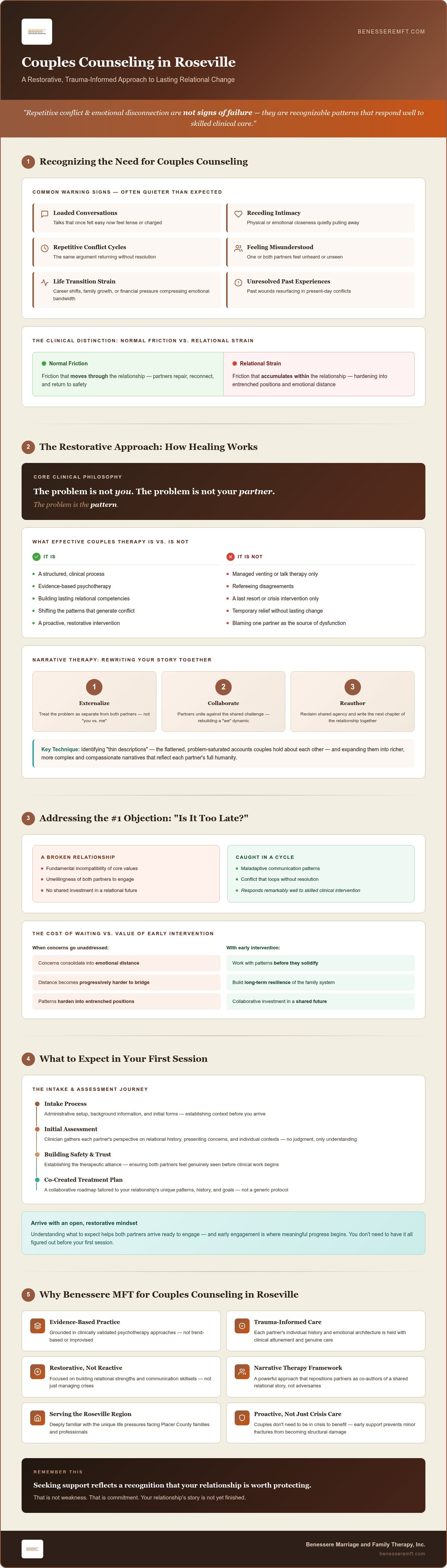
Couples counseling is not a last resort. At its core, it is a proactive, restorative intervention designed to strengthen relational health before minor fractures become structural damage. The field of couples therapy has evolved considerably over the past several decades, moving well beyond crisis management toward a sophisticated, evidence-based practice that helps partners develop lasting communication skillsets, rebuild emotional attunement, and reclaim a shared sense of purpose. Recognizing when that kind of support would serve your relationship is itself an act of relational intelligence.
The indicators that something has shifted are often quieter than people expect. It isn't always a dramatic rupture. More frequently, it's a slow drift: conversations that once felt easy now feel loaded, physical or emotional intimacy has quietly receded, or one or both partners carry the weight of unresolved past experiences that keep surfacing in the present. These patterns, sometimes called communication gridlock, are recognizable clinical presentations that respond well to skilled, structured intervention. Identifying them early matters enormously.
When 'Normal Stress' Becomes Relational Strain
Every relationship experiences friction. The clinical distinction lies in whether that friction moves through the relationship or accumulates within it. For couples in Placer County, the pace of life itself can become a contributing factor. Roseville's growth as a professional hub has brought with it the particular pressures of career transitions, longer commutes, new family responsibilities, and the financial weight of living in a high-demand region. These life transitions don't cause relationship problems in isolation, but they do compress the emotional bandwidth that partners need to stay connected. When emotional regulation becomes strained at home, the safety of the relationship itself can feel uncertain, and that uncertainty tends to amplify existing patterns of conflict.
The Cost of Avoidance vs. the Value of Intervention
Silence is rarely neutral in a relationship. When concerns go unaddressed, they don't dissolve; they consolidate into emotional distance that becomes progressively harder to bridge. Early intervention, by contrast, allows couples to work with patterns before they harden into entrenched positions. Seeking couples counseling Roseville residents can access through a trauma-informed practice like Benessere MFT is not a concession to failure. It's a collaborative investment in the long-term resilience of your family system.
Choosing to seek support reflects a recognition that your relationship is worth protecting. That is not weakness. That is commitment.
The Restorative Approach: How We Help You Heal
Effective couples therapy is not a space for managed venting. It's a structured, clinical process grounded in evidence-based psychotherapy approaches that build lasting relational competencies rather than simply providing temporary relief. The distinction matters. When couples engage with skilled, trauma-informed care, the goal isn't to referee disagreements; it's to fundamentally shift the patterns that generate them. That shift requires both clinical precision and genuine attunement to each partner's unique history and emotional architecture.
At Benessere MFT, the restorative approach to couples counseling Roseville residents engage with is built on a core conviction: the problem is not you, and it is not your partner. The problem is the pattern. Separating those two realities is where meaningful therapeutic work begins.
Rewriting Your Unique Story through Narrative Therapy
Narrative therapy offers couples a conceptually elegant and clinically powerful framework. Rather than positioning one partner as the source of dysfunction, it externalizes the problem entirely, treating it as a separate entity that has inserted itself into the relationship's story. This reframing is not semantic; it's transformative. When partners stop defending themselves against each other and begin collaborating against a shared challenge, the relational dynamic shifts at its foundation.
A central technique within this framework involves identifying what narrative therapists call "thin descriptions": the flattened, problem-saturated accounts that couples often hold about themselves and each other. These narratives tend to reduce complex, multidimensional people to a single, repeated story. "He never listens." "She always escalates." Clinical work then involves carefully building richer, more textured accounts that honor the full complexity of each person and the relationship they've constructed together. You can explore this process in greater depth through Benessere MFT's dedicated resource on narrative therapy and reclaiming agency, which outlines how this approach helps individuals and couples author more expansive, self-determined stories.
Evidence-Based Techniques for Emotional Connection
Narrative work doesn't operate in isolation. Many couples carry individual clinical presentations, including anxiety, depression, or unprocessed relational trauma, that directly shape how they show up in conflict. A trauma-informed lens allows a skilled clinician to recognize when a partner's reactive pattern isn't obstinance but rather a nervous system response rooted in earlier experience. Understanding that distinction changes everything about how a couple interprets each other's behavior.
Psychoeducation is woven throughout this process deliberately. When couples understand the mechanics of their interactions, including how emotional flooding disrupts cognitive access or how attachment styles shape conflict responses, they develop the observational capacity to interrupt cycles before they escalate. Practical de-escalation tools and restorative communication skillsets are introduced progressively, giving partners concrete methods to apply between sessions. For a fuller picture of how clinical psychotherapy supports connection at this level, Benessere MFT's article on marriage and family therapy in Roseville, CA offers a thoughtful exploration of the clinical path toward deeper relational attunement.
If you're ready to move beyond the cycle and into genuine restoration, connecting with a Benessere MFT clinician is a grounded first step.
Addressing the #1 Objection: Is It Too Late for Us?
Of all the questions that arrive quietly in the minds of couples considering therapy, this one carries the most weight: What if we're already too far gone? It's a fear that deserves a direct, honest response rather than a reassuring platitude. The clinical reality is that the belief a relationship is irreparably damaged is itself a symptom of the very pattern that therapy is designed to address. It is not a diagnosis. It is not a verdict.
There is a meaningful distinction that skilled clinicians draw between a relationship that is broken and one that is caught in a maladaptive communication cycle. A broken structure cannot be restored. A cycle, by definition, can be interrupted. Most couples who present for therapy are experiencing the latter: entrenched patterns of interaction that have repeated long enough to feel permanent, but which are, in clinical terms, responsive to structured, evidence-based intervention. The feeling of hopelessness is real. The permanence it implies is not.
Restorative therapy doesn't patch problems over. It works at the level of origin, identifying where relational wounds developed, how they've shaped each partner's interpretive framework, and what new relational experiences are needed to build genuine repair. That's a fundamentally different process from conflict management, and it produces fundamentally different outcomes.
The Myth of the 'Perfect' Marriage
Societal narratives around romantic partnership do couples a quiet but significant disservice. The implicit message, absorbed from culture, family systems, and media alike, is that a healthy relationship should feel effortless. When it doesn't, many couples interpret the difficulty as evidence of incompatibility rather than as a natural feature of long-term intimacy. Relationships move through recognizable developmental stages, each carrying its own challenges and opportunities for deepening. Struggle at any stage isn't failure. It's an invitation to grow the relationship's capacity. The couples who integrate difficult experiences together often build bonds that are more resilient, not less, than those that have never been tested. Seeking couples counseling Roseville residents can access through a trauma-informed practice is one way of accepting that invitation with skilled support.
Moving from Blame to Collaborative Growth
One of the most significant shifts that professional counseling makes possible is the movement from adversarial positioning to collaborative problem-solving. A skilled clinician doesn't function as a judge determining who is right. The therapist's role is closer to that of a Wise Guide: holding space for both partners' experiences simultaneously, ensuring that neither voice is minimized, and helping the couple develop a shared language for their relational reality.
That safety isn't incidental to the work. It's foundational to it. Without a genuinely neutral, structured environment, the nervous system remains in a defended state, and defended partners cannot access the vulnerability that meaningful repair requires. Establishing that safety is where every restorative therapeutic relationship begins.
Preparing for Your First Session: What to Expect
Deciding to seek support is one thing. Walking through the door for the first time is another. Many couples arrive at their initial session carrying a mixture of cautious hope and quiet apprehension, uncertain about what the process will ask of them. Understanding what to expect, both practically and emotionally, can lower the threshold considerably and help you arrive in a state that's genuinely open to the work ahead.
The intake process at Benessere MFT begins before you enter the room. Initial paperwork and a brief assessment phase allow your clinician to understand the broad contours of your relational history, the presenting concerns you're carrying, and any individual clinical considerations that may be relevant. This isn't bureaucratic formality; it's the foundation of a clinical relationship built on accurate understanding rather than assumption. The more honestly you engage with this phase, the more precisely your clinician can calibrate the therapeutic approach to your specific relational architecture.
Steps to Prepare for Relational Therapy
The most useful preparation isn't logistical. It's internal. Before your first session, take time individually to reflect on what you're genuinely hoping this process will restore, not just what you want your partner to change. There's a meaningful difference between arriving with a list of grievances and arriving with a clear sense of your own unmet needs and shared hopes. The former positions you as adversaries before the work even begins. The latter positions you as collaborators.
Reflect individually on what a healthier version of your relationship would feel like, not just look like.
Identify specific patterns that feel painful or repetitive, rather than cataloguing individual incidents.
Commit to the timeline with realistic expectations: restorative relational work unfolds progressively, not in a single session.
Honesty and transparency aren't optional ingredients in this process. They're the substrate everything else is built on. A skilled clinician can only work with what's brought into the room.
The Clinical Hour: Structure and Safety
A typical session at Benessere MFT balances three interconnected elements: psychoeducation that helps you understand the mechanics of your patterns, skill-building that gives you practical tools to apply between sessions, and emotional processing that allows both partners to feel genuinely witnessed. Your clinician holds space for both experiences simultaneously, ensuring neither partner's voice is minimized or overshadowed. That structural equity isn't incidental; it's what makes the therapeutic environment safe enough for real vulnerability to emerge.
On the practical side, locating a consistent schedule matters more than most couples anticipate. Regular attendance builds the relational momentum that makes progress possible. When considering couples counseling Roseville residents can access through Benessere MFT, confirming session availability and establishing a recurring appointment time early in the process helps protect the work from the very life pressures that often contribute to relational strain in the first place.
If you're ready to take that first step, reach out to a Benessere MFT clinician to discuss scheduling and begin the intake process at your own pace.
Why Choose Benessere MFT for Couples Counseling in Roseville?
Choosing a therapist is not a transaction. It's a decision about who you're willing to trust with the most private architecture of your life, and that decision deserves the same care you're bringing to the relationship itself. What distinguishes Benessere MFT isn't a single credential or a branded methodology. It's a clinical philosophy that holds two commitments simultaneously: rigorous, evidence-based practice and a genuine respect for the unique story each couple carries into the room.
That balance matters more than it might initially appear. A practice can be clinically competent without being attuned, and it can be warm without being rigorous. Neither is sufficient on its own. Benessere MFT's approach to couples counseling Roseville residents engage with is built on the integration of both, drawing on specialized training in narrative therapy and trauma-informed care to offer something more precise than generic support.
Being locally rooted in Roseville also carries practical weight. Clinicians who serve the Placer County community understand its particular rhythms, the professional pressures, the family structures, and the cultural textures that shape relational life here. That contextual familiarity isn't incidental to the clinical work; it informs it.
A Private Practice Dedicated to Restorative Healing
Private practice carries a meaningful clinical advantage: personalization. Benessere MFT's therapists are mentored to provide care calibrated to each couple's specific relational architecture, not to a standardized protocol applied uniformly across a caseload. The focus remains consistently on high-quality clinical outcomes rather than volume. For couples who want to feel genuinely known rather than processed, that distinction is significant. If individual support is also part of your healing journey, Benessere MFT's resource on individual psychotherapy in Roseville offers a thoughtful overview of how that work complements relational care.
Take the Next Step Toward Connection
There's no urgency required here. Choosing the right therapeutic fit is itself a process worth approaching steadily. An initial consultation is simply a conversation, an opportunity to assess whether the clinical approach, the relational dynamic with your therapist, and the practical logistics align with what your relationship needs right now.
Reaching out to a Benessere MFT clinician to discuss couples counseling Roseville families and partners can access is a grounded, unhurried first step. You don't need to have everything figured out before you begin. You only need to be willing to begin.
Your story isn't over. It's just ready for a new chapter.
Your Relationship's Next Chapter Starts Here
Repetitive conflict and emotional distance aren't verdicts. They're patterns, and patterns can change. Throughout this article, we've explored how trauma-informed, narrative-centered care helps couples move from entrenched cycles toward genuine repair, and why seeking support is an act of commitment rather than concession. The clinical tools exist. The framework is proven. What's needed now is simply a willingness to begin.
For those exploring couples counseling Roseville options, Benessere MFT offers something specific: evidence-based clinical skillsets, a trauma-informed lens that honors each partner's history, and a private practice environment where your relationship is treated as its own unique story worth understanding carefully.
You don't need to have the right words before you reach out. You only need to take one grounded step forward.
Schedule a restorative consultation with a Benessere MFT clinician and begin the process of writing something new together. The distance you're feeling right now doesn't have to be the final word.
Frequently Asked Questions About Couples Counseling in Roseville
How long does couples counseling typically take to see results?
There's no universal timeline, because the pace of progress depends on the complexity of the patterns you're working through and how long they've been present. That said, many couples notice meaningful shifts in their communication dynamics within the first several sessions, not because the underlying work is complete, but because understanding the mechanics of a pattern is itself the beginning of change. Restorative relational work is a progressive process, not a single event.
A realistic expectation is that substantive, lasting change typically unfolds over months rather than weeks. Consistent attendance matters considerably here. The momentum built between sessions is part of what makes the work durable rather than temporary.
Do you offer online sessions for couples in the Roseville area?
Telehealth options for couples therapy have expanded considerably, and many practices now offer remote sessions alongside in-person care. Whether Benessere MFT currently offers virtual sessions for couples is best confirmed directly with the practice, as availability can shift based on clinician capacity and scheduling. Reaching out to discuss your specific logistical needs is a straightforward first step.
What if my partner is reluctant to attend therapy?
Reluctance is one of the most common barriers couples encounter, and it's worth understanding what's underneath it before treating it as an obstacle. For many partners, hesitation reflects a fear of being blamed, exposed, or judged in a clinical setting. That's a reasonable concern, and a skilled clinician addresses it directly by establishing structural equity from the first session. Neither partner's experience is minimized or overshadowed.
If your partner isn't ready to attend together, beginning individual psychotherapy to work on your own relational patterns can be a meaningful starting point. Change in one partner's behavior frequently shifts the relational dynamic in ways that make joint participation feel less threatening over time.
Is couples counseling covered by insurance at Benessere MFT?
Insurance coverage for couples therapy varies significantly by plan and provider, and it's a question worth investigating carefully before your first session. Some plans cover relational therapy when a diagnosable condition is present; others do not cover it at all. Contacting Benessere MFT directly to discuss current billing practices and what your specific plan may cover is the most reliable way to get an accurate answer for your situation.
How is couples counseling different from individual therapy?
Individual therapy focuses on one person's internal experience, history, and psychological patterns. Couples counseling treats the relationship itself as the primary focus. The clinician holds space for both partners simultaneously, attending to the dynamic between them rather than advocating for either individual's position. This requires a distinct clinical skillset, one oriented toward relational systems rather than individual psychopathology.
The two modalities can complement each other meaningfully. Individuals carrying unprocessed trauma or anxiety often find that individual psychotherapy deepens the work they're doing together in couples sessions, since personal history shapes how each partner shows up in conflict.
Can couples counseling help if there has been an affair or betrayal?
Yes. Betrayal trauma is one of the most acute presentations couples bring into therapy, and it's also one of the most clinically responsive when both partners are willing to engage honestly with the process. Recovery from infidelity isn't linear, and it doesn't follow a predictable timeline. What it requires is a structured, trauma-informed environment where the injured partner's experience is fully witnessed and the relational rupture is addressed at its roots rather than papered over.
Couples counseling Roseville residents access through a trauma-informed practice like Benessere MFT can provide that structured environment. Repair after betrayal is genuinely possible, though it asks more of both partners than most other relational challenges do.
What should we do if we are currently in a high-conflict crisis?
If you and your partner are in an acute crisis, the most important immediate step is ensuring that both of you are physically and emotionally safe. If safety is not a concern but conflict is severe, reaching out to schedule an intake appointment as soon as possible is appropriate. A skilled clinician can assess the situation in your first session and calibrate the therapeutic approach to meet you where you are, including prioritizing de-escalation tools before moving into deeper relational work.
Crisis doesn't disqualify you from beginning therapy. In many cases, it's precisely what makes the timing right.
Do you provide therapy for non-married couples or domestic partners?
Couples therapy isn't limited to married partners. Committed relationships of any structure, including long-term partnerships, engaged couples, and domestic partners, present with the same relational dynamics and deserve the same quality of clinical care. The therapeutic process is oriented toward the relationship you've built together, not its legal status. If you're navigating relational strain with a committed partner, that context is sufficient to begin.


Comments