
Family Conflict Therapy: Breaking Cycles and Restoring Connection in Roseville
- Eddie Posadas
- 3 days ago
- 12 min read

Imagine the heavy silence that follows a door closing, not because the house is peaceful, but because every word feels like a potential spark for another explosion. When home becomes a place where you constantly walk on eggshells, the exhaustion of circular arguments can feel insurmountable. You might find yourself grieving the lost closeness with your children or partner, wondering if the cycle of tension will ever end. Seeking family conflict therapy isn't an admission of failure. Instead, it's a courageous step toward reclaiming the safety and calm your household deserves.
We understand that these patterns are often deeply rooted and require more than just a temporary truce. This article will show you how evidence-based family conflict therapy can transform repetitive arguments into restorative communication. By integrating clinical precision with human warmth, we'll explore tools to handle disagreements without escalation and foster a clearer understanding of each family member's unique story. You'll learn how a structured, collaborative process here in Roseville can help your family rewrite its narrative and build a foundation for lasting connection.
Table of Contents
Understanding Family Conflict: When Does Tension Become Clinical?
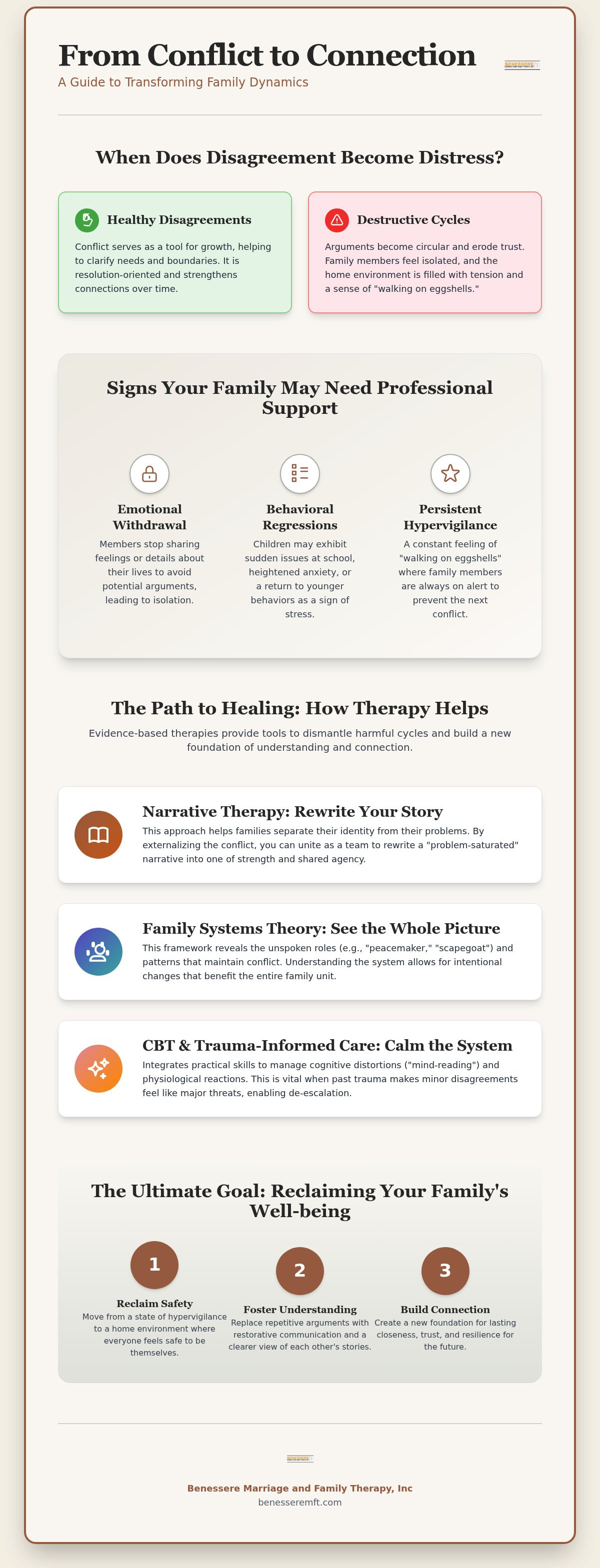
Conflict is often an invitation to deeper understanding, yet it can easily transform into a source of chronic distress. In a healthy dynamic, disagreements serve as a mechanism for clarifying boundaries and expressing needs. When these interactions lose their resolution-oriented nature, they become destructive cycles that erode trust and leave members feeling isolated. Clinical family conflict is a persistent disruption of relational safety and emotional regulation. This state often signals that the family's internal resources for repair have been exhausted, requiring the specialized framework of family conflict therapy to restore balance.
The impact of unresolved tension extends far beyond the immediate argument. For children, witnessing chronic instability can disrupt their foundational sense of security, often manifesting as developmental or emotional hurdles that persist into adulthood. Adults may experience a depletion of cognitive and emotional energy, leaving them less resilient in their professional and social lives. By viewing these challenges through the lens of family systems therapy, we can see that individual symptoms often reflect a broader breakdown in the family's communicative architecture. It's not about finding a person to blame, but about identifying the patterns that prevent the collective from thriving.
Common Triggers for Family Disputes in Modern Households
Even the most resilient families face stressors that can unbalance their equilibrium. Major life transitions, such as a relocation to Roseville or the complexities of a divorce, often force a renegotiation of roles that the family isn't prepared for. Differing parenting philosophies can lead to significant boundary confusion, leaving children feeling caught between conflicting expectations. Additionally, the external pressures of high-demand careers or financial shifts can drain the emotional reserves needed for patient, restorative dialogue. These triggers aren't failures; they're simply pressures that require new coping skillsets.
Signs Your Family May Benefit from Professional Support
Recognizing the tipping point where home-based efforts are no longer sufficient is a vital step toward healing. You might notice that the "silent treatment" has replaced meaningful conversation, or that every discussion feels like a minefield. Consider these common indicators that professional intervention is necessary:
Emotional withdrawal: Family members stop sharing their lives or feelings to avoid potential friction.
Behavioral regressions: Children may show sudden school-related issues, anxiety, or a return to younger behaviors.
Persistent hypervigilance: A pervasive sense of "walking on eggshells" to prevent the next explosive outburst.
When these patterns become the baseline for your home life, family conflict therapy offers a neutral, safe space to de-escalate and begin the collaborative work of reconstruction. It provides the clarity needed to move from a state of survival back into a state of connection. For families looking for specialized resources for their children, you can discover Thrive Teen Therapy Alberta to learn more about dedicated mental health support for teenagers and young adults.
Evidence-Based Modalities for Resolving Family Disputes
Effective family conflict therapy relies on a synthesis of clinical modalities that address both the collective dynamic and the individual experiences within the home. Family Systems Theory provides a foundational map for this work. It helps us identify the rigid roles members often adopt, such as the "peacemaker" or the "scapegoat," which can inadvertently sustain tension even when everyone desires peace. By understanding these systemic patterns, we can begin to dismantle the unconscious habits that keep families stuck in repetitive cycles.
Integrating Cognitive Behavioral Therapy (CBT) allows families to identify shared cognitive distortions, such as "all-or-nothing thinking" or "mind-reading," that fuel escalation. These tools are most effective when applied within a trauma-informed framework. It's common for individual trauma or PTSD to impact the entire family system. When a family member's nervous system is hyper-reactive due to past experiences, they may perceive a minor disagreement as a profound threat. Addressing this gap is vital. We don't just treat the argument; we treat the underlying physiological reactions that make the argument feel so dangerous.
Narrative Therapy: Rewriting Your Family’s Shared Story
Many families arrive in therapy trapped in "problem-saturated" stories. These narratives define the family by its struggles, making the conflict feel like an inherent part of who they are. Narrative Therapy works by externalizing the problem, helping you see that the conflict is an outside force rather than a character flaw. By identifying "unique outcomes," or moments where your family showed resilience and warmth despite the stress, we can begin rewriting your unique story. This process allows the family to reclaim their collective agency and foster a restorative home environment.
Psychoeducation: Understanding the Brain’s Role in Conflict
Restoring harmony often begins with understanding how our brains respond to stress. During heated disputes, the "fight or flight" response can hijack the prefrontal cortex, making logical communication nearly impossible. We provide families with a shared vocabulary for emotional regulation and de-escalation. When you understand that a loved one's withdrawal or outburst is a neurobiological reaction to feeling unsafe, shame decreases. This shift in perspective increases empathy and allows for a more collaborative approach to healing. If you are ready to explore these tools, our team offers specialized family therapy designed to support Placer County residents.
Choosing Between Individual and Family Therapy for Conflict
Deciding whether to enter the therapeutic space alone or as a collective is a nuanced choice that depends on the current emotional safety of your household. While many believe that family conflict therapy must always involve every member from the start, a strategic approach often involves assessing individual readiness first. This prevents the therapeutic environment from becoming another arena for the same destructive cycles you are trying to break. Sometimes, the most restorative path begins with a single person deciding to change their part in the dance.
A common hesitation involves the fear that one specific family member will be singled out as the "cause" of the trouble. In our practice, we view conflict as a systemic issue rather than a personal failing. We don't look for a scapegoat; we look for the shared patterns that are no longer serving your family's growth. Our role is to act as a Wise Guide, ensuring that the process remains collaborative and non-judgmental. In some cases, concurrent treatment, where members engage in both individual and group work, provides the most comprehensive support for lasting change.
When Individual Therapy is the Priority
Individual psychotherapy is often the priority when a person's personal history or past trauma significantly influences their current reactions. If you find that your emotional responses are disproportionate to the situation at hand, it's helpful to process these triggers in a private setting. Engaging in Individual Psychotherapy in Roseville allows you to build foundational self-regulation skills and reclaim your agency. This individual work creates a more stable internal environment, which is essential before re-entering the complex group dynamic of a family session.
The Goals of Group Family Sessions
Collective family sessions offer a unique value by providing a neutral ground where every voice is heard and validated. In this space, we facilitate safe communication that ensures one narrative doesn't dominate the others. These sessions are an opportunity to practice real-time conflict resolution under clinical guidance, allowing you to test new tools in a supported environment. Families learn to establish healthy boundaries that respect both individual autonomy and the needs of the collective. When everyone participates, the family can collectively witness the shifts in their shared story, making the restoration of connection feel like a shared achievement.
Practical Skills for Navigating Family Stress in Placer County
Living in Roseville or the surrounding Placer County area often brings a unique set of stressors. The fast-paced growth of our community, coupled with high-demand professional roles, can leave little emotional margin for the complexities of home life. When you're balancing a career in a competitive industry with the needs of a growing family, the home can inadvertently become a pressure cooker. Implementing practical skills from family conflict therapy allows you to navigate these pressures without sacrificing your relationships.
One of the most effective tools is the "nervous system time-out." Unlike a punitive measure, this is a physiological pause that prevents emotional flooding. When a family member notices their heart rate increasing or their breathing becoming shallow, they can call for a 20-minute break. This duration is scientifically supported as the time needed for the body to metabolize stress hormones and return to a state of calm. This isn't an avoidance tactic; it's a necessary step to ensure that the conversation remains restorative rather than reactive.
De-escalation Strategies for High-Tension Moments
Effective de-escalation begins before a single word is spoken. Learning to identify physical "tells," such as a clenched jaw or a change in vocal tone, allows you to intervene early. Using a "softened start-up" when bringing up a grievance is equally vital. Instead of starting with a critique, focus on these three elements:
Identify your feeling: Use phrases like "I feel overwhelmed when..."
Describe the situation: Focus on the specific event, such as "...the kitchen is left untidy after dinner..."
State a positive need: Clearly ask for what you need, like "...and I would appreciate some help with the cleanup tonight."
Regularly scheduled family check-ins also provide a safe space to address minor frustrations before they fester into major disputes. These meetings prioritize understanding over winning, ensuring every voice is heard.
Setting and Maintaining Healthy Family Boundaries
Boundaries provide the structure that allows emotional safety to flourish. In our interconnected world, this often includes digital boundaries, such as agreed-upon screen-free zones to ensure quality face-to-face connection. Respecting privacy and defining clear expectations for the household helps reduce friction between parents and children. Additionally, learning how to say "no" to the demands of extended family or external commitments is a vital skill for protecting the nuclear unit's well-being. If you're ready to implement these tools with professional guidance, you can schedule a session at our Roseville office to begin your family's restorative journey.
Collaborative Healing: What to Expect at Benessere Marriage and Family Therapy, Inc
The approach at Benessere Marriage and Family Therapy, Inc is built on the conviction that lasting change occurs when families are invited into a collaborative and educational process rather than being lectured. We provide a sophisticated blend of clinical authority and deep-seated empathy, ensuring that complex emotions are handled with both scientific precision and human warmth. In our practice, family conflict therapy serves as a vital bridge between current distress and a restorative future. During the initial assessment, we focus on understanding your family’s unique story, including the cultural and personal influences that shape your interactions. This ensures that our interventions are specifically tailored to the nuances of your household, moving beyond generic advice to reach the heart of your relational dynamics.
By focusing on Family Therapy Roseville CA: Strengthening Relational Bonds, we help you transition from survival mode to a state of genuine connection. We don't just address the surface symptoms of discord; we look for the underlying patterns that require a clinical, restorative update. Our role is to act as a Wise Guide, helping every member of the family reclaim their agency within a shared narrative that prioritizes safety and understanding. This collaborative work is designed to move your home from a place of tension to one of predictable peace.
A Safe, Clinical Space for Vulnerability
The environment of our Roseville office is designed to feel like a calm, safe sanctuary for all members. We maintain a professional distance that inspires confidence while ensuring every individual feels validated and respected. Our trauma-informed clinical team at Benessere Marriage and Family Therapy, Inc undergoes continuous mentoring to remain at the forefront of evidence-based practice. This commitment to excellence means that the strategies we use in family conflict therapy are grounded in psychological literacy and proven effectiveness. We prioritize the safety of the room, ensuring that even the most vulnerable voices have the space to be heard without fear of judgment or escalation.
Taking the First Step Toward a Restorative Future
Starting your healing journey begins with a streamlined intake process designed to lower your defenses and build security. When you schedule your first session, we provide the guidance needed to prepare your family for this collaborative work. Therapy is a deliberate and unhurried process; the duration depends on the complexity of your dynamics and your specific goals. Success isn't just the absence of arguments. It's the presence of restorative communication, a clearer understanding of each member's needs, and a home environment that feels safe and stable. Contact Benessere Marriage and Family Therapy, Inc today to start your family's healing journey.
Reclaiming Your Family’s Shared Narrative
The journey from chronic tension to a restorative home environment is rarely linear, yet it's entirely possible with the right clinical support. By understanding that repetitive cycles are often the result of exhausted internal resources rather than a lack of love, you can begin to view your family through a lens of compassion. We have explored how identifying destructive roles and implementing nervous system de-escalation can create the safety needed for genuine connection. Our evidence-based, trauma-informed approach ensures that every member's story is heard and respected within our local Roseville office, providing a stable foundation for your collective growth.
Choosing to engage in family conflict therapy is a courageous investment in your family's resilience and long-term health. Whether you're navigating the specific pressures of Placer County life or processing deeper relational wounds, professional guidance provides the stability required to rewrite your family's future. You don't have to navigate these complexities alone. We invite you to Schedule a Consultation with Benessere Marriage and Family Therapy, Inc to begin the collaborative work of restoring your home's harmony. Your family's story is still being written, and a more peaceful, connected chapter is within reach.
Frequently Asked Questions
How do I convince a family member who is resistant to therapy?
Inviting a resistant loved one requires a shift from criticism to collaboration. Instead of focusing on their perceived faults, express how the current family dynamic affects your own well-being and your desire for a more peaceful home. Frame the process as a shared effort to improve the environment for everyone rather than a search for a scapegoat. Suggesting a trial period of three sessions can often lower their defenses and provide a safe entry point.
Is family conflict therapy effective if only some members attend?
Yes, family conflict therapy is highly effective even with partial attendance because a change in one part of the system inevitably impacts the whole. When one person learns to regulate their nervous system or change their communicative patterns, the old "dance" of conflict becomes impossible to sustain. This approach allows the attending members to model new, restorative behaviors that can eventually invite others into the healing process as the home environment begins to stabilize.
What is the difference between family therapy and marriage counseling?
Family therapy focuses on the broader system, including children, siblings, or multi-generational dynamics, whereas marriage counseling specifically addresses the romantic dyad. While both utilize systemic theories, family work often prioritizes the health of the collective unit and the developmental needs of children. It addresses how the parent-child bond or sibling rivalries interact with the overall stability of the home, ensuring that every voice within the household is heard and validated.
Can family therapy help with adult children and their parents?
Many of our clients are adult families seeking to renegotiate boundaries and resolve long-standing grievances. As children move into adulthood, the old parent-child hierarchy often requires a clinical update to reflect mutual respect and individual autonomy. This process helps families move past historical, problem-saturated stories and build a new foundation for adult-to-adult connection. It allows both generations to honor their individual agency while maintaining a meaningful, supportive relationship through life's transitions.
How long does it take to see results in family conflict resolution?
The timeline for restorative change varies based on the duration of the conflict and the family's readiness to implement new skillsets. Some families experience a noticeable shift in atmosphere within 8 to 12 sessions as they adopt de-escalation tools. However, deeper work involving multi-generational trauma or complex PTSD may require a more unhurried, long-term commitment. Consistency in family conflict therapy ensures that new patterns of safety and communication are fully integrated into your daily life.
What should we do if an argument breaks out during a therapy session?
Arguments are welcomed in the therapeutic space as they provide a live opportunity to practice de-escalation under professional guidance. When tension rises, your therapist acts as a Wise Guide to help you identify physiological "fight or flight" responses in real-time. We use these moments to model softened start-ups and nervous system time-outs, turning a potential explosion into a controlled, educational experience. This practice builds the confidence needed to handle similar situations at home without escalation.
Is family therapy covered by insurance in Roseville, CA?
Coverage depends on your specific provider, but Benessere Marriage and Family Therapy, Inc is in-network with several plans, including Blue Shield of California and Anthem Blue Cross Medi-Cal. As of August 2026, we also accept Carelon Behavioral Health and Partnership Healthplan of CA. We recommend verifying your benefits beforehand to understand your expected costs. For those whose insurance is not directly accepted at our Roseville office, we can provide a superbill to assist you in seeking potential out-of-network reimbursement.


Comments