
How to Set Healthy Boundaries with Family: A Restorative Clinical Guide

Updated: Aug 20
What if the guilt you feel when saying "no" to a relative isn't a sign that you're doing something wrong, but rather a symptom of a relationship that has lost its balance? Many people experience a profound sense of exhaustion from carrying the emotional weight of their entire family system. You might find yourself bracing for the next holiday gathering or feeling a familiar spike of anxiety when a specific name flashes on your phone. Learning how to set healthy boundaries with family is not an act of betrayal; it's a necessary step toward reclaiming your individual agency and mental well-being.
It's natural to worry that drawing a line will create a permanent rift or make you appear cold. However, the evidence-based psychological framework we'll explore reveals that boundaries are not meant to be walls that keep people out. Instead, they act as restorative architecture that makes a sustainable, authentic connection possible. In this guide, you'll gain the internal permission to prioritize your needs and learn practical scripts for navigating difficult conversations. We'll examine the difference between defensive barriers and healthy limits, providing you with the tools to transition from emotional burnout to a state of calm, intentional engagement.
Table of Contents
Understanding the Architecture of Healthy Family Boundaries
Boundaries are the invisible lines that define where you end and another person begins. Within a family unit, these lines determine how much emotional and physical space you maintain for your own well-being. Understanding how to set healthy boundaries with family starts with recognizing that these limits aren't about punishment; they're about clarity. When we don't have clear lines, we often absorb the stress and expectations of those around us, leading to a loss of self.
Clinically, we categorize these relational lines into three distinct types:
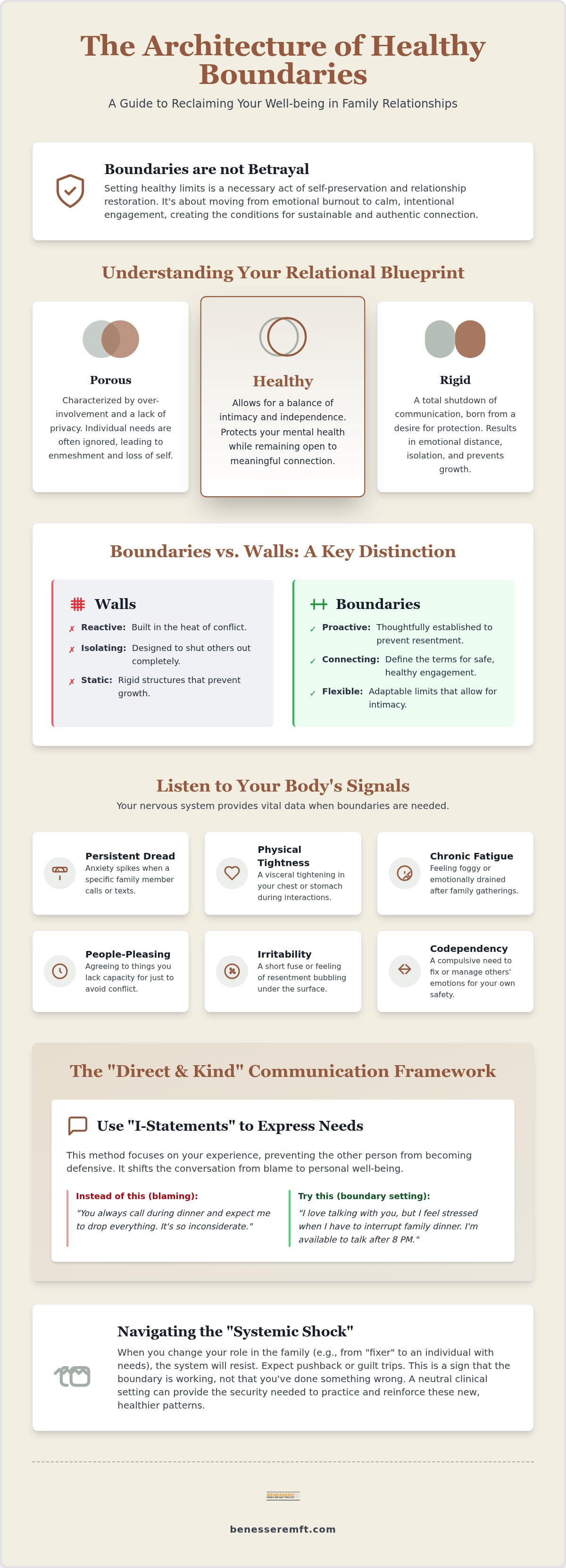
Porous boundaries: These are characterized by over-involvement and a lack of privacy, where one person's emotions dictate the mood of the entire room and individual needs are ignored.
Rigid boundaries: These function as a total shutdown of communication, often born from a desire for protection but resulting in emotional distance and isolation.
Healthy boundaries: These allow for a balance of intimacy and independence, protecting your mental health while remaining open to meaningful connection.
Central to this structure is the concept of Differentiation of Self. This family systems term describes your ability to remain emotionally connected to your relatives while maintaining your own values and identity. A healthy boundary is a tool for relational sustainability rather than a mechanism for exclusion.
The Difference Between Boundaries and Walls
Why Family Dynamics Make Boundaries Difficult
Families often operate through "enmeshment," a state where personal boundaries are blurred and individual autonomy is viewed as a threat to the group's stability. If you've spent decades in a specific role, such as the "fixer" or the "responsible one," stepping out of that narrative feels like a betrayal. This is where narrative agency becomes vital. You have the right to choose how you interact with relatives, regardless of historical roles or past expectations. Learning how to set healthy boundaries with family involves rewriting your part in the family story, moving from a script written by others to one that honors your own resilience and needs.
Recognizing the Signs: When Relational Dynamics Require New Limits
The body often serves as the most reliable indicator that relational limits have been breached. Before you can master how to set healthy boundaries with family, you must learn to listen to the subtle signals your nervous system is sending. One of the most telling diagnostic markers is a persistent sense of dread. If a phone call from a sibling or an upcoming dinner with parents triggers a visceral tightening in your chest, it's a clear sign that your current emotional space is being compromised. These physical reactions aren't failures of character; they're vital data points indicating that your environment has become unsustainable.
In many family systems, codependency is frequently mislabeled as loyalty. True loyalty is a conscious choice based on mutual respect and shared values. Codependency, however, is a compulsive need to manage or fix the emotions of others to ensure your own safety or sense of belonging. This dynamic creates a heavy burden of unstated expectations. You may feel responsible for outcomes you cannot control, which leads to a slow process of psychological erosion and burnout.
Emotional and Physical Red Flags
When boundaries are porous, the resulting emotional tax manifests in concrete ways. Chronic irritability, a feeling of fogginess after family interactions, and persistent fatigue are common red flags. You might find yourself trapped in people-pleasing cycles, agreeing to commitments you don't have the capacity for just to avoid conflict. Resentment functions here as a boundary alarm. It is an internal signal that someone has overstepped or that you have given more than you possess. If these patterns feel inescapable, engaging in individual psychotherapy Roseville can provide the clarity needed to identify these triggers in a safe, clinical environment.
The Parentified Child and Adult Roles
Many adults struggle with limits because they were parentified as children, forced into roles where they provided emotional support or physical care for their own parents. This early training makes it difficult to distinguish between being a supportive adult child and being an emotional caretaker. These childhood scripts often resurface with aging or demanding parents, where the pressure to sacrifice your own needs feels overwhelming. Utilizing narrative therapy allows you to deconstruct these old stories and reclaim your agency. By rewriting the narrative of your role, you can transition from a place of obligation to one of intentional connection. If you're finding it difficult to hold these lines on your own, Benessere Marriage and Family Therapy, Inc offers a compassionate space to explore these dynamics through professional support.
5 Clinical Strategies for Communicating Boundaries Effectively
Communicating your needs to relatives requires a shift from reactive defense to proactive clarity. Many people struggle with how to set healthy boundaries with family because they fear that being direct is synonymous with being unkind. In a clinical sense, the most compassionate thing you can do for a relationship is to be clear about your limits. This prevents the slow erosion of trust and the buildup of resentment that we discussed in previous sections. By utilizing specific evidence-based strategies, you can maintain your mental well-being while keeping the lines of communication open.
To implement these changes effectively, consider these five core strategies:
The "I-Statement" Technique: Focus on your own experience and needs rather than pointing out a relative's faults. Instead of saying, "You always stress me out," try, "I feel overwhelmed when we talk about my finances, so I need to move to a different topic."
The "Broken Record" Method: When met with persistent pushback, repeat your boundary in a calm, neutral tone without adding new justifications. Over-explaining often invites further debate.
Time-Bound Limits: Define the duration of an interaction before it begins. Stating, "I have thirty minutes to talk today," provides a natural container for the conversation.
The Exit Strategy: Identify a clear "point of departure" for when a boundary is ignored. This might mean leaving a room or ending a phone call if a specific topic is broached after you've asked to stop.
Direct and Kind Framework: Aim for a tone that is firm but devoid of hostility. You aren't attacking the other person; you're protecting your own capacity for connection.
Crafting Your Script: What to Actually Say
Having a prepared response reduces the anxiety that often accompanies limit-setting. If you receive a last-minute invitation that you cannot attend, a simple script is most effective: "Thank you for thinking of me, but I'm not available this weekend." You don't need to provide a list of reasons. When facing intrusive questions about your personal life, you might say, "I'm not comfortable discussing that right now, let's talk about something else." Remember that "No" is a complete sentence. Brief, neutral responses are often the most successful way to teach others how to set healthy boundaries with family without triggering an unnecessary escalation.
Maintaining Consistency in High-Stress Moments
The effectiveness of a boundary depends entirely on your willingness to follow through with the stated consequences. If you say you'll leave if a conversation becomes disrespectful, you must actually leave when that line is crossed. Staying regulated during these moments is difficult, but it's essential for long-term change. This consistency is particularly vital when navigating complex dynamics with in-laws or extended relatives. If you find that family interference is impacting your primary relationship, resolving marriage conflict often involves learning how to present a united front when establishing these vital limits.
Managing the "Systemic Shock": Dealing with Guilt and Resistance
Implementing a boundary often disrupts the established rhythm of the family unit. Understanding how to set healthy boundaries with family involves preparing for the "systemic shock" that follows a change in relational patterns. Families naturally seek homeostasis, which is a state of equilibrium where roles and behaviors remain predictable. When you stop playing your assigned part, the system experiences a crisis. This resistance isn't necessarily a sign of malice; it is a reflexive attempt by the family unit to pull you back into the old, familiar dynamic.
During this transition, you may encounter an "extinction burst." This clinical term describes a temporary but intense increase in negative behavior from others just before they finally accept a new limit. It's the psychological equivalent of a toddler screaming louder when they realize a tantrum isn't working. Recognizing this pattern allows you to stay firm rather than folding under the pressure. To maintain your resolve, it's essential to differentiate between healthy guilt, which arises when you've violated your own values, and manipulative guilt, which occurs when you've simply violated someone else's expectations. You can reframe the "bad child" narrative by reminding yourself that protecting your peace is a prerequisite for a healthy relationship.
The Calder Mobile: Navigating Family Pushback
Think of a family system as a Calder mobile hanging from the ceiling. If you tug on one piece, every other piece swings and spins as the entire structure tries to find a new balance. This movement often manifests as pushback from "flying monkeys," who are relatives not directly involved but who pressure you on behalf of someone else. They might ask why you're being so difficult or remind you how much a parent cares. Staying grounded during this initial shockwave requires you to repeat your boundary without over-explaining your reasons. Consistency is the only way the system will eventually find a new, healthier equilibrium.
Self-Regulation for the Boundary-Setter
The immediate anxiety of saying "no" can be physically overwhelming. Utilizing grounding techniques, such as box breathing or naming five things you can see in the room, helps lower your physiological arousal. Self-validation is vital here. You must provide yourself with the approval that your family is currently withholding. When the fear of setting a limit feels paralyzing, trauma therapy Roseville can help process the childhood roots of boundary-related anxiety. Learning how to set healthy boundaries with family is a skill that improves with practice and professional support. If you're ready to navigate these systemic shifts with professional guidance, the team at Benessere Marriage and Family Therapy, Inc is here to support your growth.
Integrating Boundaries through Family Therapy in Roseville
While the strategies discussed previously provide a foundation, applying them within a resistant family system can be daunting. A neutral clinical setting offers a controlled space where you can practice how to set healthy boundaries with family without the immediate pressure of a domestic environment. In this context, boundary experimentation becomes a collaborative effort rather than a solo struggle. A therapist acts as a steady guide, ensuring that the dialogue remains productive and that each person's agency is respected. This professional oversight helps prevent the conversations from devolving into the same cycles of conflict you may have experienced at home.
The therapist's role as a mediator is crucial for managing the "systemic shock" that occurs when you change your role. By providing psychoeducation, the clinician helps your relatives understand that these limits aren't meant to push them away, but to make the relationship more durable. This helps bridge the gap between your need for autonomy and their desire for connection. Through family therapy Roseville CA, the transition from individual growth to relational restoration becomes a methodical and supported process. It's an opportunity for the entire family to learn a new vocabulary for connection.
When to Seek Professional Support
There are instances where individual efforts to hold limits are insufficient, particularly when dealing with deep-seated trauma or cycles of abuse. If the pushback you experience triggers severe anxiety or if your safety is at risk, professional intervention is necessary. Structured marriage and family therapy Roseville CA provides a safe framework for addressing these complex dynamics. Roseville residents can access trauma-informed care that respects their unique history while building the skills needed for a healthier future. Recognizing when a situation requires external support is a vital part of your own self-care strategy.
The Path Forward: Restoring Harmony
The ultimate reward for doing this difficult work is a relationship built on mutual respect rather than obligation. When you master how to set healthy boundaries with family, you're creating the space for a more authentic connection to grow. Conflict decreases because expectations are clear, and resentment is replaced by clarity. You have the power to rewrite your family's narrative, moving toward a state of restorative harmony. If you're ready for personalized guidance, Benessere Marriage and Family Therapy, Inc offers the expertise and scientific precision required to help you navigate this transformative journey with confidence and warmth.
Reclaiming Your Narrative and Restoring Home Harmony
Establishing clear limits is not an act of isolation; it's a commitment to the long-term health of your relationships. By understanding the architecture of your emotional space and utilizing the "Direct and Kind" framework, you can transform your role within the family system from one of obligation to one of intentional choice. You've learned that the initial resistance and guilt are often signs of a system seeking its old balance. Through consistent practice and self-validation, a new, healthier equilibrium is possible.
Understanding how to set healthy boundaries with family is a journey that doesn't have to be walked alone. At Benessere MFT, our compassionate, trauma-informed therapists utilize evidence-based clinical skillsets to help you navigate these complex transitions. We specialize in Narrative and Family Systems Therapy to support you in rewriting your family story and reclaiming your individual agency. Begin your restorative journey with professional Family Therapy in Roseville today. You possess the inherent capacity for growth, and a more authentic, peaceful connection with your loved ones is within reach.
Frequently Asked Questions
Is it selfish to set boundaries with my family?
Setting limits is a vital act of self-preservation that actually protects the integrity of the relationship. When you don't have boundaries, resentment builds and eventually leads to emotional distance or burnout. By being clear about your needs, you're providing a roadmap for how to interact with you in a way that is sustainable and authentic. It isn't selfish to ensure you have the emotional capacity to remain engaged with your relatives.
What do I do if my family ignores the boundaries I set?
If a relative continues to ignore your stated limits, the focus must shift from communication to action. A boundary isn't a request for their permission; it's a statement of your own behavior. You might need to end the phone call, leave the room, or take a temporary break from interactions. Consistency is the only way to demonstrate that your limits are firm and that you're serious about protecting your mental well-being.
How can I set boundaries without hurting their feelings?
You can't control how others react to your limits, but you can control the delivery of your message. Using a "Direct and Kind" framework allows you to state your needs clearly without being hostile. Focus on your own experiences rather than their perceived faults. While they might feel hurt by the change in dynamic, being honest is ultimately more respectful than staying silent and allowing resentment to poison the relationship.
Is it ever okay to go "no contact" with family members?
Going "no contact" is a significant decision often reserved for situations involving persistent abuse, deep-seated trauma, or a total lack of safety. It's a valid choice when every attempt at setting limits has been met with continued harm. In these cases, the goal shifts from relational restoration to absolute self-protection. This path is often explored within the safe space of trauma therapy to ensure you have the necessary support for such a transition.
How do I handle the guilt I feel after saying no to a relative?
Handling guilt requires you to distinguish between "healthy guilt" and "manipulative guilt." Manipulative guilt is often a reflexive response to breaking a family rule or expectation that doesn't serve your well-being. When you're learning how to set healthy boundaries with family, remind yourself that guilt is a temporary feeling, not a fact. Practicing self-validation and focusing on the long-term benefits of your mental health can help you stay regulated through the discomfort.
What are some examples of healthy boundaries with parents?
Healthy boundaries with parents might include setting specific times for phone calls or declining to discuss certain topics like your finances or parenting choices. You might also decide not to attend every family event to prioritize your own rest. Another example is asking for a call before they visit your home rather than allowing unannounced arrivals. These small shifts help establish you as an autonomous adult while maintaining a connection.
Can family therapy help if only one person wants to change?
Family therapy can be highly effective even if only one person is initially motivated to change. Because families function as a system, one person shifting their behavior forces the entire structure to adjust. A therapist can help you develop the skills to maintain your boundaries even when met with resistance. Often, as one person becomes more differentiated and regulated, other family members may eventually become more open to the restorative process.
How do I set boundaries with family members who have toxic traits?
When dealing with relatives who exhibit toxic traits, your boundaries must be firm and non-negotiable. You shouldn't expect them to change their behavior; instead, focus on how you will respond to it. This often involves limiting the time spent together or sticking to neutral, surface-level topics during interactions. Learning how to set healthy boundaries with family in these cases is about minimizing harm and ensuring that their behavior doesn't dictate your internal emotional state.


Comments