
Personalized Mental Health Treatment: Beyond One-Size-Fits-All Therapy in 2026

What if the reason therapy felt unhelpful in the past wasn't your lack of commitment, but the rigid confines of a generic protocol? When a clinician treats you like a diagnostic code or hands you a standardized worksheet, emotional healing stalls before it even begins. Genuine progress happens when proven clinical frameworks bend to fit your personal context, not the other way around. Seeking personalized mental health treatment means expecting a collaborative, compassionate space where evidence-based interventions are thoughtfully tailored to honor your lived history.
You already know that lasting emotional regulation requires more than surface-level coping techniques; it demands deep respect for your nervous system, your relational patterns, and your individual voice. In this guide, you'll discover how individualized psychotherapy adapts proven modalities to meet your specific goals and lived experience. We examine what tailored clinical care looks like in practice, providing a clear framework to evaluate providers beyond basic credentials so you can step into restorative, evidence-based therapy with total confidence.
Table of Contents
What Is Personalized Mental Health Treatment in Modern Clinical Practice?
True clinical care begins when an intervention meets a human story, not just a diagnostic checklist. While the broader discipline of personalized medicine often focuses on biological markers or pharmaceutical selection, authentic psychotherapeutic care operates through a different lens. Personalized mental health treatment in an outpatient setting is the art of molding empirical therapeutic modalities around an individual's lived narrative, nervous system responses, and relational history.
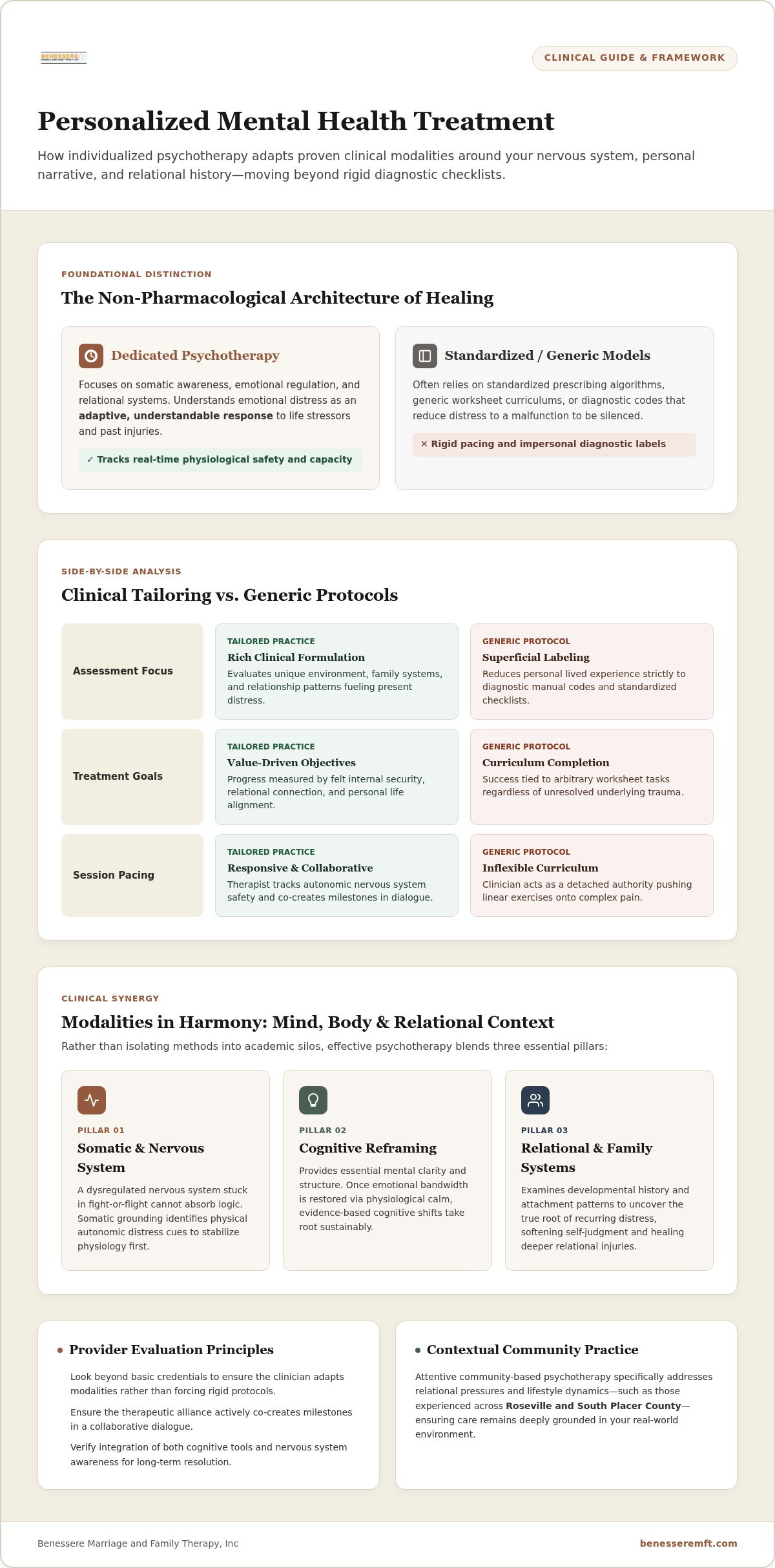
A crucial distinction exists between clinical psychotherapy and psychiatric medication management. Corporate healthcare models frequently conflate personalization with prescribing algorithms or choosing options from a menu of pharmacological interventions. Dedicated outpatient psychotherapy deliberately focuses on the non-pharmacological architecture of healing: emotional regulation, somatic awareness, and the relational systems that shape our daily lives. Within this restorative framework, emotional distress isn't viewed as a malfunction to be silenced, but as an understandable, adaptive response to life's profound stressors and past injuries.
Defining Individualized Outpatient Psychotherapy
Individualized therapy centers on a responsive therapeutic alliance. Instead of enforcing an inflexible curriculum, a thoughtful clinician tracks your physiological safety and emotional bandwidth, adjusting session pacing in real time. Rather than receiving directives from an detached authority, you engage in a collaborative dialogue. You and your therapist actively co-create treatment milestones, ensuring every session honors your genuine capacity and values.
The Contrast Between Clinical Tailoring and Generic Protocols
Standardized cognitive worksheets often stumble when applied to nuanced human pain. While linear exercises can offer temporary triage, they rarely untangle complex attachment patterns or unresolved trauma. Effective practitioners replace superficial labeling with rich clinical formulation.
Clinical formulation over diagnostic labels: Rather than reducing your experience to a generic diagnostic code, a tailored approach examines how your unique environment and relationship patterns fuel your present anxiety or low mood.
Value-driven treatment objectives: Progress isn't measured by workbook completion. It's measured by your felt sense of security, interpersonal connection, and alignment with what matters most to you.
Responsive methodology: Modalities adapt to the person in the room, ensuring evidence-based techniques serve your growth rather than forcing your experience into a rigid mold.
This deliberate synergy transforms therapy from a cold exercise into an enduring, restorative journey of psychological integration.
Core Pillars of Tailored Psychological Care: Modalities in Harmony
Academic literature often divides psychotherapy into isolated silos, treating cognitive restructuring, nervous system regulation, and relational work as separate disciplines. In an attentive clinical setting, true personalized mental health treatment occurs through their deliberate synergy. An experienced clinician does not choose between addressing thoughts, biological responses, or personal history; rather, they weave these elements into a cohesive treatment formulation that mirrors the complex reality of your life.
When you understand the root of a behavioral pattern, the urge to judge yourself begins to soften. Reaching lasting resolution requires addressing both the mind and the body. Tailored outpatient psychotherapy brings disparate modalities into alignment, ensuring that cognitive shifts are supported by felt physiological calm.
Integrating Evidence-Based Cognitive and Somatic Tools
Cognitive strategies provide valuable clarity, but a dysregulated nervous system cannot easily absorb logic. If your body remains stuck in a high-alert fight-or-flight response, intellectual exercises fall flat. Tailored care bridges this gap by combining practical cognitive reframing with somatic grounding techniques. By learning to identify subtle physical cues of autonomic distress, you can stabilize your physiology first, creating the emotional bandwidth required for deep cognitive processing and sustainable change.
Honoring the Power of Your Personal Narrative
Long before entering a therapy room, people internalize stories about who they are and what they deserve. Often, chronic distress convinces you that you are fundamentally broken or defective. Individualized care honors the process of deconstructing these damaging storylines. By exploring narrative therapy, individuals learn to externalize problems, separating their genuine identity from their struggles. This crucial perspective shift reduces shame and unlocks latent resilience.
A balanced, multimodal plan typically harmonizes three vital dimensions of healing:
Physiological regulation: Developing body-based awareness to soothe acute sympathetic arousal before addressing challenging memories.
Cognitive flexibility: Examining ingrained thought patterns with curiosity instead of self-reproach.
Narrative reclamation: Rewriting dominant stories of inadequacy into authentic accounts of agency and strength.
When modalities work together in clinical harmony, therapy becomes an expansive, empowering process. If you are ready to move beyond standardized coping sheets and experience care shaped around your unique nervous system and personal narrative, consider reaching out to the dedicated clinicians at Benessere Marriage and Family Therapy to begin establishing your individualized path forward.
Why Relational Context and Trauma History Must Shape Your Plan
Psychological distress rarely develops in total isolation. While individual symptoms like panic, emotional numbness, or chronic exhaustion manifest internally, they are deeply rooted in the relational ecosystems you inhabit. Your early family dynamics, past relational wounds, and current social bonds continually shape how you perceive safety. Effective personalized mental health treatment recognizes that treating a person without understanding their relational world produces temporary relief at best.
A responsive clinician looks beyond immediate distress to map your broader emotional ecosystem. By examining how developmental experiences shape your current responses, therapy shifts from superficial crisis management into deep, lasting healing.
Trauma-Informed Customization for Nervous System Safety
Unprocessed traumatic memories fundamentally alter how the autonomic nervous system appraises risk. When painful past events remain unresolved, the body reacts to benign current moments as immediate threats. If a therapist rushes into emotionally charged material without establishing physiological ground rules, the client risks intense retraumatization. Clinicians offering thoughtful trauma therapy in Roseville emphasize measured pacing, allowing individuals to build internal regulation tools before processing sensitive memories.
Tailored trauma care creates stabilization through customized grounding practices:
Sensory-specific anchors: Identifying tactile, auditory, or visual resources that actively calm your unique threat physiology.
Pacing driven by capacity: Honoring your nervous system's threshold rather than forcing an artificial, predetermined clinical schedule.
Restoring agency: Ensuring you retain complete collaborative control over which topics are explored in each session.
Integrating Family Systems into Individual Healing
We often carry unconscious scripts handed down across generations. Systemic therapy frameworks acknowledge that individual distress frequently mirrors unresolved tensions within partnerships or family networks. An individual may learn vital emotional regulation skills inside a therapist's office, yet struggle to maintain them if their home dynamics remain volatile or unsupportive.
By mapping family-of-origin roles, you uncover why certain interpersonal boundaries feel impossible to hold or why simple disagreements trigger deep abandonment fears. This awareness allows you to make deliberate adjustments in your daily relationships. Instead of reacting out of historic defense mechanisms, you gain the confidence to communicate needs clearly, establishing a home environment that actively supports your long-term emotional recovery.
How to Evaluate and Choose a Personalized Mental Health Provider
Finding the right clinician requires looking past polished websites and basic credentials. While verifying active standing with the California Board of Behavioral Sciences is an essential baseline, clinical licensure alone does not guarantee attentive care. Many large platforms advertise tailored care, yet funnel clients into assembly-line care driven by pre-set protocols. Discovering authentic personalized mental health treatment requires evaluating how deeply a practitioner listens, adapts, and respects your autonomy.
To cut through generic marketing, use a five-step evaluation framework during your search:
Examine clinical orientation: Look for clinicians with advanced training in systemic models, somatic awareness, or narrative methods rather than generalists relying solely on standard manuals.
Assess the intake process: Notice whether the initial consultation feels like a dynamic dialogue or a hurried diagnostic checklist.
Evaluate flexibility: Ask directly how the therapist modifies their style when a client feels stuck or overwhelmed.
Gauge cultural attunement: Ensure the practitioner genuinely invites your spiritual beliefs, cultural background, and lived identity into session goal setting.
Observe the pace: Trust your visceral reaction. A skilled therapist creates a grounded atmosphere that lowers internal tension rather than rushing your narrative.
Essential Consultation Inquiries for Prospective Clients
A brief consultation offers a rare window into a therapist's true methodology. Ask targeted questions that reveal their willingness to collaborate:
"How do you adapt your clinical interventions when an evidence-based tool isn't producing the relief we hoped for?"
"In what ways do you integrate my family history and community background into our ongoing sessions?"
"How do we regularly review and adjust my treatment milestones together?"
Distinguishing Authentic Customization from Commercial Marketing
Beware of clinics that lean heavily on uniform handouts or force you to complete rigid weekly homework sheets that disregard your current emotional capacity. Burnout and high caseloads often cause practitioners to fall back on generic protocols. Authentic customization feels like collaborative discovery. Your clinician should treat you as the foremost expert on your own internal experience, acting as a steady guide rather than a clinical interrogator.
If you're seeking a grounded, collaborative space tailored to your unique story, schedule an initial clinical consultation with our experienced team to discover what thoughtful outpatient psychotherapy can look like for you.
Beginning Your Restorative Journey in Roseville, California
Large corporate telehealth platforms frequently overlook the distinct cultural and environmental rhythms of specific communities. Living and working in South Placer County brings its own set of rhythms and expectations, from managing fast-paced careers along the Highway 65 corridor to balancing demanding family commitments. Pursuing personalized mental health treatment within an attentive, community-based practice ensures your therapist understands the day-to-day context shaping your stress, offering a grounded local presence that distant virtual directories simply cannot replicate.
Entering therapy is not an admission of defeat; it is an empowering investment in your long-term emotional resilience. When care is rooted in your local community, treatment feels both deeply relevant and immediately applicable to your real life.
What to Expect During Your Initial Collaborative Consultation
Your first session is designed to be a calm, unhurried exploration rather than an intimidating clinical evaluation. Within a quiet, confidential setting, you and your therapist will review your personal history, relational background, and current emotional hurdles. Together, you will map out clear, realistic milestones tailored to your personal goals.
A personalized intake focuses on practical integration across several core life areas:
Relational harmony: Identifying recurring communication hurdles and emotional triggers with partners or family members.
Somatic stabilization: Developing actionable grounding practices to reduce physical tension during periods of intense overwhelm.
Occupational equilibrium: Utilizing specialized individual psychotherapy in Roseville to dismantle workplace perfectionism and alleviate high-stress professional burnout.
Taking the Next Step Toward Restorative Health
It is entirely natural to feel a degree of apprehension before opening up to a new clinician. Sharing personal stories requires vulnerability, especially if past counseling experiences felt detached or overly rigid. Sustainable healing does not require dramatic, forced breakthroughs; it unfolds through steady, thoughtful steps that respect your internal pacing and nervous system limits.
You do not have to untangle complex emotional patterns on your own. When you are ready to move beyond generic advice and establish a tailored path toward emotional clarity, reach out to the dedicated clinicians at Benessere Marriage and Family Therapy to schedule your initial consultation and begin your restorative journey.
Embracing a Restorative Path Tailored to Your Life
Meaningful emotional healing doesn't emerge from rigid manuals or detached checklists. It flourishes when evidence-based interventions honor your personal history, autonomic nervous system, and relational world. Choosing authentic personalized mental health treatment allows you to step away from assembly-line care and enter a collaborative partnership built around your innate resilience.
At our dedicated local practice rooted in Roseville, California, licensed clinical therapists bring deep expertise to tailored evidence-based modalities. We provide restorative, client-centered outpatient care designed to navigate complex anxiety, trauma recovery, and family dynamics at a pace that honors your capacity. You deserve support that sees the full context of your story. When you're ready to experience therapy that respects your autonomy, begin your personalized clinical journey with Benessere Marriage and Family Therapy and take the next grounded step toward lasting well-being.
Frequently Asked Questions
What is the primary difference between personalized mental health treatment and standard counseling?
The primary difference lies in moving away from uniform protocols to adapt clinical modalities around your distinct life story, relational dynamics, and autonomic nervous system. While standard counseling often relies on generic worksheets and static timelines, personalized mental health treatment prioritizes individualized clinical formulation. In practices like Benessere in Roseville, therapists collaborate with you to pace sessions according to your emotional tolerance, ensuring interventions directly match your lived context rather than a rigid manual.
How do clinicians tailor evidence-based therapies without compromising clinical integrity?
Clinicians tailor evidence-based care by preserving the core mechanisms of proven modalities while modifying their delivery, pacing, and relational framing to match client capacity. Evidence-based practice doesn't require robotic adherence to scripts. Instead, a skilled practitioner identifies which specific cognitive, somatic, or narrative tools serve your immediate window of tolerance. The therapeutic integrity remains intact because underlying clinical principles guide the process, but the execution adapts flexibly to your unique emotional safety.
Can personalized mental health treatment effectively support trauma and chronic anxiety?
Yes, personalized mental health treatment is particularly effective for trauma and chronic anxiety because it prioritizes nervous system regulation before addressing distressing memories. Standard therapies sometimes rush exposure exercises, risking overwhelm. Tailored outpatient therapy integrates sensory grounding techniques with narrative exploration, allowing your autonomic state to stabilize first. By honoring your specific threat triggers and relational history, clinicians help restore emotional equilibrium and build lasting resilience at a sustainable pace.
Does personalized therapy in outpatient settings include psychiatric medication prescriptions?
No, outpatient psychotherapy focuses exclusively on therapeutic dialogue, relational exploration, and behavioral interventions rather than psychiatric medication prescriptions. Private clinical practices such as Benessere Marriage and Family Therapy do not provide psychiatric evaluations or medication management. Instead, personalized psychotherapy emphasizes non-pharmacological modalities, addressing the psychological, somatic, and systemic roots of distress. If medication is needed, clinicians can coordinate care with your independent medical provider while remaining centered on your psychotherapy.
How long does personalized psychotherapy take to create lasting emotional improvements?
The duration of personalized psychotherapy varies depending on the complexity of your distress, your personal history, and your specific wellness goals. Some individuals experience meaningful symptom relief within a few months of targeted individual psychotherapy, particularly when learning practical somatic and cognitive skills. Deeper healing involving developmental trauma or entrenched family patterns often unfolds over a longer timeline. Because pacing is collaborative, you and your therapist regularly evaluate milestones to ensure steady, ongoing progress.
What should I ask a potential therapist to confirm their care is genuinely individualized?
Ask how the clinician adjusts their methodology when a standard clinical tool feels unhelpful or dysregulating to your nervous system. You can also inquire how they weave your cultural background, relational history, and personal values into ongoing goal setting. A genuinely individualized practitioner welcomes these questions with warmth, describing a collaborative treatment process rather than a rigid syllabus. Pay attention to whether they listen attentively or rush through a formulaic diagnostic checklist.
Why is family systems theory important when addressing individual psychological struggles?
Family systems theory is vital because individual emotional challenges rarely exist in isolation from past relational dynamics and current home environments. Unresolved patterns from your family of origin often dictate how you manage stress, respond to conflict, and establish interpersonal boundaries today. Examining these relational networks helps your therapist uncover the underlying roots of persistent anxiety or mood shifts, enabling sustainable change that strengthens both individual well-being and daily relationship dynamics.


Comments