
Relationship Therapy: Understanding the Clinical Path to Connection
- Eddie Posadas
- Jul 10
- 12 min read

Updated: 5 days ago
What if the cyclical arguments that leave you feeling drained are not signs of a failing partnership, but rather a call for a more structured form of support? It's common to feel that the "spark" has vanished or to wonder if your connection is still salvageable when communication feels like a series of dead ends. When these patterns of resentment take root, relationship therapy offers more than just a space to vent; it provides a clinical framework to understand the underlying mechanics of your bond.
You likely feel that you've tried every way to be heard, only to find yourselves back in the same familiar conflict. This article will guide you through the methodical process of professional intervention and how it helps couples restore emotional safety. You'll learn the specific stages of the therapeutic journey and gain insight into the practical skillsets that transform how you perceive and interact with your partner. By understanding this clinical path, you can move toward a future defined by clarity and restorative intimacy.
Table of Contents
What is Relationship Therapy? A Clinical Overview
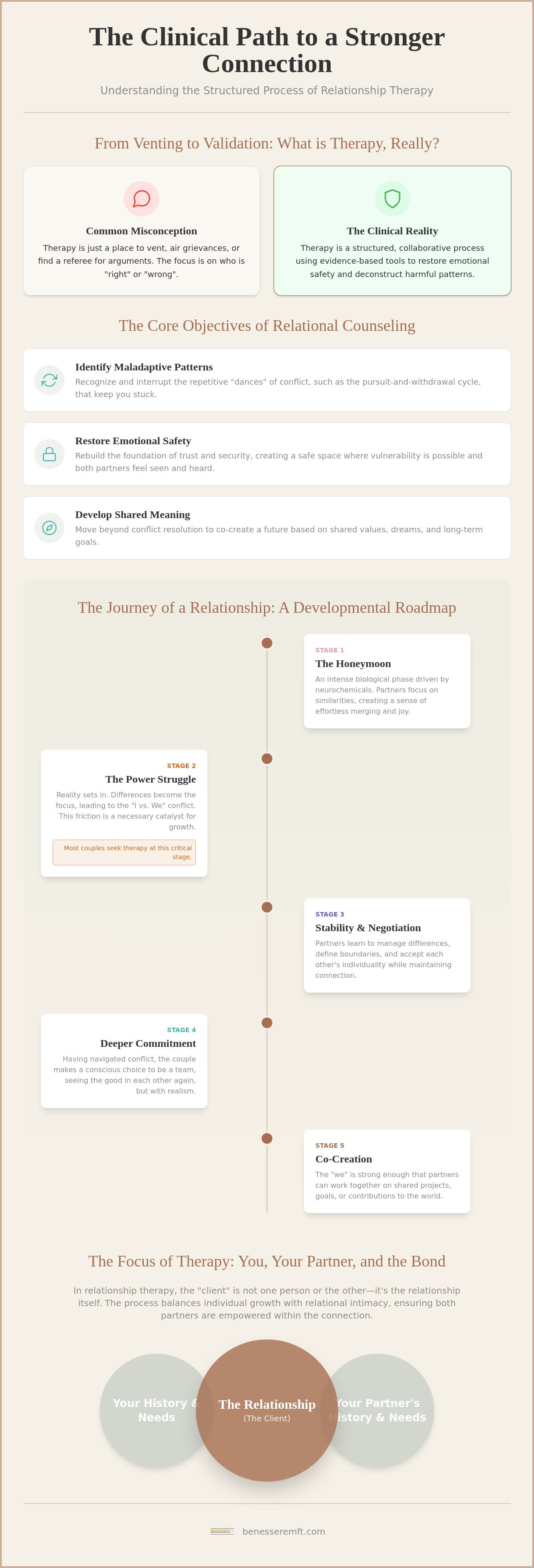
Relationship therapy is often misunderstood as a simple forum for airing grievances or seeking a neutral judge to settle disputes. In reality, it is a collaborative clinical process designed to deconstruct the invisible scripts that dictate how two people interact. This professional intervention moves beyond the surface of daily arguments to examine the underlying architecture of a partnership. By utilizing a structured framework, partners can transition from a state of reactive conflict to one of intentional connection.
One of the most significant distinctions in a clinical setting is the move away from "venting." While expressing frustration is a natural part of the human experience, a therapist ensures that these expressions serve a restorative purpose. Unlike casual conversations with friends or family, sessions rely on evidence-based interventions that prioritize the health of the bond itself. This Clinical Overview of Couples Therapy highlights how practitioners use specific methodologies to facilitate change rather than just observing discord. The therapist acts as a steady, professional guide, providing a safe container where complex emotions are handled with both scientific precision and human warmth.
The Core Objectives of Relational Counseling
The primary goal of any clinical intervention is to provide clarity where there was once confusion. This involves a methodical approach to several key areas:
Identifying Maladaptive Patterns: We often fall into repetitive "dances" of pursuit and withdrawal. Therapy helps identify these cycles so they can be interrupted.
Restoring Emotional Safety: Without a sense of security, vulnerability is impossible. We work to rebuild the foundation that allows both partners to feel seen and heard.
Developing Shared Meaning: Beyond resolving conflict, therapy encourages couples to co-create a future based on shared values and long-term goals.
Individual vs. Joint Growth in Therapy
In relationship therapy, the "client" is not just one person or the other; it's the relationship itself. This concept is vital because it acknowledges that while each individual brings their own history and mental health challenges to the table, the focus remains on how those elements interact. An individual's struggle with anxiety or past trauma inevitably impacts the partnership, yet the therapeutic process seeks to balance personal autonomy with relational intimacy. You don't have to lose your sense of self to find a deeper connection. Instead, the process teaches you how to maintain your own resilience while contributing to a healthy, integrated whole. This balance ensures that growth is sustainable and that both partners feel empowered within the connection.
Understanding the 5 Stages of a Relationship
Relationships don't simply exist in a static state; they evolve through a series of predictable developmental stages. While many couples believe that a healthy partnership should remain in a state of perpetual harmony, the clinical reality is that friction is a natural and necessary part of relational evolution. Understanding these stages provides a roadmap for couples who feel lost, helping them recognize that their current struggles are often indicators of growth rather than signs of failure. Most couples enter relationship therapy during the second stage, often referred to as the Power Struggle, where the initial "merging" of the honeymoon phase begins to fracture under the weight of reality.
Therapy acts as a guiding framework during these transitions, offering a safe space to navigate the shift from idealization to authentic connection. By identifying where you currently stand in this developmental model, you can begin to see your partner not as an adversary, but as a fellow traveler on a complex journey toward lasting intimacy.
From Romance to the Power Struggle
The Honeymoon Phase is characterized by an intense biological high, where partners focus almost exclusively on similarities and shared joy. During this period, neurochemicals like dopamine and oxytocin create a sense of effortless merging, often masking potential incompatibilities. Eventually, this phase transitions into the Power Struggle, where the "I vs. We" conflict takes center stage. In this stage, the focus shifts toward differences, and partners may attempt to change one another to regain the comfort of the earlier phase.
This shift can be disorienting, yet it is essential to recognize that the Power Struggle serves as a necessary catalyst for growth, forcing individuals to define their boundaries while maintaining connection. Clinical approaches like Imago Relationship Therapy specifically target this stage, teaching couples how to transform conflict into a healing dialogue. Instead of viewing disagreement as a threat, you learn to see it as an opportunity to deepen your understanding of each other's inner worlds.
Stability, Commitment, and Bliss
Couples who successfully navigate the power struggle move into the Stability Phase. Here, you learn to accept your partner’s differences without judgment or the urgent need to "fix" them. It's a period of cooling down, where emotional safety is restored through mutual respect. In this phase, the tools gained during relationship therapy become integrated into daily life, allowing for a deeper level of acceptance and a more realistic view of the partnership.
The Commitment Phase follows, representing a conscious decision to stay together despite a clear-eyed understanding of each other's flaws. This is not a choice made out of habit, but a proactive dedication to the partnership's health. Finally, the stage of Co-Creation or Bliss involves moving toward a shared life purpose. In this final developmental stage, the relationship becomes a platform for both partners to contribute to the world around them, achieving a sense of synergy. If you find yourself stuck in the repetitive cycles of the power struggle, seeking couples therapy can provide the tools needed to transition into a more stable and fulfilling commitment.
Evidence-Based Methodologies in Relationship Therapy
Modern relationship therapy relies on a sophisticated toolbox of clinical styles, each designed to address specific relational wounds. When we speak of "evidence-based" practices, we refer to methodologies that have been rigorously studied and proven effective in clinical settings. This scientific grounding ensures that your sessions aren't merely anecdotal; they're guided by a clear, restorative logic. Research indicates that approximately 71% of people who attend Couples Therapy see a measurable improvement in their relationship satisfaction. This success often stems from the integration of psychoeducation, which provides partners with the literacy they need to understand their own psychological responses during moments of tension.
By utilizing varied clinical styles, a therapist can tailor the intervention to the unique needs of the partnership. Some couples require structured communication tools, while others need to deconstruct long-standing emotional barriers. The clinical path is not a one-size-fits-all solution, but a collaborative effort to find the right combination of techniques that resonate with your specific history and goals.
The Gottman Method and Narrative Therapy
One of the most prominent frameworks in the field is the Gottman Method, which focuses on identifying specific communication behaviors that predict relationship dissolution. By teaching "antidotes" to reactive patterns like defensiveness or stonewalling, this approach creates a more stable environment for dialogue. While Gottman focuses on the mechanics of interaction, narrative therapy offers a different perspective by helping couples externalize their problems. Instead of viewing the partner as "the problem," this method treats the conflict as a separate entity that both individuals can work together to overcome. This shift is vital for moving past historical blame and co-creating a new, collaborative story for the future.
Trauma-Informed and Emotionally Focused Care
Relational conflict is rarely just about the present moment. Often, current arguments are fueled by past trauma or PTSD triggers that remain unresolved. A trauma-informed approach recognizes these sensitivities, providing a safe container for partners to explore their vulnerabilities without fear of judgment. This involves a heavy emphasis on emotional regulation, teaching you how to stay present when your nervous system feels overwhelmed. For those dealing with significant past experiences, integrating trauma therapy Roseville into the relational work can be a transformative step toward deeper healing. By addressing these underlying triggers, couples can move from a state of constant high alert to one of genuine emotional safety and resilience.
Signs Your Relationship Could Benefit from Clinical Support
Professional support is often viewed as a last resort, yet waiting for a crisis to occur can make the path to restoration significantly more difficult. A common misconception persists that relationship therapy is reserved only for partnerships on the brink of dissolution. In a clinical context, we view therapy as a form of preventative maintenance. Just as we prioritize physical health through routine check-ups, relational health requires proactive attention to ensure that small fractures don't evolve into structural breaks. Normalizing the act of seeking help before a crisis occurs allows couples to build a foundation of resilience that can weather future storms.
Identifying the subtle indicators that your connection needs support is a skill in itself. Often, the signs aren't explosive; they're quiet shifts in how you interact and perceive one another. By recognizing these red flags early, you can engage in a collaborative process of repair before resentment becomes deeply entrenched.
Communication and Conflict Red Flags
Communication breakdowns are one of the most frequent reasons couples seek professional guidance. Clinical research identifies four specific behaviors that signal a need for intervention: criticism, contempt, defensiveness, and stonewalling. When these patterns become the default mode of interaction, the emotional safety of the relationship is compromised. You might find yourselves trapped in cyclical arguments that never reach a resolution, leaving both partners feeling exhausted and unheard. If you recognize these patterns, learning specific techniques for resolving marriage conflict can help you break the cycle and return to a state of mutual respect.
Emotional and Intimacy Indicators
Not all relational distress is loud. Sometimes, the most significant indicator is a quiet drift toward "Roommate Syndrome," where partners live parallel lives with little emotional or physical connection. You may find that you've stopped sharing your inner world, or that the "spark" has been replaced by a neutral, business-like co-existence. It's helpful to compare your current state against the established signs of a healthy relationship to see which pillars of connection may have eroded over time. Significant life transitions, such as the arrival of a new baby or the shift into retirement, can also strain a partnership's existing coping mechanisms. If you feel the distance growing, you can schedule a consultation for couples therapy to begin the work of closing the gap and restoring intimacy.
The Benessere Approach: Relationship Therapy in Roseville
At Benessere MFT, we view relationship therapy as a deeply personal and collaborative endeavor. Our commitment to the Roseville community is rooted in the belief that every partnership possesses a unique history that deserves a tailored clinical approach. We move away from standardized models, opting instead for a restorative framework that respects your individual story. By creating a calm, safe space, we ensure that complex emotions are handled with both scientific precision and human warmth. This environment allows you to lower your defenses and engage in the honest work of rebuilding your connection without the fear of judgment.
Our focus on restorative mental health means we don't just look for what's "broken." Instead, we work with you to identify the strengths that already exist within your bond. The therapist acts as a wise guide, facilitating a process where both partners feel empowered to contribute to the relationship's evolution. This collaborative relationship between the practitioner and the couple ensures that the path forward is one you've built together, supported by professional expertise and deep-seated empathy.
A Clinical Path to Connection in Roseville
Each session at our practice is designed to address the specific dynamics of your relationship. We integrate psychoeducation to empower you with the tools needed to manage emotional triggers and communication breakdowns independently. This educational component is vital for long-term resilience, as it provides a clear framework for improvement outside the therapy room. Our local focus on marriage and family therapy Roseville CA ensures that our interventions are grounded in the specific needs of our community, blending licensed clinical expertise with a trauma-informed perspective that honors your unique relational story.
Next Steps: Embarking on the Restorative Journey
Taking the first step toward relationship therapy can feel daunting, yet it's often the most significant move toward reclaiming your peace. In your first session, you can expect an unhurried, methodical assessment of your relationship's current state and your shared goals. We prioritize the "fit" between the couple and the therapist, as a strong therapeutic alliance is a key predictor of successful outcomes. It's essential that both partners feel equally heard and respected throughout this process. We invite you to begin this restorative journey, where the focus isn't on blame, but on the inherent possibility of growth and a deeper understanding of the person you've chosen to walk through life with.
Reclaiming Your Relational Resilience
Sometimes, building this foundation involves resolving external pressures such as financial debt or legal disagreements. In these instances, seeking professional counsel from experts like the Law Offices of Matthew T. Desrochers, P.C. can offer the expertise in family law and debt relief needed to support a couple’s long-term stability.
At Benessere MFT, we blend evidence-based clinical skillsets with specialized trauma-informed care to support your growth. Our local Roseville expertise is offered with a compassionate heart, ensuring that your unique story is handled with the precision and warmth it deserves. You don't have to navigate these challenges alone. Begin your restorative journey with Benessere MFT today. There is an inherent possibility for growth in every struggle, and we're here to guide you toward a deeper, more intentional connection with your partner.
Frequently Asked Questions
How long does relationship therapy usually take to see results?
The duration of the therapeutic process varies based on the complexity of the relational wounds and the couple's commitment to the work. While some partners report a sense of relief after just a few sessions, meaningful and lasting change typically requires several months of consistent engagement. A structured clinical path often involves an initial assessment phase followed by active skill-building, allowing couples to integrate new patterns into their daily lives over time.
What if my partner refuses to attend therapy with me?
You can still begin your own restorative journey through individual psychotherapy if your partner is not yet ready to participate. When one individual in a partnership changes their approach to conflict and communication, it often creates a shift in the entire relational system. This proactive step can provide you with the emotional regulation skills and clarity needed to navigate the partnership, even if you're currently working on these challenges independently.
Is relationship therapy the same as marriage counseling?
These terms are often used interchangeably, but relationship therapy is frequently viewed as a broader clinical term that encompasses all forms of partnership. Whether you're married, cohabitating, or in a long-term commitment, the focus remains on the health of the connection itself. This approach utilizes evidence-based methodologies to address interpersonal dynamics, regardless of the legal status of the union, ensuring that the work is tailored to your specific relational structure.
Can therapy help if there has been an affair or betrayal?
Yes, professional intervention is specifically designed to help couples navigate the profound loss of trust that follows an affair. A trauma-informed approach allows both partners to process the pain of betrayal in a safe, controlled environment. By utilizing structured dialogue and restorative techniques, couples can work toward deconstructing the events that led to the rupture and slowly co-create a new foundation of transparency and emotional security.
How do we know if we have found the right therapist for us?
Finding the right "fit" involves assessing whether both partners feel seen, heard, and respected by the practitioner. A wise guide should maintain a professional distance that inspires confidence while demonstrating deep-seated empathy for your unique story. You've likely found the right match when the therapist provides a sense of clinical authority that lowers your defenses and creates a secure space where you feel safe exploring complex and vulnerable emotions together.
What is the success rate of relationship therapy?
Clinical research indicates that approximately 71% of people who attend relationship therapy see a measurable improvement in their partnership. Studies have consistently shown a positive impact on relationship satisfaction for 70% to 80% of couples. These statistics highlight the efficacy of evidence-based interventions, especially when partners are willing to engage in the collaborative and educational process of deconstructing old narratives to build a more resilient future.
Will the therapist tell us if we should break up?
A therapist's role isn't to make decisions for you, but to provide the clarity and skillsets you need to make an informed choice yourself. We act as neutral facilitators who highlight maladaptive patterns and help you understand whether the connection is salvageable. The goal is to restore emotional safety so that you can decide, with a clear mind and a full heart, what the healthiest path forward is for both individuals.
Is relationship therapy covered by insurance in California?
Most health insurance plans don't provide coverage for couples therapy unless one partner has a diagnosed mental health condition that requires joint sessions. However, some practitioners offer "superbills" that you may submit to your insurance provider for potential reimbursement. It's also important to note that under federal law, therapists are required to provide a "Good Faith Estimate" of expected charges if you aren't using insurance for your care.


Comments