
Resolving Marriage Conflict: Evidence-Based Strategies for Lasting Connection
- Eddie Posadas
- 4 hours ago
- 12 min read

What if the recurring arguments that leave you feeling exhausted aren't evidence of a failing relationship, but are actually a biological invitation to restructure how you connect? When you're caught in a cycle of blame and defense, it's natural to feel unheard or fear that you've simply grown apart. Many couples find themselves trapped in these patterns, yet research from 2026 indicates that 71% of people who attend couples therapy see significant improvement in their relationship. Resolving marriage conflict isn't about the absence of disagreement; it's about developing the clinical and emotional tools to navigate friction with precision and grace.
You've likely felt the weight of silence after a fight or the frustration of a conversation that circles the same drain. We believe that these struggles are a normal part of the human experience and offer a profound path toward growth. In this guide, you'll discover professional, restorative techniques designed to transform marital friction into a foundation for lasting intimacy. We'll provide a clear framework for handling future disagreements, moving from a place of reactive defense to a collaborative state where you and your partner feel like a team again.
Table of Contents
Understanding Marriage Conflict: Why Disagreement is Normal
Marital conflict isn't a sign of incompatibility; it's the natural result of two distinct life narratives attempting to weave together. Each partner brings a unique history, a set of values, and a specific emotional architecture to the union. When these elements inevitably clash, the resulting friction is often misinterpreted as a fundamental flaw in the relationship. In the field of professional marriage and family therapy, we view these moments as indicators of where the relationship is asking for more depth and clarity.
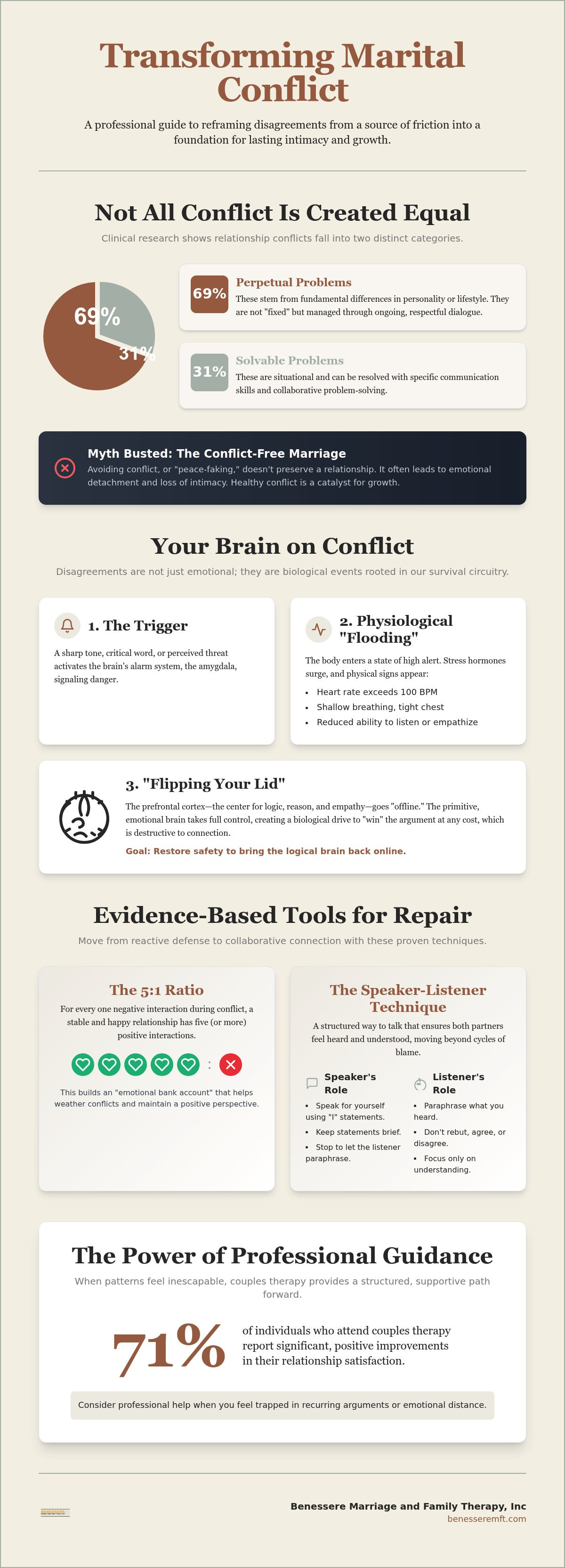
Clinical research suggests that nearly 69% of relationship conflicts are perpetual, meaning they stem from fundamental differences in personality or lifestyle that may never fully disappear. These aren't problems to be "fixed" in the traditional sense, but rather managed through ongoing, respectful dialogue. The remaining 31% are solvable problems, which are situational and can be addressed with specific communication skillsets. Understanding this distinction is the first step in resolving marriage conflict without the weight of unnecessary shame or the fear that the partnership is failing.
Often, a heated argument is actually a bid for connection that has been poorly translated. When a partner feels ignored or undervalued, their attempt to reach out might manifest as criticism or frustration. Recognizing the underlying need for proximity can change the entire trajectory of an argument, turning a moment of friction into a restorative opportunity for mutual support.
The Myth of the Conflict-Free Marriage
Many couples believe that "good" relationships are characterized by constant harmony. This misconception often leads to "peace-faking," where partners suppress their true feelings to avoid discomfort. While this might create a temporary veneer of calm, it frequently results in emotional detachment and a loss of intimacy. Silence isn't safety. Avoiding conflict doesn't preserve the relationship; it simply postpones the necessary work of repair and can eventually lead to a total breakdown of communication.
When Conflict Becomes a Catalyst for Growth
When handled with precision and empathy, disagreement serves as a mirror, highlighting the specific areas where a couple needs to evolve. Resolving marriage conflict through a restorative lens builds relational resilience, proving to both partners that the bond is strong enough to hold their complex truths. Restorative conflict is a collaborative process where disagreements are used as data points to foster deeper understanding and long-term intimacy by 2026 standards.
The Science of Disagreement: Your Brain on Conflict
To understand the mechanics of resolving marriage conflict, we must first look at the biological architecture of the human brain. While we like to believe our disagreements are purely intellectual or emotional, they are deeply rooted in our survival circuitry. Understanding The Science of Disagreement reveals that when a partner uses a sharp tone or a critical word, your amygdala may perceive it as a threat to your safety. This triggers the fight, flight, or freeze response, shifting the body's resources away from logic and toward defense.
When this happens, you experience what clinicians call diffuse physiological arousal, or "flooding." This is a state where your heart rate exceeds 100 beats per minute and your system is saturated with stress hormones like cortisol and adrenaline. In this biological state, your ability to process information or empathize with your partner is physically compromised. If you have a history of trauma, your nervous system may be even more sensitized, causing you to reach this state of flooding much faster than others.
The Neurobiology of the 'Flip'
During a heated argument, the prefrontal cortex, which is the part of the brain responsible for complex reasoning and empathy, effectively goes offline. We call this "flipping your lid." You lose access to your "logical brain," leaving the amygdala in total control. This creates a biological drive to "win" the argument at any cost. While winning feels like a form of safety to your primitive brain, it is actually destructive to the relationship. You cannot engage in meaningful repair when your body is convinced it is under attack. Physical signs of this shift include shallow breathing, a tight chest, or a sudden inability to hear what your partner is actually saying.
Emotional Regulation as a Foundation
Restoring a sense of safety is the only way to move back into a collaborative state. The most effective tool for this is the 20-minute break rule. Research shows it takes at least twenty minutes for the body to metabolize stress hormones and for the nervous system to return to the "Window of Tolerance." During this time, you shouldn't ruminate on the fight. Instead, focus on self-soothing through deep breathing or a neutral activity like walking or reading.
The first step toward resolving marriage conflict is recognizing that you cannot solve a relational problem while in a state of biological threat. If your arguments frequently lead to this type of shutdown, engaging in couples therapy can help you map these triggers and build the regulation skills needed for lasting connection. Once both partners are calm, the prefrontal cortex can come back online, allowing for the empathy and nuance required for true resolution.
Productive vs. Destructive Conflict Patterns
The health of a marriage isn't determined by the absence of disagreement, but by the specific patterns that emerge when those disagreements occur. Research by the Gottman Institute indicates that stable, happy couples maintain a 5:1 ratio; for every one negative interaction during a conflict, there are five positive ones. This ratio acts as an emotional buffer, allowing the relationship to withstand the weight of difficult conversations. When this balance shifts, the path toward resolving marriage conflict becomes significantly more challenging.
How a conversation begins is also a critical predictor of its success. A "harsh start-up," characterized by blame or immediate judgment, leads to a negative outcome in 96% of cases. Conversely, a "softened start-up" focuses on the speaker's feelings and a specific positive need. This invites the partner into a collaborative space rather than a defensive one, setting a tone of mutual respect from the outset.
Identifying the Four Horsemen in Your Marriage
Certain behaviors act as clinical indicators of relational distress. Criticism differs from complaining; while a complaint addresses a specific behavior, criticism attacks the partner's character. The antidote is the softened start-up. Contempt is even more destructive, involving sarcasm, cynicism, or a sense of superiority. It's the strongest predictor of relationship dissolution because it erodes the foundation of respect. To counter this, couples must actively build a culture of appreciation. Defensiveness often follows, where a partner shifts blame to avoid responsibility, effectively blocking any chance of resolution. Partners must practice accepting even a small part of the responsibility to move forward. Finally, stonewalling occurs when one partner withdraws entirely, often as a response to the physiological flooding discussed previously. The remedy here is proactive self-soothing and a planned return to the conversation.
The Power of Validation and Repair
Successful couples aren't those who never fail, but those who excel at repair. A "repair attempt" is any statement or action, small or large, that prevents negativity from escalating out of control. It might be a brief apology, a touch on the arm, or a self-deprecating joke. For these attempts to work, the partner must be willing to "turn toward" the bid for connection rather than turning away or against it. This is a fundamental skill in resolving marriage conflict effectively.
Validation is another essential skill that fosters safety. It's the act of acknowledging your partner's emotional reality without necessarily agreeing with their perspective. When you validate, you're saying, "I can see why you feel that way." This creates the security needed to accept influence from one another. By allowing your partner's needs to weigh into your decision-making, you move from a competitive stance to a unified, restorative team.
Evidence-Based Techniques for Resolving Marriage Conflict
Moving from a theoretical understanding of conflict to practical resolution requires a structured approach. One of the most effective tools for resolving marriage conflict is the refined "I" Statement formula. Instead of beginning with a "you" statement that often triggers the biological defense mechanisms discussed earlier, you state your experience clearly: "I feel [emotion] about [event] and I need [positive need]." This shift provides your partner with a roadmap for support rather than a list of failures, making it easier for them to stay engaged and empathetic.
To ensure both parties feel truly heard, we often recommend the Speaker-Listener technique. In this exercise, one partner holds the floor while the other's only job is to listen and then paraphrase what they heard before responding. This prevents the common pitfall of formulating a rebuttal while the other person is still speaking. For issues that feel like a perpetual gridlock, the "Dream Within Conflict" method is invaluable. It involves looking past the surface level of the argument to discover the underlying values, hopes, or "dreams" that each partner is trying to protect. Understanding the "why" behind a position can soften even the most rigid disagreements.
If you find that these techniques are difficult to implement on your own, working with a clinician to develop couples therapy skills can provide the guided practice needed to make these habits permanent. Professional support offers a safe container to test these new ways of interacting.
Rewriting the Narrative of the Argument
In our practice, we utilize Narrative Therapy to help couples externalize the conflict. Instead of viewing your spouse as the problem, you identify a third party, such as "The Misunderstanding" or "The Resentment," that is interfering with your connection. By naming the vicious cycle you get caught in, you can join forces against the pattern itself. This mental shift from "You vs. Me" to "Us vs. The Problem" fosters a collaborative spirit, allowing you to fight the cycle together rather than fighting each other.
Practical Communication Exercises
Consistency is the foundation of relational health. We encourage couples to establish a "Weekly State of the Union" meeting, a dedicated hour to discuss the relationship's temperature and address small grievances before they accumulate. This meeting should always begin with a softened start-up, focusing on what is working well. Using regular expressions of appreciation creates a reservoir of emotional goodwill that makes resolving marriage conflict more intuitive during times of high stress. By proactively building this buffer, you ensure that the relationship remains resilient even when life becomes challenging.
Seeking Professional Marriage and Family Therapy in Roseville
While the strategies discussed previously provide a foundation for repair, there are seasons when the weight of unresolved tension requires more than self-guided effort. Recognizing when you've reached the limit of your current resources is an act of courage, not an admission of defeat. Professional intervention becomes necessary when the same vicious cycles repeat despite your best efforts, or when the emotional distance between you and your partner begins to feel insurmountable. If your disagreements have become characterized by a sense of hopelessness or a total breakdown of communication, it's likely time to invite a Wise Guide into your process.
A clinically trained third party serves as an objective observer, identifying the subtle, often invisible, mechanics of your interactional patterns. At Benessere Marriage and Family Therapy (BMFTI) in Roseville, we provide a restorative environment where complex emotions are handled with scientific precision and human warmth. Our approach is grounded in the belief that every couple possesses the capacity for growth, provided they have the right framework for resolving marriage conflict. By offering a neutral space, we help you lower your defenses and begin the work of genuine repair.
Often, what appears as a simple disagreement is actually fueled by individual histories of trauma or PTSD. Therapy provides a safe container where these deep-seated experiences can be externalized and understood without judgment. By addressing the root causes of reactivity with trauma-informed perspectives, couples can move toward a state of holistic health and resilience. This process isn't about assigning blame, but about understanding how your individual stories intersect and impact your shared life.
What to Expect in Couples Counseling
Demystifying the therapeutic process is the first step toward feeling secure in the clinical setting. The initial phase of couples counseling focuses on a comprehensive assessment and narrative exploration. Rather than simply venting grievances, you'll work with your therapist to identify the unique story of your relationship and the patterns that have kept you stuck. We use evidence-based skillsets tailored to your specific needs, helping you set clear, collaborative goals for the future. This methodical progression ensures that both partners feel seen and respected throughout the journey.
Finding the Right Fit in Roseville
When looking for support in Roseville, it's essential to find a therapist who is trauma-informed and operates within a mentored clinical environment. You deserve a guide who respects the individual stories of both partners while providing the psychological literacy needed for real change. Our team specializes in Narrative Therapy and psychoeducational approaches that make mental health concepts accessible and actionable. To learn more about our specific approach and how we support local couples, you can explore Marriage and Family Therapy Roseville CA for professional support in our community.
Restoring the Foundation of Your Partnership
Disagreement isn't a symptom of a failing union, but a call to deepen your understanding of one another. By recognizing the biological triggers of flooding and implementing structured communication, you move from a state of reactive defense to one of proactive repair. Resolving marriage conflict requires a commitment to seeing the problem as an external force rather than a character flaw in your partner. This shift in perspective, supported by evidence-based skillsets, allows you to reclaim the safety and intimacy that may have felt lost.
Our team at Benessere Marriage and Family Therapy provides the local Roseville expertise needed to navigate these complex emotional landscapes. We specialize in Narrative Therapy and trauma-informed care, offering a restorative environment where your unique stories are honored. You don't have to navigate these cycles alone. When you're ready to transform friction into a catalyst for growth, Schedule a consultation for Couples Counseling in Roseville today. Your relationship has the inherent capacity for resilience and lasting connection.
Frequently Asked Questions
Is it normal to fight every day in a marriage?
Daily friction often signals that a couple's communication patterns have become rigid or that underlying emotional needs are consistently unmet. While disagreements are a natural part of two lives intersecting, fighting every day can lead to physiological exhaustion and emotional detachment. The focus shouldn't be on the number of arguments, but on the quality of repair. If you lack the tools for resolving marriage conflict, these daily interactions can erode your partnership over time.
How do I talk to my spouse about starting therapy without them getting defensive?
Approach the conversation during a calm moment using a softened start-up that focuses on your own feelings. Instead of highlighting your partner's perceived flaws, frame the request as a desire for a deeper, more resilient connection. You might say, "I value our relationship and want us to have better tools for navigating our differences." This positions therapy as a restorative resource for the team rather than a punishment for an individual's behavior.
What should we do if one partner refuses to participate in conflict resolution?
If a partner is hesitant, you can still begin the work through individual psychotherapy to change your part of the relational dance. A marriage is an interdependent system, so changing your own responses and internal narrative often shifts the entire dynamic. By developing your own regulation skills and understanding your triggers, you can lead by example. Often, when one partner begins to show more empathy, the other feels safer and becomes more open.
Can a marriage survive contempt or chronic stonewalling?
While contempt and stonewalling are significant indicators of distress, they aren't necessarily terminal for a relationship. Survival depends on both partners' willingness to replace these destructive patterns with their clinical antidotes, such as building a culture of appreciation. Resolving marriage conflict in these cases usually requires professional guidance to move past deep-seated resentment. With dedicated effort, couples can learn to recognize these behaviors and choose more restorative ways of connecting during difficult moments.
How long does it usually take to see improvement from couples therapy?
Every couple's timeline is unique, but many begin to feel a shift in their communication within eight to twelve sessions. Initial progress often manifests as a decrease in the intensity of arguments and a faster return to a state of calm. According to a 2026 survey, 71% of people who attended couples therapy saw measurable improvement in their relationship. Lasting change involves the consistent application of new skills and a commitment to the therapeutic process.
What is the difference between a normal disagreement and an unhealthy conflict?
A normal disagreement focuses on a specific behavior or situational problem and maintains a level of mutual respect. In contrast, unhealthy conflict often involves character attacks, contempt, or a total withdrawal from the conversation. The key differentiator is the presence of repair attempts. Healthy couples may argue, but they remain a team working against a problem. Unhealthy patterns turn the partner into the enemy, making resolution feel impossible without clinical intervention.
How can we resolve conflicts about money or parenting without it escalating?
These topics often touch on deep-seated values, making them prone to escalation. To navigate them, try externalizing the issue by naming "The Financial Stress" as a shared challenge you're facing together. Use the "Dream Within Conflict" method to understand the underlying hopes or fears your partner associates with money or parenting. By shifting from a competitive stance to a collaborative one, you can find compromises that respect both partners' unique life narratives.
Can trauma from the past affect how we fight in our marriage today?
Past trauma often sensitizes the nervous system, causing a partner to perceive neutral comments as significant threats. This can lead to rapid physiological flooding, where the logical brain shuts down almost instantly. In our Roseville practice, we use trauma-informed perspectives to help couples identify these triggers. Understanding that a partner's reactivity is a biological survival response rather than a personal attack can foster the empathy needed for deeper healing and more effective communication.


Comments