
Signs of a Healthy Relationship: A Restorative Clinical Perspective

What if the most reliable indicator of a lasting bond isn't the intensity of your chemistry, but the quality of your repair after a disagreement? Many individuals find themselves caught in a cycle of high-octane passion that eventually feels unsustainable; this often leaves them questioning if they're building a foundation or simply repeating old, exhausting patterns. It's natural to feel a sense of confusion when you're trying to identify the true signs of a healthy relationship amidst the noise of modern expectations and the echoes of past hurts.
We understand that distinguishing between normal conflict and systemic issues requires both clinical precision and emotional nuance. This article provides a restorative framework to help you gain clarity on your current partnership and learn the evidence-based skills that foster long-term resilience. You'll discover how to cultivate a connection rooted in mutual safety and restorative agency. We will explore the specific clinical markers of wellness and discuss how proactive support, such as couples therapy, can help you rewrite your shared narrative into one of lasting health and quiet optimism.
Table of Contents
Beyond the Absence of Conflict: Defining a Healthy Relationship
The Pillars of Relational Wellness: Agency, Trust, and Mutual Respect
Healthy Interdependence vs. Codependency: Recognizing the Nuance
Cultivating Connection: Evidence-Based Skills for Everyday Life
When to Seek Professional Support: Couples Therapy in Roseville
Beyond the Absence of Conflict: Defining a Healthy Relationship
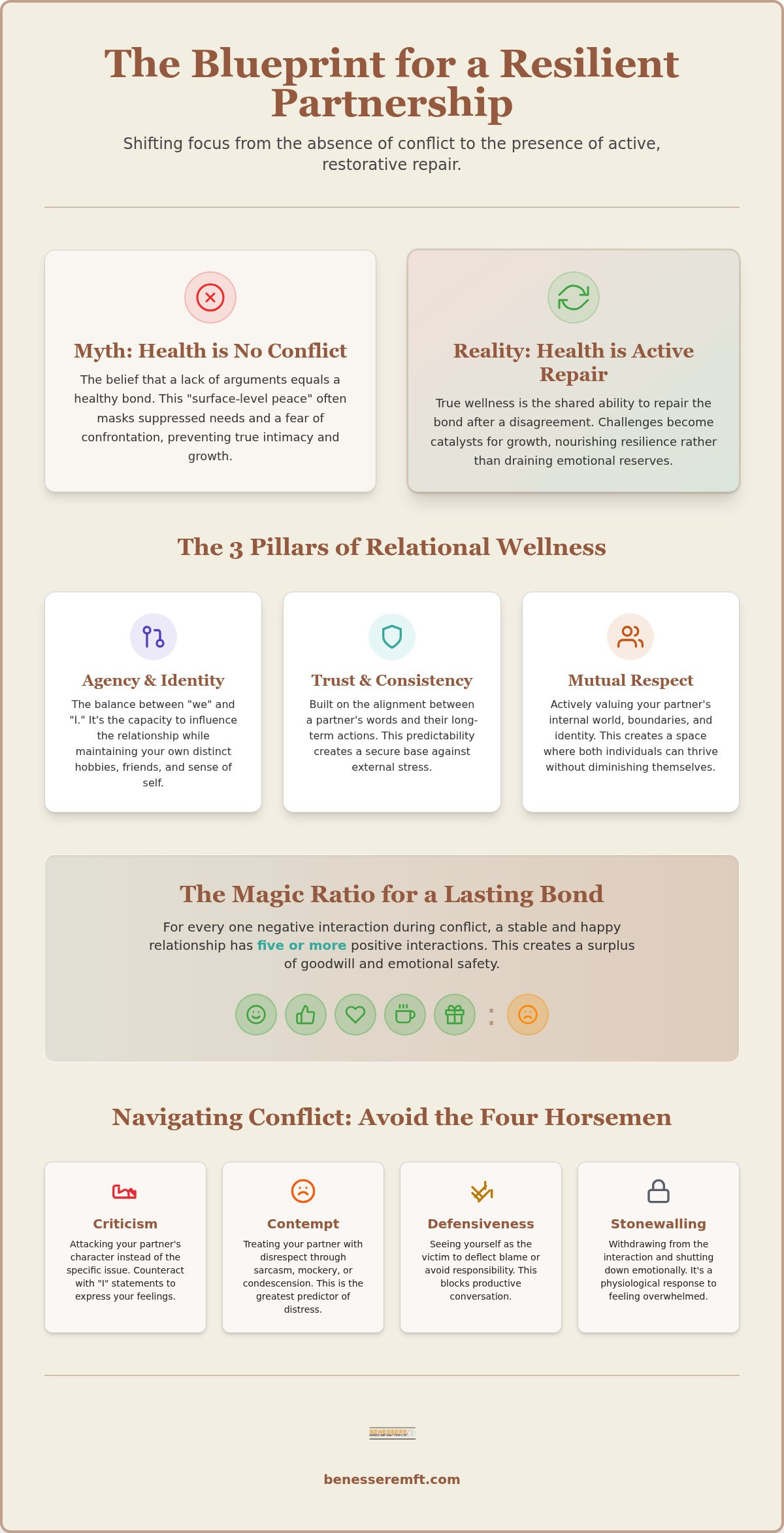
Many individuals mistakenly believe that the absence of arguments is the ultimate goal of a partnership. However, from a clinical perspective, true wellness is an active and evolving process rather than a static destination. When understanding interpersonal relationships, we must look past "surface-level peace," which often masks suppressed needs or a fear of confrontation. Authentic health isn't found in the silence of avoided topics, but in the vibrant, sometimes messy work of staying connected through life's inevitable stressors.
One of the most significant signs of a healthy relationship is the presence of restorative agency. This is the shared belief that both partners have the power to influence the bond and repair it when it feels strained. A restorative relationship doesn't just survive challenges; it uses them as catalysts for growth. It's a dynamic that heals the participants by offering a safe harbor to process individual and shared difficulties, effectively nourishing your capacity for resilience rather than draining your emotional reserves.
Healthy conflict is actually a marker of a high-functioning partnership. It signals that both individuals feel secure enough to disagree without fearing the end of the connection. When evaluating the signs of a healthy relationship, clinicians look for the ability to move through disagreement toward a state of mutual understanding and adjusted behavior. The focus shifts from "winning" an argument to preserving the integrity of the bond.
The Role of Emotional Safety
Emotional safety serves as the bedrock for every other marker of relational health. Without it, vulnerability feels like a risk rather than a bridge to intimacy. Emotional safety is the nervous system's ability to remain regulated in a partner's presence. When this foundation is solid, you can express deep-seated fears or unmet needs without triggering a defensive "fight or flight" response. This regulation allows for a calm, non-judgmental exchange of ideas, even during moments of high emotional stakes.
Relational Agency and Your Unique Story
Agency refers to your capacity to influence the direction of the relationship while maintaining your distinct sense of self. It's the balance between "we" and "I." Through narrative therapy, couples can learn to rewrite shared stories that have become dominated by conflict or past trauma. By externalizing the problem, you can reclaim your agency and view the relationship as a collaborative project. Maintaining separate identities, hobbies, and social circles isn't a sign of distance; it's a proactive way to ensure your partnership remains a choice made by two whole individuals who choose to walk together.
The Pillars of Relational Wellness: Agency, Trust, and Mutual Respect
Relational wellness rests on a foundation of observable behaviors that demonstrate a deep commitment to your partner's psychological safety. One of the primary signs of a healthy relationship is mutual respect, which manifests as a profound regard for a partner's boundaries. Respect isn't just about avoiding harm; it's about actively valuing your partner's internal world as much as your own. This creates a space where both individuals can thrive without feeling the need to diminish their identities to maintain the connection.
Trust serves as the structural integrity of this bond. Identifying the signs of a healthy relationship requires looking at the consistency between a partner's words and their long-term actions. When behavior is predictable and aligned with promises, it lowers the nervous system's defenses. This predictability allows the relationship to become a secure base, providing a necessary buffer against the external stressors of a demanding world.
Communicating with Precise Precision
Effective communication requires more than just talking; it involves the clinical skill of listening to understand rather than listening to respond. High-functioning couples use "I" statements to own their emotional experiences, which prevents the other person from feeling attacked or blamed. This approach is essential for neutralizing the "Four Horsemen" of criticism, contempt, defensiveness, and stonewalling. These behaviors are known clinical predictors of relationship distress that can be managed through intentional emotional regulation. To improve daily connection, partners can practice a stress-reducing conversation where each person shares their feelings without receiving unsolicited advice.
Building Trust Through Micro-Moments
Trust is often built in small, seemingly insignificant interactions known as bids for connection. A bid might be a brief comment about a news story, a physical touch, or a request for help. When you turn toward these bids, you deposit relational capital into an emotional bank account that sustains you during leaner times. This transparency extends to digital and physical spaces, where an open-book policy fosters a sense of shared reality. For those struggling to maintain these foundations, professional couples therapy can provide the structured guidance needed to restore these essential pillars.
Shared values also play a critical role in long-term sustainability. While you don't need to agree on every minor preference, aligning on major life trajectories, such as financial goals, family structures, and core ethics, ensures that you're moving in the same direction. This alignment allows for a partnership that feels like a collaborative journey rather than a constant negotiation of fundamental truths.
Healthy Interdependence vs. Codependency: Recognizing the Nuance
Distinguishing between a deep, secure connection and a loss of self is a vital part of recognizing the true signs of a healthy relationship. In a clinical context, we look for interdependence, which is the ability to rely on one another for support while maintaining a robust sense of individual identity. This differs significantly from codependency, where an individual's emotional state is entirely dictated by their partner's moods or behaviors. When you're caught in a codependent cycle, your internal peace feels fragile because it's tied to an external source you can't control.
The transition from "needing" to "choosing" your partner marks a restorative path toward relational wellness. Trauma-informed care helps us understand that codependent patterns often emerge as survival strategies from past experiences where safety was conditional or inconsistent. By identifying these origins with empathy, you can begin to reclaim your agency. You move away from a desperate need for external validation and toward a conscious, daily choice to share your life with another whole person. This shift lowers the pressure on the partnership and allows for more authentic intimacy.
The Spectrum of Connection
Finding the "Goldilocks zone" of relational closeness requires constant, intentional calibration. On one end of the spectrum lies enmeshment, where boundaries are so porous that it's difficult to tell where one person's needs end and the other's begin. On the opposite end is detachment, a state of emotional distance that leaves both partners feeling isolated despite being together. Utilizing marriage and family therapy Roseville CA frameworks allows couples to navigate this spectrum with clinical precision. It provides the necessary tools to build a connection that is secure but not suffocating, ensuring that the bond remains a source of strength rather than a source of stress.
Individual Growth as a Relationship Asset
A common misconception is that a partner's evolution is a threat to the stability of the bond. In reality, pursuing personal hobbies and maintaining separate friendships are essential signs of a healthy relationship. These individual life paths provide fresh energy and new perspectives to the partnership, preventing the stagnation that often leads to resentment. A Wise Guide views the intersection of two evolving individuals as a source of relational resilience. Supporting your partner's growth, even when it feels unfamiliar or slightly threatening, demonstrates a commitment to their holistic health. It signals that the relationship is a safe space for mutual flourishing rather than a container for limitation.
Cultivating Connection: Evidence-Based Skills for Everyday Life
Maintaining a resilient partnership requires the consistent application of evidence-based skillsets that nourish the bond daily. One of the clearest signs of a healthy relationship is the practice of regular "Relational Check-ins." These scheduled moments provide a safe space to address minor frictions before they evolve into systemic issues. Clinical research suggests that successful couples maintain a 5:1 ratio of positive to negative interactions. This surplus of goodwill creates an emotional buffer, ensuring that the occasional disagreement doesn't destabilize the entire connection.
Boundaries around work, family, and technology are equally vital for long-term relational health. In an era of constant connectivity, intentionally carving out space for emotional intimacy is a proactive choice. This means prioritizing deep conversation and shared experiences over the passive consumption of digital media. By establishing these limits, you protect the relationship from being drained by external demands, allowing you to prioritize physical and emotional closeness as equal pillars of your wellness.
The Art of Restorative Conflict
Conflict is an inevitable part of any partnership, but its impact is determined by how you navigate the friction. "Fair fighting" rules, such as avoiding global generalizations like "always" or "never," keep discussions focused on specific behaviors rather than character flaws. If an argument becomes too heated, a self-regulation timeout is necessary. This is a deliberate pause of at least twenty minutes to allow the nervous system to return to a state of calm. Perhaps the most critical skill is the repair attempt. A repair attempt is any statement or action, whether a joke or a soft touch, that prevents negativity from escalating out of control and signals a desire for reconnection.
Psychoeducation: Understanding Your Brain in Love
When we experience relationship stress, the amygdala often triggers a "fight, flight, or freeze" response. This biological hijack can make us say things we don't mean or shut down entirely, making productive conversation impossible. Conversely, chemicals like oxytocin and dopamine facilitate the deep bonding and pleasure that sustain long-term connections. Understanding the physiological basis of your stress response can significantly reduce the shame associated with relationship struggles. By recognizing these biological drivers, you can approach yourself and your partner with more compassion and precision. If you're finding it difficult to implement these restorative habits, Couples Therapy can provide the clinical guidance needed to navigate these complex neurological dynamics.
When to Seek Professional Support: Couples Therapy in Roseville
Seeking professional support is often misunderstood as a reactive measure to a failing partnership. In reality, one of the most proactive signs of a healthy relationship is the willingness to invite a neutral, clinical perspective into your shared world. Even high-functioning couples benefit from the structured guidance of a therapist to refine their communication and deepen their emotional intimacy. At Benessere MFT, our approach is evidence-based and restorative, focusing on the normalization of human struggles rather than the pathologizing of individual behaviors.
Identifying "yellow flags" is a key part of this process. These aren't catastrophic events, but rather subtle shifts in the relationship's weather. You might notice a recurring argument that never reaches a resolution or a gradual decrease in the frequency of your bids for connection. When these patterns emerge, a trauma-informed clinical team can help you identify the origins of these behaviors with scientific precision and human warmth. Our goal is to help you rewrite your story, moving away from cycles of conflict and toward a shared narrative of resilience and mutual safety.
Moving Beyond the Stigma of Therapy
Viewing therapy as preventative maintenance is a shift that honors the importance of your bond. It's similar to how we care for our physical health through regular check-ups. In your first session at Benessere MFT, you can expect a calm, safe space where we prioritize building a collaborative relationship. We move beyond simple venting to provide structured, clinical couples counseling in Roseville. This process involves identifying specific goals and learning the evidence-based skillsets that sustain long-term wellness.
Next Steps for Your Relationship
Bringing up the idea of counseling to a partner can feel daunting, but it's best approached as an invitation to collaborate on your future. Frame the conversation around your desire for a deeper connection rather than a list of your partner's perceived faults. When evaluating therapist credentials in Placer County, look for a clinical fit that feels steady and non-judgmental. It's essential to find a practitioner who respects your individual stories while guiding you toward a unified path of growth. Schedule a consultation with a Wise Guide at Benessere MFT today.
Cultivating Your Restorative Partnership
Identifying the signs of a healthy relationship involves looking beyond the surface of daily interactions to the deeper mechanics of emotional safety and mutual respect. We've explored how true wellness is found in the presence of active repair and the ability to maintain your individual identity while building a shared life. By implementing evidence-based skills like the 5:1 positivity ratio and regular check-ins, you can create a foundation that's resilient enough to handle life's stressors. It's about moving from a state of reactive survival to a place of intentional, restorative connection.
If you're ready to move from confusion toward clinical clarity, our trauma-informed team offers the expertise needed to help you rewrite your story. We combine evidence-based clinical expertise with a restorative approach in our convenient Roseville office to foster lasting growth. Take the first step toward a restorative connection; book a session at Benessere MFT today. Your journey toward a more fulfilling partnership is a vital part of your holistic health, and choosing to seek guidance is an act of profound hope.
Frequently Asked Questions
What are the three most important signs of a healthy relationship?
The three most vital signs of a healthy relationship are emotional safety, restorative repair, and maintained individual agency. Emotional safety ensures both partners feel secure expressing vulnerabilities without fear of retaliation. Restorative repair allows couples to resolve conflicts effectively, while agency ensures each person remains a whole individual. These markers create a foundation where the partnership nourishes both people rather than draining their emotional reserves over the long term.
Can a relationship be healthy if we argue frequently?
A relationship can be healthy despite frequent arguments if the quality of your repair is high and respectful. Clinical wellness isn't defined by the absence of conflict but by how you navigate disagreements without resorting to contempt or defensiveness. If you can move through friction toward mutual understanding, the conflict becomes a tool for growth. However, frequent arguments without resolution may suggest a need for evidence-based skillsets to improve your communication.
How do I know if my relationship is codependent or just close?
The distinction lies in whether you maintain your sense of self while relying on your partner. In a healthy, close relationship, you experience interdependence, where you support each other but remain emotionally autonomous. Codependency occurs when your internal state is entirely dictated by your partner's moods or behaviors. If you feel you've lost your individual hobbies or friendships to sustain the bond, it's a sign you may need to reclaim your agency.
Is it a bad sign if we want to go to couples therapy?
Seeking couples therapy is a proactive sign of relationship health rather than a signal of failure. It demonstrates that both partners value the bond enough to invest in its long-term resilience. Many couples in Roseville use therapy as "preventative maintenance" to address small issues before they become systemic. Our Wise Guides at Benessere MFT view this step as a courageous commitment to rewriting your shared story and strengthening your emotional foundation.
What should I do if only one partner wants to work on the relationship?
If only one partner is ready for change, starting with individual psychotherapy can still positively influence the relationship dynamic. When one person changes their reactions and sets healthier boundaries, the entire system of the relationship must adjust. This individual work often provides the clarity needed to handle relational stress more effectively. At our Roseville office, we help individuals develop the skillsets to manage their side of the partnership with precision and empathy.
How do I set boundaries without hurting my partner's feelings?
Setting boundaries is most effective when framed as a way to protect the connection rather than a way to push a partner away. Use clear "I" statements to explain your needs, such as "I need thirty minutes of quiet time after work so I can be fully present with you later." This approach reduces defensiveness by focusing on your internal experience. It's a restorative practice that ensures both partners feel respected and understood within the bond.
How long does it typically take to see results from couples counseling?
While every story is unique, many couples begin to notice shifts in their communication after 12 to 20 sessions. This timeframe, typically spanning three to six months, allows enough space to integrate new evidence-based skillsets into daily life. Some partnerships may require longer support for deep-seated trauma, while others find clarity sooner. The goal is to build sustainable habits that foster long-term resilience and a lasting sense of mutual safety in Roseville.
What are some 'green flags' to look for in a new partner?
Green flags in a new partner include consistent accountability, respect for your boundaries, and a high degree of emotional regulation. Look for someone whose actions consistently align with their words over a long-term period. A healthy partner will support your individual growth and maintain their own separate interests. These behaviors are clinical indicators that the person is capable of building a secure, interdependent bond that respects your unique story and needs.


Comments