
Talk Therapy in Roseville: A Restorative Guide to Personalized Mental Health Care
- Eddie Posadas
- Aug 5
- 12 min read

Updated: 4 days ago
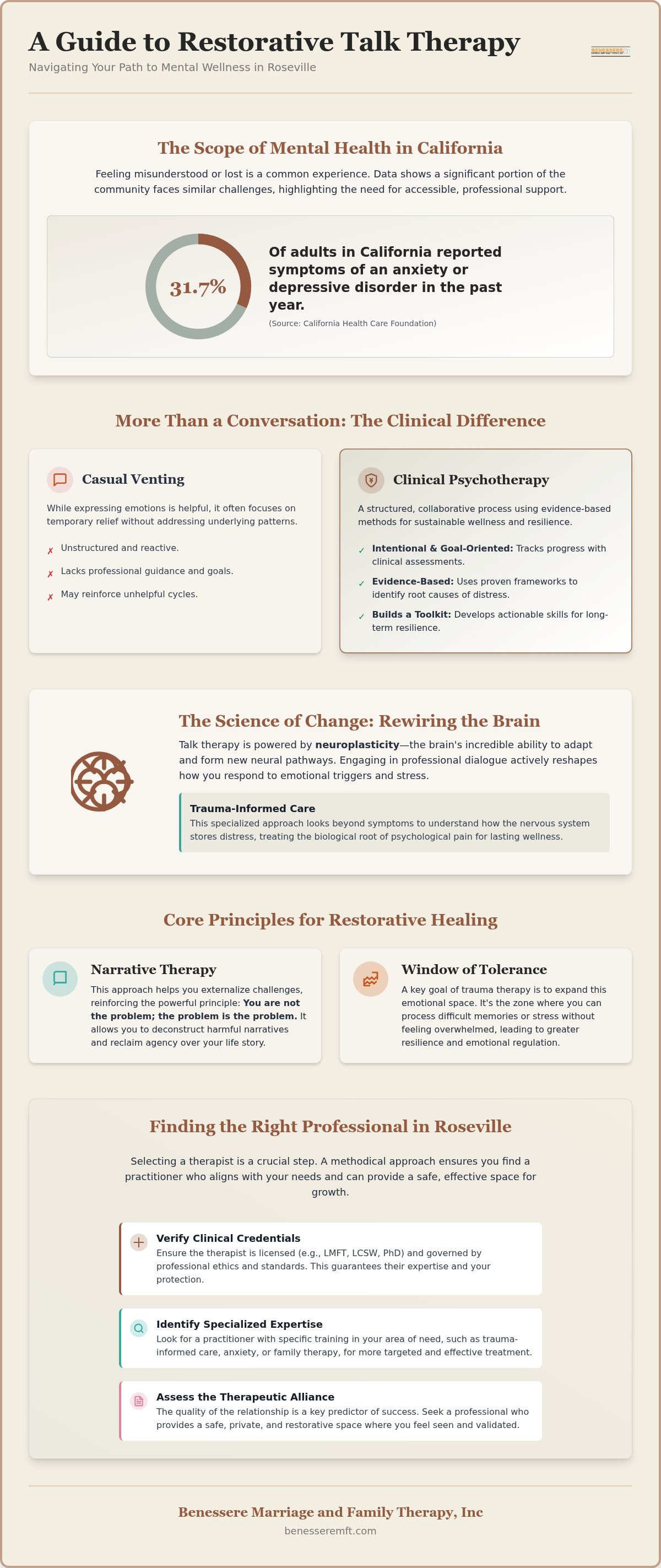
Approximately 31.7% of adults in California reported symptoms of an anxiety or depressive disorder in the past year, according to data from the California Health Care Foundation. For many in Placer County, these aren't just numbers; they represent the daily weight of feeling misunderstood or lost in a sea of generic providers. You might feel a sense of hesitation about the perceived coldness of clinical settings, yet you're searching for talk therapy Roseville that offers more than just a listening ear. It's natural to want a professional who sees the person behind the symptoms and respects the complexity of your journey.
This article serves as your restorative guide to finding personalized mental health care that honors your individual experience. You'll discover how professional talk therapy in Roseville can help you navigate life's complexities through evidence-based clinical expertise and compassionate guidance. We'll look at the importance of deconstructing harmful narratives and building lasting resilience. By the end, you'll understand how to identify a local expert who can help you process trauma and develop the actionable skillsets needed to reclaim agency over your own life story.
Table of Contents
Talk Therapy: Why It's Essential for Mental Wellness
Understanding What is talk therapy begins with recognizing it as a structured, collaborative clinical process. It's not merely a conversation; it's a professional partnership designed to help individuals deconstruct complex emotional patterns. In our local community, talk therapy Roseville has become a vital resource for those seeking to move beyond temporary relief toward sustainable wellness. Engaging in talk therapy Roseville allows for a focused exploration of your life story within a safe, professional environment where your experiences are validated and handled with scientific precision.
Many people initially mistake therapy for simply "venting" about their week. While expressing emotions is a necessary component, clinical psychotherapy involves a strategic shift toward evidence-based intervention. This means using specific psychological frameworks to identify the root causes of distress rather than just addressing surface-level symptoms. It's about building a toolkit of resilience that remains effective long after the session ends. Through this process, mental health struggles are normalized as part of the human experience, rather than viewed as personal failures.
The Clinical Difference: Venting vs. Psychotherapy
Professional therapy relies on structured goals and ongoing clinical assessments to track your progress toward healing. Unlike a casual chat with a friend, the therapeutic alliance between a practitioner and a client is a specialized relationship governed by ethics and scientific methodology. Therapists use evidence-based skillsets to help you process trauma or manage anxiety. This structured approach ensures that every session serves a clear purpose in your restorative journey, providing a sense of stability when life feels chaotic.
Common Reasons Roseville Residents Seek Support
Residents in Placer County often face unique stressors, from the demands of high-pressure careers to the intricacies of navigating family transitions. It's common to feel a sense of overwhelm when self-help books or generic advice no longer provide the clarity you need. Recognizing when to transition to professional guidance is a sign of strength. For instance, seeking a therapist for family issues early can prevent relational patterns from becoming deeply entrenched and difficult to change.
At its core, this process is also about psychoeducation. By understanding the mechanics of how your mind and body respond to stress, you gain a sense of agency over your life. When we handle complex emotions with both clinical authority and human warmth, we create a path toward genuine growth. This collaborative effort empowers you to stop reacting to your environment and start responding with intention and clarity.
The Science of Change: How Talk Therapy Rewires the Brain
The human brain is remarkably adaptable. This quality, known as neuroplasticity, serves as the scientific foundation for why talk therapy Roseville is so effective. When you engage in professional dialogue, you aren't just sharing stories; you're actively reshaping the neural pathways that dictate your emotional and behavioral responses. At Benessere Marriage and Family Therapy, Inc. (BMFTI), our focus remains on restorative mental health. This approach recognizes that genuine healing isn't just about suppressing a symptom. It's about integrating your life experiences into a cohesive, resilient whole through a methodical clinical process.
Trauma-informed care represents a significant departure from general counseling. While general support offers a helpful space to be heard, trauma-informed practitioners look deeper into how the nervous system stores past distress. This scientific precision allows us to treat the root causes of psychological pain rather than just the surface-level reactions. By understanding the biological mechanics of your struggles, we can move toward a state of lasting wellness and stability. It's a collaborative effort that respects the complexity of your unique history while providing the tools for a different future.
Processing Trauma and Restoring Resilience
Effective trauma therapy in Roseville focuses on expanding what clinicians call the "window of tolerance." This is the emotional space where you can process stress or difficult memories without becoming overwhelmed or shutting down. Through specific regulation techniques, you can learn to stay grounded even when navigating the complexities of PTSD symptoms. Clinical safety is paramount in this process. A stable, non-judgmental environment signals to the brain's alarm system that the immediate threat has passed, which finally allows the restorative process to begin.
Evidence-Based Modalities Explained
We utilize several proven frameworks to support this neurological shift. Cognitive Behavioral Therapy (CBT) is a primary tool for managing anxiety, helping you identify and reframe the thought patterns that trigger physical stress responses. Psychoeducation also plays a vital role in our work. By learning how your brain responds to perceived threats, you can transform a confusing emotional experience into a manageable biological one. We don't apply these tools in a rigid, one-size-fits-all manner. Instead, we tailor each intervention to ensure it honors your specific story and goals. If you're ready to explore how these clinical methods can support your growth, individual psychotherapy offers a structured and compassionate path forward.
Beyond the Symptoms: Understanding Narrative Therapy
While understanding the neurological basis of change is essential for healing, the clinical process also requires a deep exploration of the stories we tell ourselves. Narrative therapy is a specialized approach that views individuals as the experts of their own lives. It moves beyond a narrow focus on symptoms to help you reclaim agency by examining the influence of dominant, often negative, narratives. In the context of talk therapy Roseville, this means looking at how societal expectations or past traumas have shaped your sense of self. A core tenet of this work is "externalizing the problem." This perspective asserts that you are not the problem; the problem is the problem. By separating your identity from the challenges you face, you create the necessary psychological distance to address them with clarity and scientific precision.
This collaborative approach handles complex emotions with both clinical authority and human warmth. It provides a calm, safe space where you can investigate the origins of your struggles without the weight of self-blame. By identifying the external forces that contribute to your distress, you can begin to see your life through a more restorative lens. This isn't just about changing your perspective; it's about fundamentally altering your relationship with the challenges you encounter every day.
Rewriting Your Unique Story
Negative narratives often become so dominant that they obscure your moments of strength and resilience. When you experience chronic depression or low self-worth, it's common to only remember events that support a "failure" story. The clinical goal of talk therapy Roseville is to identify "unique outcomes," which are specific instances where you resisted a problem's influence or acted in alignment with your values. By highlighting these moments, you become the primary author of your life story. This methodical investigation into your lived experience empowers you to see your inherent capacity for growth and change.
Narrative Therapy for Couples and Families
This approach is particularly effective in resolving long-standing relational conflicts that feel insurmountable. Often, families become trapped in shared negative cycles where blame is the primary form of communication. Through marriage and family therapy in Roseville, clinicians help families deconstruct these harmful patterns together. By externalizing the conflict, family members can stop seeing each other as the enemy and start working together against a shared problem, such as "the silence" or "the anger." This shift from blame to collaborative problem-solving is a hallmark of restorative psychotherapy. It provides a steady, non-judgmental framework for restoring home harmony and strengthening relational bonds.
How to Choose the Right Talk Therapist in Roseville, CA
Selecting a professional to guide your mental health journey is a decision that deserves careful consideration. With the Roseville area hosting approximately 328.3 mental health providers per 100,000 population, the abundance of choice can paradoxically make the search feel more difficult. Finding effective talk therapy Roseville involves looking beyond a simple directory listing to identify a clinician who offers both scientific precision and a restorative presence. This process is best approached through five methodical steps that ensure your care is both safe and tailored to your needs.
First, verify the clinician's credentials. In California, Licensed Marriage and Family Therapists (LMFT), Licensed Clinical Social Workers (LCSW), and Licensed Professional Clinical Counselors (LPCC) must complete a relevant master's degree and 3,000 hours of supervised experience. Second, seek out specialized training that aligns with your specific challenges, such as trauma or anxiety. Third, use the initial consultation to assess the therapeutic fit; you should feel heard and respected. Fourth, consider the logistics of the practice, including its location and availability. Finally, evaluate the therapist's communication style. It should feel authoritative yet deeply empathetic, creating a stable foundation for your growth.
Navigating Licensing and Specialties
A common misconception is that Marriage and Family Therapy (MFT) is only for couples or groups. For individual clients, an MFT provides a unique perspective by examining how your relational history and environment shape your current state of being. It's essential to prioritize "evidence-based" care, which means the interventions used are backed by clinical research. Quality practices also emphasize ongoing mentorship and advanced training for their clinicians, ensuring that the care you receive is informed by the latest developments in psychological literacy. This commitment to professional growth directly translates to better outcomes for your personal resilience.
For an example of a clinical practice that prioritizes these high standards of evidence-based care, Your Psychologist offers specialized schema therapy and counseling designed to help individuals navigate complex emotional patterns and achieve lasting resilience.
Local Considerations for Roseville Residents
The environment where therapy takes place is as important as the dialogue itself. For many in Placer County, choosing a practice located near the I-80 corridor provides easy access and reduces the stress of a long commute. Local therapists who live and work in the community understand the specific cultural and economic landscape of Roseville, from the pressures of high-stakes careers to the nuances of local family life. A professional office should serve as a calm, safe space that feels physically and emotionally separate from the stressors of daily life. If you're ready to begin this collaborative process, individual psychotherapy at a local private practice can provide the personalized support you need.
The Benessere Path: Restorative Psychotherapy in Roseville
Benessere Marriage and Family Therapy, Inc. (BMFTI) operates as a private clinical practice dedicated to facilitating deep, lasting change. Unlike large corporate therapy chains that often prioritize volume over depth, our approach centers on the restorative power of a personalized therapeutic relationship. We believe that human struggles are a natural part of life, and we handle these challenges with a blend of scientific precision and profound empathy. Our office environment is intentionally designed to be professional and sophisticated, providing a calm sanctuary where you can step away from the noise of Placer County to focus on your wellness.
Starting talk therapy Roseville with our team begins with an unhurried initial contact, followed by a thorough clinical assessment. This methodical progression ensures that we understand the nuances of your history before developing a tailored treatment plan. We don't believe in generic advice; instead, we provide a structured path toward resolution that respects your pace and your specific goals. By integrating various evidence-based modalities, we create a stable framework for you to process past experiences and build a more resilient future.
Personalized Care for Individuals and Families
Our practice places a high value on individual psychotherapy in Roseville, recognizing that personal growth often serves as the foundation for relational health. We integrate psychoeducation into every session, empowering you with a clear understanding of how your mind and body respond to stress. This collaborative process involves setting specific clinical goals, ensuring that our work together remains focused and effective. Whether you're seeking support for yourself or your family, our clinicians are mentored in tailored interventions that honor your unique life story while providing the tools for emotional regulation.
Taking the First Step Toward Healing
We acknowledge the significant courage it takes to begin talk therapy Roseville and reach out for professional support. It's common to feel a mix of hesitation and hope as you look for a path forward. At BMFTI, you'll find a non-judgmental, quietly optimistic environment where your story is handled with the seriousness and respect it deserves. We're here to help you deconstruct the narratives that no longer serve you and rebuild a sense of agency over your life. If you're ready to transition from merely managing symptoms to experiencing genuine restorative growth, we invite you to explore your path toward resolution with us.
Reclaiming Your Story Through Restorative Care
The journey toward mental wellness is built on the understanding that your struggles are a natural part of the human experience. We've explored how the clinical application of neuroplasticity and narrative therapy allows you to deconstruct harmful cycles and rebuild a sense of agency. By prioritizing evidence-based clinical skillsets and specialized trauma-informed care, you ensure that your healing process is grounded in scientific precision. Finding the right professional for talk therapy Roseville is a significant step toward integrating your life experiences into a narrative of resilience and growth.
This process is most effective when conducted within a sophisticated, safe office environment that respects your need for privacy and calm. At Benessere Marriage and Family Therapy, Inc., we're committed to providing that steady, non-judgmental guidance as you navigate life's complexities. You don't have to carry the weight of your story alone. It's possible to move beyond simply managing symptoms toward a state of genuine restoration and hope.
We look forward to supporting you as you step into a future defined by clarity, connection, and emotional stability.
Frequently Asked Questions
What is the difference between a therapist and a psychiatrist?
A therapist focuses on the psychological and relational aspects of mental health through talk therapy, while a psychiatrist is a medical doctor who primarily manages mental health through medication. Our practice specializes in the clinical dialogue and evidence-based skillsets that facilitate behavioral change and emotional healing. If your specific treatment plan requires medication, we recommend coordinating with a psychiatric professional to ensure a holistic and integrated approach to your mental wellness.
How long does talk therapy typically take to see results?
The timeline for seeing results in talk therapy Roseville is unique to each person's story and the complexity of their challenges. While some individuals report a sense of relief after just a few sessions, deep-seated restorative work often requires a more consistent, long-term commitment. We focus on sustainable growth rather than quick fixes, ensuring that the changes you experience are deeply integrated into your overall resilience and emotional regulation.
Is talk therapy in Roseville covered by my health insurance?
Coverage for mental health services depends entirely on your specific health insurance provider and the details of your plan. It's essential to contact your insurance company directly to verify your out-of-network benefits or co-payment requirements for psychotherapy. Under federal law, if you're uninsured or not using insurance, you have the right to receive a "Good Faith Estimate" for the expected cost of your clinical care before your sessions begin.
What should I expect during my first therapy session?
Your initial session is a collaborative clinical intake where we gather your history and define your specific goals for healing. It's a time to establish a safe, professional connection and discuss the challenges that brought you to our practice today. We handle this process with scientific precision and human warmth, ensuring you feel respected as we begin to map out a tailored treatment plan for your restorative journey.
Can talk therapy help with physical symptoms of anxiety?
Talk therapy can effectively address physical symptoms of anxiety by helping you understand and regulate your nervous system's response to stress. We use psychoeducation to explain how the brain triggers physical sensations like a racing heart or shallow breathing. By expanding your window of tolerance and learning specific grounding techniques, you can regain control over your body's physiological reactions and reduce the intensity of your anxiety symptoms.
Is online therapy as effective as in-person sessions at your Roseville office?
What is the difference between 'counseling' and 'psychotherapy'?
Counseling typically addresses specific, short-term situations or behaviors, whereas psychotherapy involves a deeper exploration of long-standing psychological patterns and past trauma. Talk therapy Roseville at our practice falls under the category of psychotherapy, focusing on the deconstruction of harmful narratives. This methodical approach allows for more comprehensive healing by addressing the root causes of your distress rather than just providing temporary coping strategies for immediate life stressors.
How do I know if I need individual therapy or family therapy?
Individual therapy is ideal for focusing on personal growth and processing internal experiences, while family therapy is designed to address negative cycles within a relational system. If your primary distress stems from personal anxiety or trauma, individual sessions are often the most effective starting point. However, if the challenges involve shared communication patterns or home harmony, a collaborative family approach might be more appropriate for achieving a lasting resolution.


Comments