
Therapy for Blended Families in Roseville: A Restorative Guide to Local Support

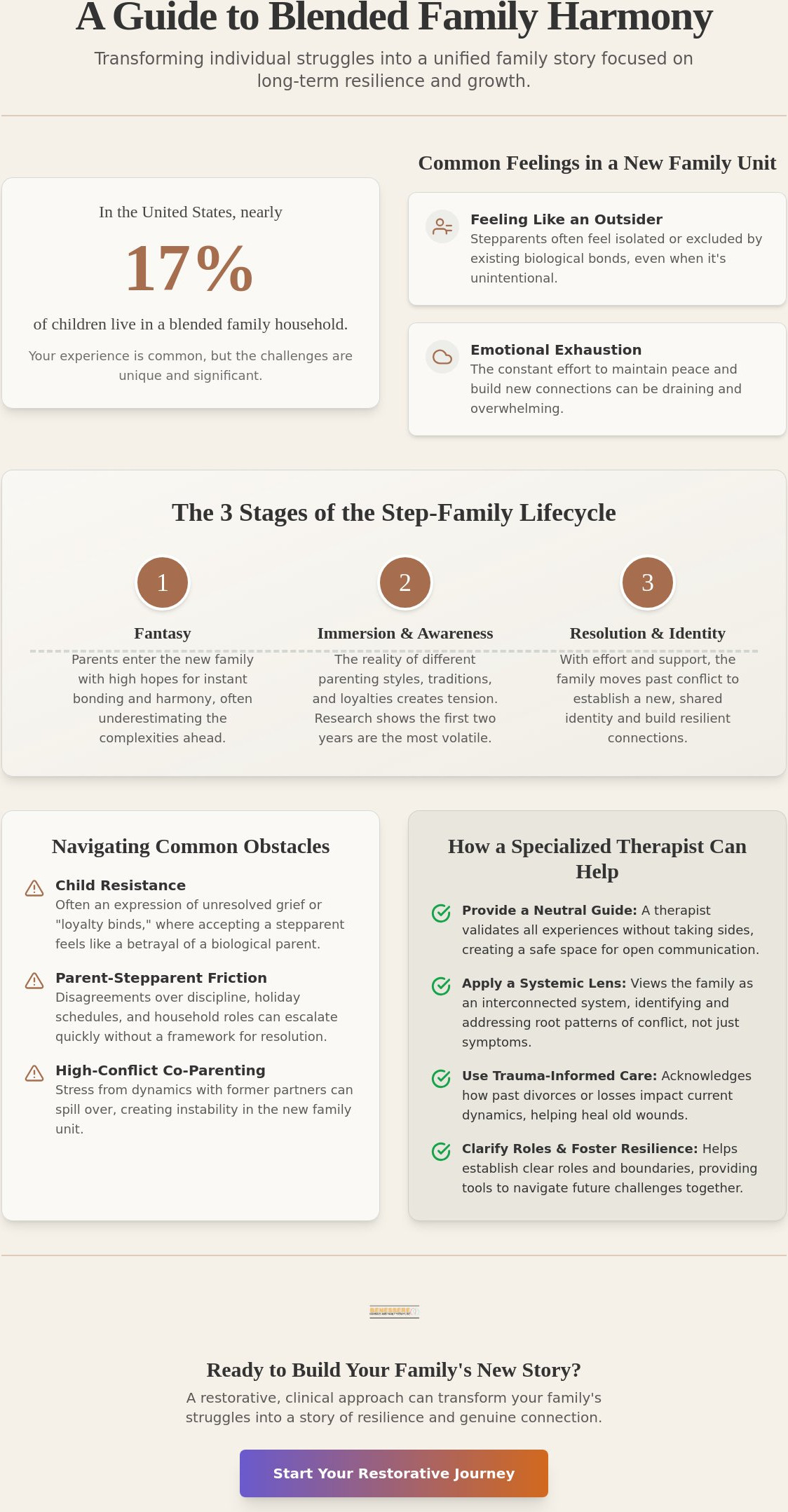
Nearly 17% of children in the United States live in a blended family, a statistic that highlights just how common your experience is; however, it doesn't diminish the unique weight of your daily challenges. When you're navigating the complexities of merging two distinct households, it's natural to encounter resistance from children or feel the strain of high-conflict co-parenting dynamics. Seeking therapy for blended families Roseville provides a structured, compassionate environment where these delicate transitions can be managed with professional precision and genuine empathy.
You may currently feel like an outsider in your own home or worry that the friction between new family members is irreparable. It's understandable to feel exhausted by the effort of maintaining peace while trying to build a new life together. This guide will show you how specialized family therapy can help your household resolve deep-seated conflicts and create a cohesive new story. We'll examine the restorative tools available to help you foster resilience, clarify roles, and ensure that every member of your family feels seen and valued in this new chapter.
Table of Contents
Understanding the Unique Dynamics of Therapy for Blended Families in Roseville
Merging two distinct family cultures is rarely a seamless transition. It's a complex psychological undertaking that requires more than just good intentions. A therapist specializing in therapy for blended families Roseville acts as a neutral guide, providing a steady hand as you navigate the intricate process of household mergers. Many stepparents enter this journey feeling like an outsider in their own home, watching from the periphery as biological bonds create an invisible but palpable barrier. This exclusion isn't usually intentional, yet it creates a profound sense of isolation that can destabilize the primary partnership.
Traditional approaches often overlook how individual trauma from past divorces or losses informs current reactions. When a child resists a new family structure, it's frequently an expression of unresolved grief rather than simple defiance. By understanding Clinical Modalities that Support Blended Family Harmony, we can address these loyalty binds, where children feel that accepting a stepparent is a betrayal of their biological parent. These hidden frictions require a specialized lens that recognizes the family as a series of overlapping systems rather than a single, uniform unit.
The "Step-Family" Lifecycle
Integration typically follows a predictable lifecycle, beginning with a "fantasy" stage where parents hope for instant bonding. This often shifts into a period of immersion and awareness where the reality of different parenting styles and traditions creates tension. Clinical research indicates the first two years are the most volatile for new units. During this window, triggers like holiday scheduling or discipline disagreements can escalate. Distinguishing between normal adjustment stress and clinical family conflict is vital; the latter involves persistent patterns of withdrawal or hostility that prevent the family from reaching the final stage of resolution and shared identity.
Why Local Roseville Families Seek Specialized Support
Families in Roseville often face unique pressures while maintaining harmony in high-stress suburban environments. The fast-paced nature of local professional and school commitments can leave little room for the slow, intentional work of family bonding. Seeking therapy for blended families Roseville locally ensures that frequent sessions involving multiple family members remain accessible and sustainable. The restorative goal of this work is to move the household from a state of mere tolerance to one of genuine, resilient connection. It's about honoring the past while building a stable, supportive future together.
Criteria for Choosing a Therapist for Family Issues in Roseville
Selecting a clinician is a pivotal step in your family’s restorative journey. It requires more than just finding a nearby office; it involves identifying a practitioner who understands the specific architecture of a stepfamily unit. You should prioritize professionals with specialized training in Marriage and Family Therapy (MFT). These clinicians are educated to view the family as an interconnected system rather than a collection of isolated individuals. This systemic perspective is essential when seeking therapy for blended families Roseville, as it ensures the therapist looks at the relational patterns between everyone in the household.
A trauma-informed lens is also a non-negotiable criterion. Given that 40% of all new marriages in the U.S. are remarriages, many families enter the blending process while still carrying the emotional weight of past divorce or loss. The right therapist will acknowledge these histories without letting them dictate your future. This specialized focus is necessary because Understanding the Unique Dynamics of Therapy for Blended Families reveals that the structural foundations of step-units differ significantly from nuclear units. Your provider must remain a neutral third party, avoiding the trap of taking sides or validating one person's perspective at the expense of another's trust.
Evaluating Clinical Expertise and Modalities
Effective support goes beyond simple venting sessions. Look for a practice that utilizes narrative therapy to help family members externalize their problems, viewing the "conflict" as the enemy rather than each other. Emotionally Focused Therapy (EFT) is another vital tool, as it strengthens the couple-bond which serves as the family's new foundation. Additionally, your therapist should provide psychoeducation, helping parents understand that child resistance is often a developmentally appropriate response to structural change rather than a personal rejection.
Local Logistics for Roseville Residents
Proximity matters for families in Placer County, especially when coordinating "conjoint sessions" that involve different subsets of the family. You might need sessions for just the siblings, just the couple, or the entire household. Inquire about evening availability to accommodate school-age children and working parents. A local Roseville expert will also be familiar with regional school districts and other mental health resources, allowing for a more integrated approach to your family's care. If you're ready to explore how these clinical frameworks can support your household, our team at Benessere Marriage and Family Therapy, Inc provides the specialized expertise needed to navigate these transitions.
Clinical Modalities that Support Blended Family Harmony
The clinical framework for therapy for blended families Roseville must be as multifaceted as the families themselves. We don't view your household as a collection of separate problems but as a dynamic system in transition. Family Systems Theory serves as the foundational bedrock of this approach, treating the new household as an organism where a change in one part inevitably impacts the whole. This perspective is vital because it shifts the focus from individual blame to systemic adjustment, allowing every member to see their role in the family’s collective health.
By utilizing family conflict therapy, we can identify generational patterns that might be unconsciously replicated in the new merger. It's common for parents to bring parenting scripts from their own childhoods that clash with their new partner's expectations. Recognizing these origins provides the clarity needed to choose a new, shared path forward. While deep systemic work is essential, we also integrate Cognitive Behavioral Therapy (CBT) to manage immediate behavioral outbursts. It's a practical addition that helps family members develop emotional regulation skills for the heat of the moment. Instead of reacting with defensiveness, you'll learn to pause and respond with intention.
The "Wise Guide" approach characterizes our collaborative process. We aren't here to lecture or impose a rigid structure; instead, we invite your family into a clinical process that respects each individual's pace. This steady, non-judgmental guidance lowers defenses and builds the security necessary for genuine growth. It's a methodical progression from identifying specific triggers to establishing long-term relational resilience.
Narrative Therapy: Rewriting the Stepfamily Script
Using narrative therapy allows a family to externalize conflict. We move from a "broken family" story to a "resilient merger" story where the problem is viewed as an external force rather than a personality trait of a child or stepparent. This technique is particularly effective for children who feel they've lost their agency during the merger. By inviting them to help write the family's new chapter, we foster a sense of belonging and control. When the family fights the problem instead of each other, the path to resolution becomes much clearer.
Trauma-Informed Care for Previous Transitions
Previous transitions often leave ghosts in the room—unresolved grief or fear from past relationships that colors present interactions. Our focus on trauma therapy Roseville supports individual healing within the larger family context. We work to create a "felt sense" of safety, especially for children of divorce who may be hyper-vigilant about further change. This trauma-informed care ensures that the new family structure is built on a foundation of security rather than survival, allowing for the integration of all life experiences into a holistic, healthy future.
Navigating Common Obstacles in the "Blending" Process
Many parents hesitate to begin therapy for blended families Roseville because they fear the clinical process might inadvertently alienate their children. This concern is valid; children often feel that their family life is being redesigned without their consent. However, professional intervention doesn't force children into a new mold. Instead, it provides a safe, restorative space where their resistance is heard and validated. When a child feels understood rather than managed, their need to rebel against the new structure often diminishes. We work to ensure that therapy acts as a bridge, not a barrier, to deeper connection.
Obstacles often manifest through the "disengaged" stepparent or the "over-protective" biological parent. These roles are frequently defensive mechanisms rooted in individual trauma from previous relationship failures. A stepparent might withdraw to avoid the pain of potential rejection, while a biological parent might over-function to shield their children from further change. Recognizing these behaviors as trauma responses rather than personality flaws allows the couple to approach each other with empathy. Stability for the entire household depends on the couple remaining the core of the family unit; when the primary partnership is secure, the children feel a sense of structural safety that allows them to eventually settle into their new roles.
Resolving Parenting and Discipline Discrepancies
Developing a unified parenting plan is a critical step in reducing household friction. We focus on introducing the stepparent as an "ally" or a "mentor" rather than a direct replacement for a biological parent. This distinction respects biological boundaries while allowing the stepparent to build a unique, non-threatening bond with the children. During family sessions, we help you establish clear, shared household values that apply to everyone. This creates a predictable environment where discipline is based on agreed-upon principles rather than individual whims, reducing the "you're not my dad/mom" conflict that often arises during transitions.
Managing High-Conflict Co-Parenting with Ex-Partners
External pressures from high-conflict ex-partners can easily bleed into the new family unit, creating a state of perpetual hyper-vigilance. Setting firm, clinical boundaries is necessary to protect your new household from this external stress. We teach emotional regulation techniques that help you remain steady when dealing with difficult co-parenting dynamics. It's essential to maintain a restorative balance where the needs of the new unit are prioritized without neglecting the logistical realities of shared custody. If your family is struggling to find this equilibrium, our Family Therapy services in Roseville offer the strategic support needed to insulate your home from outside conflict and foster internal peace.
Benessere MFT: A Restorative Approach to Your Family’s Story
Benessere Marriage and Family Therapy, Inc. stands as a clinical leader in Placer County, offering a sophisticated space where families can untangle the complexities of their shared lives. Our approach to therapy for blended families Roseville is rooted in the belief that every household possesses an inherent capacity for resilience and restorative growth. We don't apply a one-size-fits-all template to your family’s situation. Instead, our clinicians carefully tailor each intervention to honor your specific history, cultural values, and immediate needs. By combining scientific precision with human warmth, we help you transition from a state of reactive conflict to one of proactive connection.
Our practice emphasizes evidence-based treatment, ensuring that every strategy we suggest is grounded in psychological literacy and proven clinical frameworks. We provide authoritative guidance that doesn't lecture, but rather invites you into a collaborative process of discovery. This methodical approach ensures that no family member feels rushed or overlooked, allowing the new family story to unfold at a pace that feels secure for everyone involved. It's about moving beyond the "broken" narrative and recognizing the strength required to build a new, integrated unit.
Collaborative Care in Roseville
Located near the heart of Roseville, our office environment is designed to feel like a calm, safe sanctuary. We understand that the decision to seek therapy for blended families Roseville often comes after months or years of trying to manage on your own. We normalize these human struggles, viewing them not as failures, but as expected challenges of the merging process. The journey begins with a comprehensive initial family assessment. This structured evaluation allows us to identify the specific systemic pressures within your household and develop a roadmap for your restorative work. Our goal is to lower your defenses and build a sense of security from the very first session.
Taking the Next Step Toward Healing
Even in the most complex family structures, the possibility of growth is always present. While we focus on the family as a whole, we recognize that individual members may also need focused attention. For this reason, individual psychotherapy Roseville is available to support personal healing alongside the family’s collective progress. This integrated approach ensures that every person has the tools they need to contribute to the family's new narrative. We encourage a steady, methodical pace that respects each member's unique journey toward healing. When you're ready to move toward a more cohesive and supportive family life, we're here to guide you through the restorative process with expertise and care.
Creating a Resilient Future for Your Blended Family
The journey of merging two households is inherently complex, yet it offers a unique opportunity for profound relational growth. By understanding the systemic nature of your family and addressing underlying loyalty binds with scientific precision, you can move past the friction of the initial transition. Specialized therapy for blended families Roseville provides the neutral, expert guidance necessary to navigate these shifts while honoring the individual stories of every family member. It's a methodical process of turning daily survival into genuine connection.
Our practice combines evidence-based clinical expertise with specialized training in family systems to support your household’s evolution. We focus on a deeply empathetic, restorative approach that prioritizes stability and long-term resilience over surface-level conflict management. You don't have to navigate these transitions in isolation. It's possible to transform current tensions into a shared foundation of trust and mutual respect. Begin your family’s restorative journey at Benessere MFT today. We look forward to helping you write a cohesive, healthy new chapter together.
Frequently Asked Questions
How long does it typically take for a blended family to feel "blended"?
Clinical observations suggest it typically takes between two and seven years for a blended family to reach a state of resolution and shared identity. This timeline is influenced by the ages of the children and the intensity of previous transitions. It's a slow, methodical process of building trust. Early years often focus on establishing stability, while later years allow for the integration of new traditions and deeper emotional bonds.
What if my child refuses to attend family therapy sessions?
Resistance is a natural response to structural changes children didn't choose. If a child refuses to attend, we often begin the work with the parents alone to establish a unified leadership core. This restorative approach focuses on changing the family's environment, which eventually encourages the child to engage. We create a safe, non-judgmental space where the child's autonomy is respected, lowering their defenses over time.
Can we start with couples therapy before involving the children?
Starting with couples therapy is often a strategic choice to ensure the primary partnership is secure before addressing broader family dynamics. A stable couple-bond serves as the foundation for the entire household's resilience. By clarifying your unified parenting plan and resolving partnership friction first, you create a more predictable and safe environment for the children when they eventually join the clinical process.
Is therapy for blended families different from regular family counseling?
Yes, therapy for blended families Roseville specifically addresses structural complexities like loyalty binds and stepparent roles that aren't present in nuclear units. This approach accounts for the influence of multiple households and previous relationship histories. We use a systemic lens to identify how these external factors impact your current home life. It's a specialized field that focuses on integration and the creation of a new, unified family narrative.
What should we look for in a therapist for family issues in Roseville?
You should prioritize a therapist with specific training in Marriage and Family Therapy (MFT) and a trauma-informed perspective. It's essential that the clinician maintains neutrality and avoids taking sides in complex household mergers. Look for a provider who offers evidence-based modalities, such as narrative or family systems theory, to ensure the work is grounded in clinical precision rather than just surface-level venting.
How can therapy help with high-conflict co-parenting situations?
Therapy provides clinical techniques for setting firm boundaries that protect your new family unit from external co-parenting stress. We focus on emotional regulation skills that allow you to remain steady when dealing with high-conflict ex-partners. This restorative work helps you move from reactive survival to a state of internal peace, ensuring that external pressures don't destabilize the security of your current home life.
Does insurance usually cover blended family therapy sessions?
Many specialized providers in Placer County operate as out-of-network clinicians; however, they often provide a superbill for potential reimbursement. Your coverage depends on your specific insurance plan's provisions for family therapy. Under federal law, you're entitled to a Good Faith Estimate of expected costs. It's best to verify your out-of-network benefits directly with your insurance carrier before beginning therapy for blended families Roseville.
What is the role of a stepparent during the first few therapy sessions?
During initial sessions, the stepparent’s role is often focused on observation and building an "ally" relationship rather than acting as a disciplinarian. This stage is about validating the children’s experiences and understanding the existing family culture. We guide stepparents in developing a non-threatening presence that respects biological boundaries. This methodical approach helps lower the children's hyper-vigilance and paves the way for genuine, long-term integration.


Comments