
When to See a Marriage Counselor: Recognizing the Clinical Indicators for Support in 2026

Updated: Aug 22
What if the most telling sign of a struggling relationship isn't the frequency of your arguments, but the quiet realization that you've become little more than polite roommates? It's deeply unsettling to feel the distance grow while you're sitting in the same room. Many partners grapple with the question of when to see a marriage counselor, especially when trapped in circular arguments that never reach a resolution. Recognizing these patterns is a heavy burden, yet it's also a vital moment of clarity in your journey together.
Deciding to seek help is often the most significant hurdle a couple faces, but it's also the most courageous. We'll help you identify the subtle and overt clinical indicators that your relationship requires professional support. You'll learn how restorative therapy can bridge the gap between your current distress and a future of renewed connection. This article explores how evidence-based frameworks, such as those used at Benessere MFT in Roseville, help couples rewrite their shared stories and foster genuine resilience. By understanding these signs, you can move toward a collaborative process of healing and growth.
Table of Contents
Defining the Threshold: When Does Relationship Stress Require Clinical Support?
5 Critical Indicators That Your Relationship Dynamics Require Professional Intervention
The Myth of the 'Breaking Point': Why Waiting Too Long Hinders Recovery
Navigating the Process: What to Expect in Relational Therapy
Restoring Connection with Marriage and Family Therapy in Roseville
Defining the Threshold: When Does Relationship Stress Require Clinical Support?
Every partnership experiences friction. It's a natural byproduct of two lives merging. However, knowing when to see a marriage counselor involves recognizing when that friction has calcified into a structural problem. Instead of viewing therapy as a referee service where a third party decides who's right, it's more accurate to see it as a restorative clinical intervention. Couples therapy provides a structured environment to rebuild the emotional safety that often erodes during long periods of conflict. When safety is absent, partners stop being vulnerable, and the relationship enters a defensive crouch that prevents genuine healing.
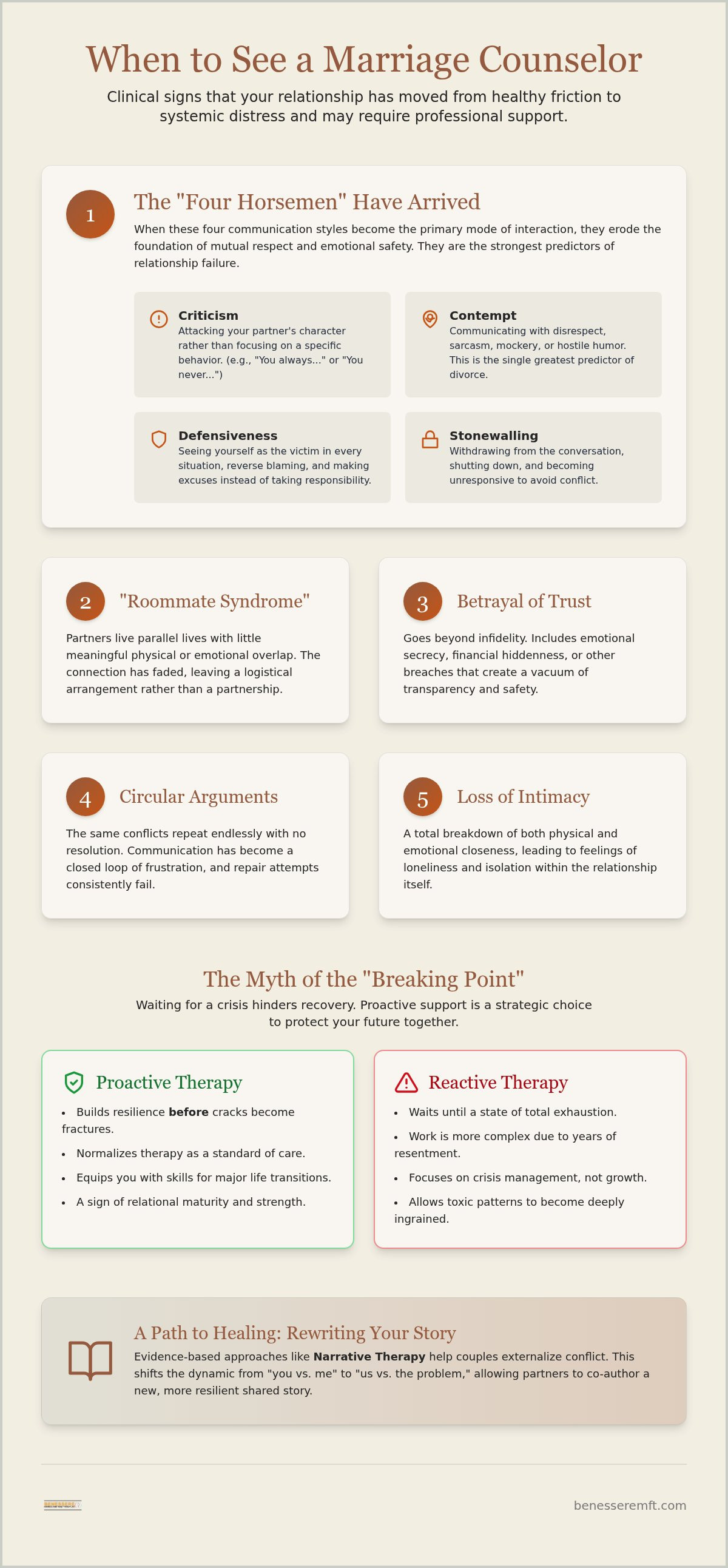
Many couples adopt a "wait and see" posture, hoping that time alone will heal the rift. This approach often leads to deeper emotional scarring because it allows toxic patterns to become the default mode of communication. By the time a couple reaches out in a state of total exhaustion, the work of dismantling years of resentment is significantly more complex. Proactive intervention isn't a sign of failure; it's a strategic choice to protect the family unit's future.
The Clinical Definition of Relational Distress
In a clinical context, distress goes beyond occasional unhappiness. It often manifests as a "negative sentiment override," a psychological state where even neutral or positive gestures from a partner are filtered through a lens of past hurt and suspicion. When this happens, you lose your "shared story," the cohesive narrative that once gave your union its unique purpose and strength. Relational distress is the persistent inability to co-regulate emotions. Through narrative therapy, couples can begin to externalize these destructive patterns, seeing the conflict as the problem rather than seeing each other as the enemy.
Proactive vs. Reactive Therapy
You don't have to wait for a crisis to seek professional support. Seeking help during major life transitions, such as a career shift or the transition into parenthood, is a sign of relational maturity. For couples navigating the complexities of starting a family, specialized reproductive centers like Rain IVF & Women's Hospital offer the type of expert care that can help mitigate the stress often associated with fertility journeys. These shifts put immense pressure on your "relational bank account," and early intervention ensures you have the skills to keep that account in the black. Normalizing therapy as a standard of care for modern partnerships allows couples to build resilience before the cracks become fractures. It's about moving from a reactive state of survival to a proactive state of growth and connection.
5 Critical Indicators That Your Relationship Dynamics Require Professional Intervention
Recognizing specific behavioral patterns provides the necessary clarity to determine when to see a marriage counselor. While every couple faces challenges, certain clinical indicators suggest that the relationship’s internal repair mechanisms have failed. One of the most significant frameworks for understanding this is the "Four Horsemen" of conflict: criticism, contempt, defensiveness, and stonewalling. When these behaviors become the primary mode of interaction, they erode the foundation of mutual respect and emotional safety.
Beyond active conflict, chronic emotional withdrawal often manifests as "roommate syndrome," where partners live parallel lives with little meaningful overlap. This distance is frequently compounded by a betrayal of trust. While many associate betrayal solely with physical infidelity, emotional secrecy or financial hiddenness can be equally destructive. These breaches create a vacuum of transparency that is difficult to fill without professional guidance. If you find yourself trapped in circular arguments that never reach a restorative conclusion, or if you've experienced a total loss of physical and emotional intimacy, it’s a sign that your communication has become a closed loop of frustration rather than a path to understanding.
The Breakdown of Effective Communication
Effective communication isn't just about the absence of shouting; it's about the presence of safety. When every conversation feels like a minefield or a high-stakes trial, it is often the clearest sign of when to see a marriage counselor. You might notice a shift from "complaining" about a specific behavior to "criticizing" your partner’s fundamental character. Rebuilding these bridges requires specialized skillsets, such as those found in marriage and family therapy Roseville CA, where clinicians help couples move from character assassination to vulnerable expression.
Emotional Distance and the 'Quiet' Crisis
A lack of fighting isn't always a sign of health. In many cases, a "quiet" crisis is more dangerous than frequent arguing because it signals that one or both partners have simply given up. This indifference often begins when partners stop making "bids for connection" or, worse, when those bids are consistently met with a "turning away" or silence. Understanding why waiting too long is a mistake helps emphasize that empathy must be actively maintained. When indifference replaces anger, the emotional bond is at its most fragile. If you recognize these patterns in your own home, seeking couples therapy can provide the restorative space needed to rekindle that lost intimacy.
The Myth of the 'Breaking Point': Why Waiting Too Long Hinders Recovery
The most common reason couples delay seeking help is the belief that their situation isn't "bad enough" yet. This breaking point mentality is a dangerous myth that treats therapy as an emergency room visit rather than a preventative measure. When you wonder when to see a marriage counselor, the answer is often found in the presence of persistent resentment rather than a singular catastrophic event. Waiting until you're packed and ready to leave creates a fatalistic environment where recovery is significantly more difficult because the emotional foundation has already crumbled.
Chronic resentment carries a heavy psychological cost, often manifesting as anxiety, depression, or sleep disturbances for both individuals. It’s a weight that doesn’t just stay within the relationship; it permeates every aspect of your life. To address these personal impacts, individual psychotherapy Roseville can be a vital companion to couples' work, allowing each partner to process their own history and emotional responses. This dual approach helps prevent "relational burnout," a state where one partner has emotionally checked out. Once a partner reaches this level of exhaustion, the process of re-engagement requires far more clinical effort than if intervention had occurred earlier.
Debunking the 'Crisis-Only' Stigma
Think of counseling as a necessary alignment for your relationship’s engine. You don't wait for the engine to seize before getting an oil change. Psychoeducation plays a critical role here, providing couples with the skills to identify and de-escalate conflict before it becomes systemic. In Roseville, we see an increasing number of high-functioning couples choosing maintenance therapy to ensure their connection remains vibrant and resilient against the stressors of modern life. It's a proactive choice that signals a high value for the partnership.
The Impact of Chronic Stress on the Family Unit
Relational tension is never contained within the couple. It radiates outward, affecting children, extended family, and even career performance. When your primary relationship is in distress, your capacity for stress management at work is often compromised. Children do not just 'hear' fights; they 'feel' the lack of emotional safety. This invisible stress can impact their own emotional regulation and sense of security, making professional support a gift for the entire family unit rather than just the partnership.
Navigating the Process: What to Expect in Relational Therapy
The transition from recognizing when to see a marriage counselor to actually entering a clinical space often brings a mix of relief and apprehension. Understanding the mechanics of the therapeutic process can lower these defenses and build a sense of security. The journey begins with a comprehensive initial assessment where the unique history of your partnership is explored with scientific precision and human warmth. This phase isn't about assigning blame; it's about identifying the systemic patterns that have hindered your connection over time.
A central component of this restorative work involves narrative therapy, which helps couples externalize the problem. By viewing the conflict as a separate entity rather than an inherent flaw in either partner, you gain the agency to rewrite your shared story. Goal setting then shifts from the immediate desire of "stopping the fights" to the long-term objective of "building a future." While every partnership is unique, a typical course of therapy lasts between 12 and 25 sessions. Throughout this time, the therapist serves as a neutral, clinical guide, ensuring that the process remains a collaborative and educational experience rather than a courtroom.
The Therapeutic Alliance
The success of relational therapy relies heavily on the "fit" between the couple and the practitioner. Both partners must feel a sense of trust and safety to engage in deep, restorative work. A skilled clinician maintains strict neutrality, ensuring that both voices are heard and validated without the therapist becoming a judge. By utilizing evidence-based skillsets, we provide a structured roadmap for change that moves beyond temporary fixes toward lasting resilience. If you're ready to begin this journey, you can schedule a couples therapy session to explore your path forward.
Individual Work within the Relational Context
Sometimes, the work of rebuilding a marriage reveals individual challenges that require focused attention. A therapist might suggest concurrent depression counseling Roseville if one partner is struggling with a clinical mental health state that impacts their ability to connect. Addressing past trauma that surfaces during sessions is also a common part of the restorative process. Integrating individual resilience into the shared relationship creates a stronger, more holistic foundation for the family unit. This methodical progression ensures that both the individual and the partnership receive the specific support they need to thrive.
Restoring Connection with Marriage and Family Therapy in Roseville
Deciding when to see a marriage counselor is a pivotal moment that requires both self-awareness and a commitment to the relationship's future. Understanding when to see a marriage counselor is the first step toward restoration; finding the right local partner is the second. Once you've recognized the clinical indicators of distress, the next step involves choosing a therapeutic environment that fosters safety and growth. For families in Placer County, selecting a local clinician provides a level of continuity and community context that remote options often lack. At Benessere MFT, our restorative practices are designed to help you move beyond the "roommate phase" and back into a vibrant, shared life.
Why a Local Roseville Practice Matters
In-office sessions offer a distinct clinical advantage, especially for couples experiencing high-conflict or high-stress dynamics. Being in a physical, neutral space allows for a more nuanced reading of non-verbal cues and creates a dedicated sanctuary away from the triggers of home life. This local focus also enables a more integrated approach to care. We often find that relational issues are intertwined with broader family patterns. In these cases, accessing family therapy Roseville CA ensures that every member of the household is supported as the couple works toward healing.
Initiating the conversation with your partner about seeking help can feel daunting. It's helpful to frame the suggestion as a collaborative investment in your shared well-being rather than a list of grievances. Use "I" statements to express your feelings and emphasize your desire for a deeper connection. For example, stating, "I value our relationship so much that I want us to have the professional tools to manage these challenges together," invites cooperation rather than defensiveness. This approach normalizes the need for support and positions the therapist as a resource for the team.
Invitation to Healing
We acknowledge the immense courage it takes to invite a professional into your private world. It's a step that signals a profound respect for your history and a quiet optimism for your future. The Benessere team provides a non-judgmental space where complex emotions are handled with scientific precision and human warmth. We invite you to move from a state of survival to one of thriving. If you're ready to reclaim the joy and resilience of your partnership, schedule a clinical consultation with our Roseville team today. Your journey toward restoration starts with this single, decisive action.
Reclaiming the Future of Your Partnership
Identifying the specific moments when a relationship requires professional support is an act of profound relational maturity. We've explored how recognizing behavioral markers like the "Four Horsemen" or chronic emotional withdrawal provides the necessary clarity to determine when to see a marriage counselor. By moving away from the myth of the breaking point, you allow for a proactive, restorative approach that preserves the emotional health of your entire family unit. Relational therapy isn't just about resolving conflict; it's about building the skills necessary for long-term resilience.
At Benessere MFT, our expert clinicians utilize an evidence-based, trauma-informed framework to help you navigate these complexities. Our convenient Roseville location serves as a calm, safe space for Placer County residents to rewrite their shared stories with both scientific precision and human warmth. You don't have to navigate this path in isolation. To begin the collaborative process of healing and growth, we invite you to Schedule a Clinical Consultation with Benessere MFT in Roseville. There is always a path toward restoration, and the reclamation of joy remains a tangible possibility for your partnership.
Frequently Asked Questions
Is it too late for marriage counseling if we've already discussed divorce?
It's not too late. Discussion of divorce often signals that your current coping mechanisms are exhausted rather than the relationship being beyond repair. Therapy provides a structured environment to determine if the partnership can be restored or how to navigate a transition with dignity. It moves the conversation from a reactive crisis to a methodical evaluation of your shared potential and history.
How much does a typical marriage counseling session in Roseville cost?
Fees for couples therapy in the Roseville area vary based on a clinician's experience and the length of the session. While we don't list specific rates here, many private practices in Placer County fall within standard regional ranges. You should check with individual providers regarding their specific fee structures. Some clinicians may offer sliding scale options or different rates for intensive restorative sessions.
What happens if my partner refuses to attend therapy with me?
You can still begin individual psychotherapy to work on your own relational patterns and emotional regulation. Often, when one partner begins to shift their behavior and gains clinical insight, it can change the dynamic of the entire relationship system. This individual work serves as a restorative step for your own mental wellness, even if the partnership isn't yet ready for a joint process.
How many sessions of marriage counseling are usually needed to see results?
A typical course of treatment often lasts between 12 and 25 sessions. While some couples notice a shift in their communication patterns within the first few visits, building long-term resilience requires a more methodical progression. The total duration depends on the depth of the challenges and the consistency of the work performed both inside and outside the clinical office during the week.
Can marriage counseling help if there has been an affair?
Yes, restorative therapy is specifically designed to address the trauma of infidelity and breaches of trust. The process involves creating a safe space for transparency, understanding the origins of the rift, and rebuilding a new foundation. It is a structured journey that moves from the initial crisis phase toward a long-term reclamation of safety, vulnerability, and mutual respect between partners.
What is the difference between a marriage counselor and a family therapist?
Both roles are typically filled by Licensed Marriage and Family Therapists. The primary difference lies in the clinical focus of the session. Marriage counseling concentrates specifically on the dyadic relationship between partners. Family therapy expands the lens to include children or extended family members, addressing the systemic dynamics that influence the entire household's emotional health and the integration of various life experiences.
How do we find a therapist in Roseville that accepts our insurance?
You should start by contacting your insurance provider for a list of in-network clinicians in Placer County. It's important to understand that many plans require a specific mental health diagnosis for coverage. If you're unsure when to see a marriage counselor, checking your plan's "medical necessity" requirements for conjoint therapy is a practical first step in navigating the financial logistics of care.
Can we see a marriage counselor even if we aren't 'fighting' all the time?
Absolutely. Many couples seek support to address emotional distance, "roommate syndrome," or major life transitions before high-conflict patterns emerge. Proactive therapy acts as a preventative alignment for your relationship. It ensures that your connection remains vibrant and that you have the skills to navigate future stressors without losing the sense of emotional safety that defines a healthy, resilient partnership.


Comments