
Anxiety Management Techniques: A Clinical Guide to Restoring Agency

What if the physical exhaustion you feel isn't just a byproduct of a busy life, but a direct signal from a nervous system that has forgotten how to find its way back to calm? It's deeply unsettling to feel like a passenger in your own body, watching as persistent "what-if" thoughts dictate your day and leave you physically drained from constant hypervigilance. You're not alone in this experience. In 2026, anxiety rates in the U.S. rose by 9.3 percent, highlighting a growing need for accessible, science-based support. Learning effective anxiety management techniques is not about suppressing these responses, but about understanding the biological language your body is speaking.
This guide provides the evidence-based strategies you need to regulate your nervous system and reframe your internal narrative, helping you build the long-term emotional resilience required to regain your agency. We'll explore practical tools for somatic regulation, clarify when it's time to transition into professional clinical support, and outline a path toward lasting emotional balance. By bridging the gap between clinical precision and human warmth, we can move beyond mere survival and toward a state of restorative growth.
Key Takeaways
Gain a deeper understanding of the nervous system's survival mechanisms to help normalize your body's physiological response to stress.
Practice somatic anxiety management techniques designed to engage the Vagus nerve and promote a restorative 'rest and digest' state.
Discover how to externalize your internal narrative so you're observing your thoughts with clarity rather than being consumed by them.
Establish a resilient daily routine that integrates intentional boundaries and wellness habits to lower your overall anxiety threshold.
Recognize the clinical indicators that suggest when it's time to transition to professional individual psychotherapy for deeper support.
Table of Contents
The Physiology of Anxiety: Understanding Your Nervous System
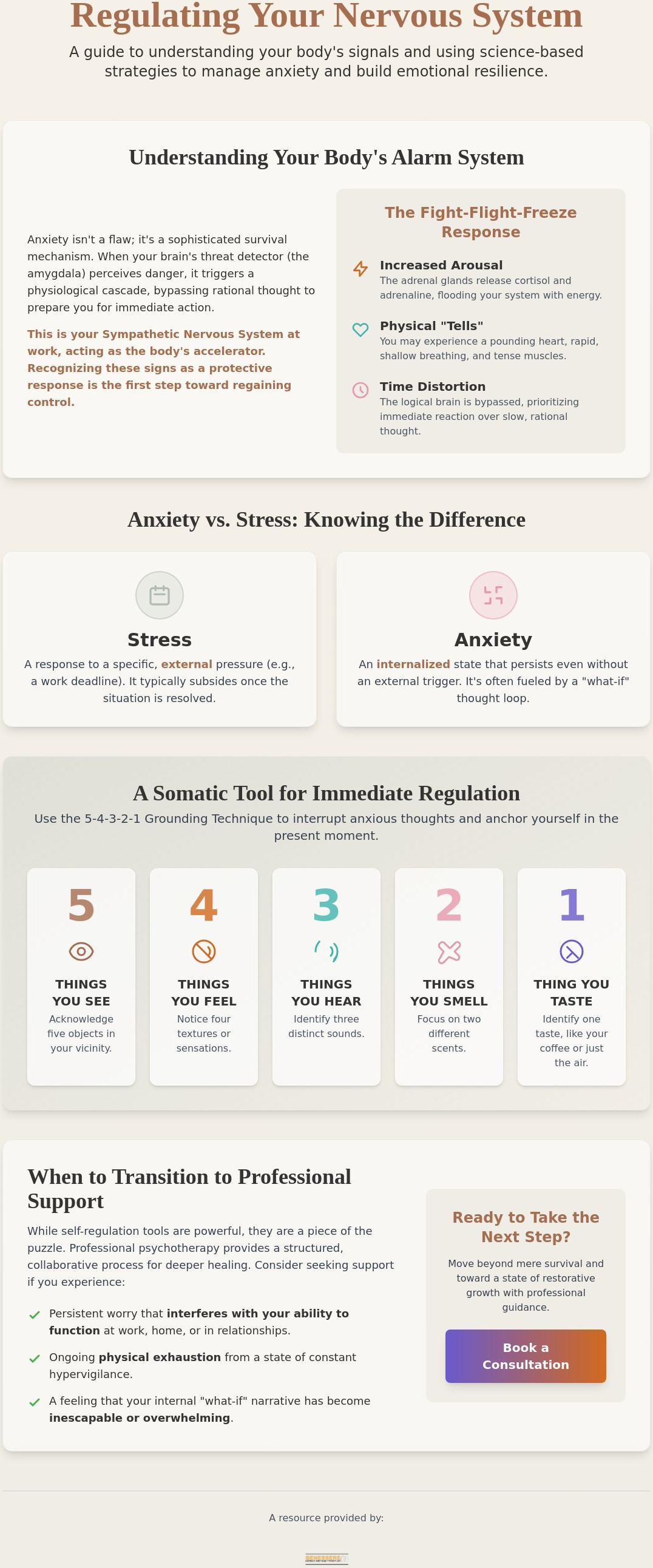
Anxiety is often experienced as a chaotic, internal disruption, yet it's fundamentally a sophisticated protective mechanism designed for your survival. When your brain perceives a threat, it triggers a cascade of physiological changes intended to keep you safe. The adrenal glands release cortisol and adrenaline, flooding the system with energy to meet a challenge. In our modern world, this system can become overactive, treating psychological stressors with the same intensity as physical dangers. By understanding the biological "why" behind these sensations, we can begin to strip away the shame often associated with mental health struggles. Recognizing that your body is attempting to protect you, even if its methods are currently misaligned, is a vital first step in implementing effective anxiety management techniques. This shift in perspective moves you from being a victim of your symptoms to an active participant in your recovery.
The Fight-Flight-Freeze Response
During moments of high stress, the amygdala, a small almond-shaped structure in the brain, effectively hijacks your system. It bypasses the logical prefrontal cortex to prioritize immediate action over slow, rational thought. The sympathetic nervous system acts as the body's accelerator, rapidly increasing physiological arousal to prepare you for a perceived battle or escape. This manifests in recognizable physical "tells" such as shallow, rapid breathing, a pounding heart, and muscle tension. Integrating relaxation techniques into your daily life can help signal to the brain that the immediate danger has passed, allowing the logical mind to come back online. When you name these physical sensations as they occur, you begin to de-escalate the intensity of the response.
Anxiety vs. Stress: Knowing the Difference
It's helpful to distinguish between situational stress and clinical anxiety. Stress is typically a response to an external pressure, like a looming deadline or a difficult conversation, and it generally dissipates once the situation is resolved. Anxiety, conversely, is an internalized persistence of that state that remains even after the external trigger is gone. It's a "what-if" loop that persists in the absence of a clear threat. When worry begins to interfere with your ability to function or leads to persistent physical exhaustion, it has likely crossed the threshold into a clinical concern. Seeking mental health counseling Roseville CA allows for a professional assessment to determine if your symptoms require a more structured, clinical approach to healing. This collaborative process helps you identify the specific patterns that keep your nervous system in a state of high alert, providing a roadmap toward emotional balance.
Somatic Anxiety Management Techniques for Immediate Regulation
Somatic regulation is the practice of addressing psychological distress through the body's physical state. Before you can engage in complex cognitive tasks, your nervous system must feel a baseline sense of safety. This safety is mediated by the Vagus nerve, a primary component of the parasympathetic nervous system that facilitates the "rest and digest" response. By intentionally stimulating this nerve, you can shift your body out of a high-arousal state and back into a window of tolerance. These anxiety management techniques are essential during acute panic spikes, but they also serve as foundational tools for daily maintenance. Integrating these tips for coping with an anxiety disorder into your regular routine builds a resilient buffer against future stressors. Physical grounding isn't a distraction; it's a necessary physiological prerequisite for any meaningful cognitive reframing or emotional processing.
Grounding Exercises: The 5-4-3-2-1 Technique
Grounding is a powerful way to interrupt the intrusive "what-if" loops of the mind by anchoring your awareness in the immediate, physical present. The 5-4-3-2-1 technique requires you to methodically identify five things you see, four things you can touch, three things you hear, two things you can smell, and one thing you can taste. This sensory focus forces the brain to process external stimuli, effectively pulling resources away from the amygdala's alarm response. In public settings where you might feel self-conscious, you can practice a discreet version of this. Simply focusing on the specific texture of your steering wheel or the rhythm of your footsteps can provide the same stabilizing effect. This subtle shift helps you maintain a sense of presence and agency without drawing external attention to your internal struggle.
Breathwork and Muscle Relaxation
Breathwork acts as a direct manual override for the autonomic nervous system. The 4-7-8 technique involves inhaling quietly through the nose for four seconds, holding the breath for seven, and exhaling forcefully through the mouth for eight. This extended exhalation is particularly effective at slowing the heart rate and lowering blood pressure. Diaphragmatic breathing signals safety to the brain by physically moving the diaphragm and stimulating the Vagus nerve. Complementing this with Progressive Muscle Relaxation (PMR) allows you to release the physical tension that often goes unnoticed during periods of chronic stress. By systematically tensing and then releasing different muscle groups, you teach your body the difference between a state of high alert and true relaxation. If these physical symptoms feel overwhelming or persistent, exploring individual psychotherapy can provide a structured environment to master these tools with clinical guidance and support.
Cognitive and Narrative Strategies: Rewriting the Script
While somatic tools stabilize the body's immediate arousal, cognitive and narrative strategies address the mind's interpretation of those physical signals. Many people inadvertently fuse their identity with their struggle, often stating "I am anxious" as though it were a permanent character trait. When we shift this language to "I am currently experiencing a wave of anxiety," we engage in a process of externalization. This subtle but profound linguistic change creates the psychological distance necessary to observe thoughts without being consumed by them. Effective anxiety management techniques involve recognizing that while the feeling is real, it's not an absolute truth about your identity or your future.
This cognitive work often targets distortions such as catastrophizing, where the mind leaps to the worst possible outcome, or black-and-white thinking, which leaves no room for nuance. By integrating these approaches with restorative narrative techniques, you can begin to reclaim agency over the story you tell about your life. Organizations like the ADAA offer a wealth of Anxiety and Stress Management Strategies that highlight how changing our internal dialogue can lower our overall emotional baseline. This isn't about forced positivity; it's about developing the clinical skillsets required to view your experiences through a lens of balanced reality rather than one of perpetual threat.
Challenging Automatic Negative Thoughts
Automatic negative thoughts (ANTs) are the reflexive, often irrational beliefs that fuel emotional distress. One of the most practical anxiety management techniques for addressing these is the creation of a thought record. This involves documenting an anxious belief and then objectively evaluating the evidence that supports it versus the evidence that contradicts it. This process often reveals that our fears are based on habit rather than fact. We can also practice shifting from "what-if" thinking to "even-if" preparation. Instead of spiraling into "What if I lose my job?", we move toward "Even if I face a career setback, I have the skills and support to find a new path." This shift transforms a passive worry into an active, resilient plan.
Narrative Therapy: Reclaiming Your Story
Beyond traditional cognitive exercises, narrative therapy offers a restorative way to manage anxiety by separating the person from the problem. This approach views anxiety as an external influence that has tried to take up residence in your life, rather than a personal failing. By identifying "unique outcomes", those moments where you successfully managed a challenge or felt a sense of peace despite the pressure, you begin to build a more resilient self-image. This clinical framework helps you recognize your inherent strengths and the times you've already demonstrated agency. It's a collaborative process that allows you to stop being the protagonist in a tragedy and start being the author of a story defined by growth and recovery.
Building a Sustainable Routine for Long-Term Resilience
Establishing a sustainable routine is the cornerstone of moving from acute symptom management to enduring emotional health. While immediate anxiety management techniques provide relief in the moment, long-term resilience requires a methodical approach to your daily environment. This process involves stabilizing the physiological baseline so that the nervous system is less reactive to minor stressors. Consistency is significantly more impactful than intensity. A ten-minute daily practice of mindfulness or movement often yields better clinical outcomes than a three-hour session once a month. When you integrate these habits into your high-stress professional or family roles, you create a protective buffer that prevents minor irritations from escalating into full-blown crises.
Lifestyle Foundations for Mental Wellness
The biological foundations of mental wellness are often overlooked in traditional discussions of anxiety. There is a profound connection between gut health, restorative sleep, and emotional regulation. Sleep hygiene, in particular, ensures that the brain has the opportunity to process the day's emotional data, reducing the likelihood of waking up in a state of hypervigilance. Regular physical movement serves a clinical purpose by helping the body metabolize excess adrenaline and cortisol that would otherwise remain circulating in the system. For those whose anxiety has led to a state of emotional burnout, depression counseling Roseville can be an essential resource to address the lethargy and withdrawal that often accompany chronic stress. By addressing these physical pillars, you lower your overall anxiety threshold, making other psychological tools more effective.
Digital and Social Boundaries
In an era of constant connectivity, managing your digital intake is a vital component of modern anxiety management techniques. "Doomscrolling," or the continuous consumption of distressing news, keeps the amygdala in a state of perpetual alarm. Establishing clear digital boundaries allows the nervous system the space it needs to decompress and return to a state of equilibrium. Social boundaries are equally important. Communicating your emotional needs to family and colleagues isn't an act of selfishness; it's a necessary step to prevent burnout and maintain your capacity to contribute. By clearly defining when you are "off-duty," you protect the emotional energy required for your own restorative process. If you find that establishing these routines feels overwhelming on your own, our team offers individual psychotherapy to help you design a personalized plan for long-term health.
When to Seek Professional Anxiety Counseling in Roseville
While mastering self-applied anxiety management techniques is a significant step toward health, these tools exist within a broader continuum of care. There are moments when the complexity of a nervous system's response requires the specialized guidance of a clinical professional. Recognizing the need for support isn't a sign of personal failure; it's an astute acknowledgment of your own humanity and the depth of your experiences. In a professional setting, the work shifts from solo management to a collaborative partnership where scientific precision meets restorative empathy. This transition allows you to move beyond simply coping with symptoms and toward a profound resolution of the underlying patterns that sustain emotional distress.
Clinical Indicators for Professional Support
There are specific "red flags" that indicate when self-help strategies may no longer be sufficient to manage the intensity of your experience. If you find that anxiety is consistently interfering with your professional performance, straining your closest relationships, or causing persistent physical health issues like chronic exhaustion or digestive distress, clinical intervention is often necessary. Self-help tools can sometimes reach their limit when symptoms are rooted in deep-seated past experiences. In these instances, trauma therapy Roseville offers a structured, safe environment to process triggers that exist below the surface of conscious thought. Moderate-to-severe clinical disorders often require this level of specialized care to unlock long-term relief.
The Benessere Approach: Personalized and Precise
At Benessere MFT, we provide a safe, restorative space where Roseville residents can explore their mental health with both scientific clarity and human warmth. Our therapists don't use a one-size-fits-all model. Instead, we tailor our interventions to your unique story, integrating psychoeducation with active skill-building to ensure you feel empowered in your daily life. We focus on helping you refine your anxiety management techniques while simultaneously addressing the narrative and physiological roots of your struggle. This dual approach ensures that the progress you make in the therapy room translates into a lasting sense of agency in the outside world. You don't have to carry the weight of chronic hypervigilance alone. Schedule a consultation with Benessere MFT today to begin the collaborative process of restoring your emotional balance and reclaiming your life.
Reclaiming Your Path to Emotional Agency
The journey toward emotional balance begins with a shift in perspective, moving from a state of reactive fear to one of intentional agency. By understanding your nervous system's protective role and implementing evidence-based anxiety management techniques, you've already begun the process of stabilizing your internal world. Each strategy, from somatic grounding to narrative reframing, contributes to a foundation of long-term resilience. These practices are not merely temporary fixes; they are the building blocks of a life defined by growth rather than restriction.
If the path forward feels complex, professional support can provide the clinical precision and compassionate guidance necessary for deeper healing. Benessere MFT offers evidence-based clinical skillsets within a trauma-informed restorative approach, conveniently located in Roseville, CA. Our team is dedicated to helping you navigate the intricacies of your mental health with scientific expertise and human warmth. Take the first step toward reclaiming your peace and book a consultation with Benessere MFT today. You possess an inherent capacity for recovery, and we're here to walk alongside you in that restorative process.
Frequently Asked Questions
What is the most effective anxiety management technique for immediate relief?
Somatic grounding techniques, such as the 5-4-3-2-1 method, are widely considered the most effective tools for immediate relief. These exercises work by manually overriding the sympathetic nervous system and shifting the brain's focus from internal distress to the external environment. By engaging your physical senses, you interrupt the physiological alarm response, which allows your heart rate to slow and your logical mind to return to a state of calm.
Can I manage clinical anxiety without professional therapy?
While mild situational stress can often be managed through lifestyle adjustments and self-directed anxiety management techniques, clinical disorders usually require professional guidance for sustainable recovery. Therapy provides a methodical framework to address the underlying cognitive and biological patterns that self-help tools might overlook. For many, a collaborative clinical approach ensures that strategies are applied correctly, preventing symptoms from becoming a chronic, debilitating presence in your daily life.
How do I know if my anxiety is 'normal' stress or a clinical disorder?
The distinction between normal stress and a clinical disorder lies in the duration, intensity, and impact on your daily functioning. Normal stress is typically a reaction to a specific external pressure and usually resolves once that situation passes. Clinical anxiety is often internalized, persisting even in the absence of a clear threat and interfering with your ability to work, maintain relationships, or sleep. If your worry feels disproportionate to your circumstances, it may indicate a clinical concern.
Are there specific anxiety management techniques for high-stress professionals?
High-stress professionals often benefit from discrete "micro-interventions" that can be performed seamlessly during the workday. Strategic anxiety management techniques such as box breathing or identifying "glimmers" (small moments of safety) help maintain a window of tolerance amidst high-stakes environments. Establishing clear digital boundaries and practicing transition rituals between work and home also helps prevent the accumulation of chronic hypervigilance, protecting both your professional capacity and your personal well-being.
How long does it take for these coping strategies to start working?
Somatic tools often provide a noticeable shift in your physical state within minutes, but building long-term emotional resilience typically takes several weeks of consistent practice. Much like physical exercise, the brain requires repetitive engagement to strengthen the neural pathways associated with the relaxation response. While you might feel an immediate slowing of your heart rate during a breathing exercise, the restorative benefits of cognitive reframing and routine building accumulate over time through steady application.
What should I do if a panic attack starts in a public place?
If a panic attack begins in a public place, prioritize finding a "grounding anchor" rather than attempting to escape the situation immediately. Focus on the sensation of your feet on the floor or the texture of an object in your pocket to stay present in your body. Remember that while a panic attack is intensely uncomfortable, it is a physiological event that will pass. Slowing your exhalation signals to your brain that you are safe, even in a crowded space.
How can narrative therapy help with chronic worrying?
Narrative therapy addresses chronic worrying by helping you externalize the anxiety as something separate from your identity. Instead of viewing yourself as a "worrier," you learn to see "The Worry" as an intrusive guest that tries to dictate your life story. This process allows you to identify "unique outcomes," which are specific moments when you remained calm or acted with agency despite the presence of anxious thoughts, effectively rewriting your self-narrative toward resilience.



Comments