
Family Conflict Therapy: Navigating the Path to Restorative Healing

What if the repetitive arguments that leave you feeling exhausted aren't a sign that your family is failing, but rather a signal that your current communication system has reached its limit? Many households find themselves trapped in cycles where the same triggers lead to the same painful outcomes, creating a persistent sense of being stuck. You might worry about the long-term impact of this friction on your children or grieve the loss of emotional safety that your home once provided. These feelings are a natural response to relational strain, and acknowledging them is the first step toward reclaiming a sense of stability.
By engaging with evidence-based family conflict therapy, your household can begin to deconstruct these patterns and replace them with a resilient, shared narrative. This professional approach offers more than just temporary relief; it provides a clinical framework for restorative healing. In the following sections, we'll explore how specialized therapeutic techniques restore communication and offer practical tools to manage future disagreements. You'll discover how to move beyond the discord toward a lasting sense of peace and mutual understanding within your home.
Table of Contents
What is Family Conflict Therapy? Defining the Restorative Process
The Mechanics of Family Systems: Why Discord Becomes a Cycle
Identifying the Emotional Toll: When Professional Intervention is Essential
The Therapeutic Journey: Evidence-Based Approaches to Healing
Reclaiming Your Family Narrative: Clinical Care in Roseville
What is Family Conflict Therapy? Defining the Restorative Process
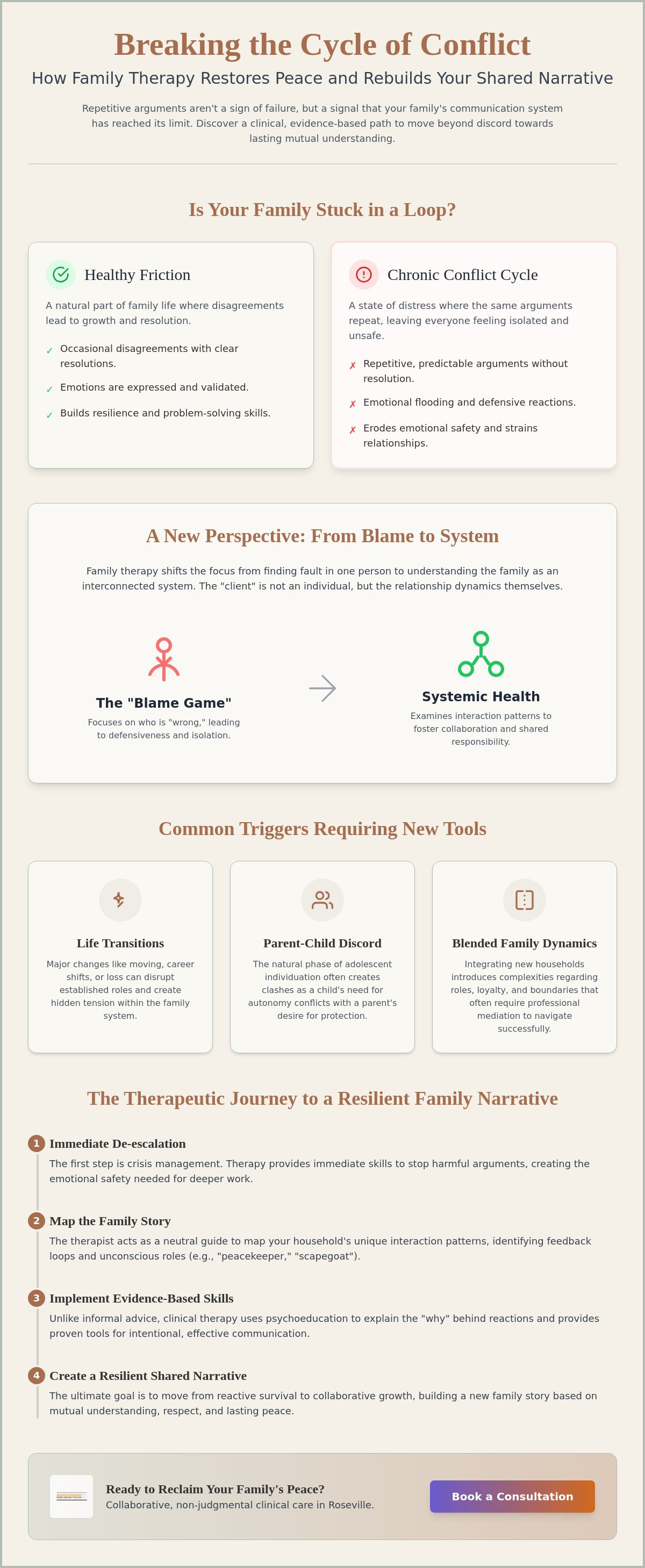
Understanding What is Family Conflict Therapy? requires a fundamental shift in perspective from individual blame to systemic health. At its core, family conflict therapy is a clinical intervention that views the family as a single, interconnected unit. While individual therapy focuses on the internal world of one person, this approach treats the interactions between members as the primary focus. In this setting, the "client" isn't a single person who is "wrong" or "broken," but rather the relationship dynamics that have become strained over time. By focusing on the unit, we can address the root of the friction without making any one individual feel like the source of the problem.
Healthy families experience friction. It's a natural byproduct of different personalities and needs living in close proximity. However, there's a distinct line between occasional disagreements and clinically significant conflict cycles. These cycles are characterized by repetitive, predictable arguments that leave everyone feeling isolated and emotionally unsafe. When a household enters this state, the conflict becomes a closed loop where every reaction triggers a pre-set defense in another person. This is where professional intervention becomes a restorative necessity. It provides the tools to break these loops and replace them with intentional communication.
The therapist acts as a Wise Guide within this process. They don't take sides or act as a judge; instead, they provide a structured, neutral ground where complex emotions can be deconstructed with scientific precision and human warmth. This creates a safe space where each member can feel validated while learning how their specific behaviors impact the collective whole. The goal is to move the family from a state of reactive survival to one of collaborative growth.
To support this transition, specialized resources such as Citizen Coaching and Counselling offer targeted therapeutic services and support for managing intense emotions, helping individuals prepare for more constructive participation in the family unit.
Common Triggers for Seeking Professional Support
Families often seek support during periods of significant instability. Life transitions, such as moving to a new community like Roseville or navigating major career shifts, can disrupt established roles and create hidden tension. We also frequently see parent-child discord during the phase of adolescent individuation, where the child's need for autonomy clashes with the parent's desire for protection. Additionally, blended family dynamics introduce complexities regarding new household roles and loyalty, which often require professional mediation to navigate successfully. These triggers aren't failures of the family; they're simply moments where the family system needs new tools to adapt.
The Clinical Difference: Therapy vs. Informal Advice
While friends or family may offer well-meaning suggestions, clinical family conflict therapy provides evidence-based skillsets that lead to durable resolution. A professional therapist uses psychoeducation to help you understand the "why" behind the "what," explaining the biological and psychological roots of your family's reactions. This clinical distance prevents the "blame game" objection, as the focus shifts from finding fault to building resilience. By providing a neutral, authoritative environment, therapy ensures that every voice is heard without the conversation devolving into the same patterns used at home. This professional structure is what allows for true, long-term healing rather than temporary fixes.
The Mechanics of Family Systems: Why Discord Becomes a Cycle
Families function as a cohesive biological unit where every member's behavior serves as a catalyst for the others. This is the foundation of Family Systems Theory. It posits that an individual's struggle is rarely isolated; it's often a symptom of the broader system's health. In the context of family conflict therapy, we examine these invisible threads of influence to understand why a household feels perpetually on edge. When one part of the system shifts, every other part must adjust to compensate, often leading to unintended friction.
Conflict often manifests through feedback loops. When one person expresses frustration, another may respond with defensive silence, which then heightens the first person's agitation. This circularity creates specific roles that members unconsciously adopt to survive the tension. You might recognize the "peacekeeper," who tirelessly diffuses arguments at the expense of their own needs, or the "scapegoat," who absorbs the family's collective stress through outward rebellion. Systemic homeostasis is the family's natural pull toward familiar patterns, even painful ones, as the system seeks to maintain a predictable state of being.
Intergenerational Patterns and Inherited Conflict
Communication styles are frequently inherited, passed down through generations like a silent legacy. If a previous generation utilized emotional distance to manage stress, current members might struggle with vulnerability without knowing why. Addressing these deep-seated echoes often involves trauma therapy Roseville, which helps families process the historical events shaping their current interactions. By gaining clinical awareness, you can decide which patterns to keep and which to release, breaking the cycle of "this is just how we are."
Communication Breakdowns: Beyond the Words
In high-conflict environments, the "demand-withdraw" cycle often takes center stage. This occurs when one person pursues connection through criticism while the other retreats into emotional stonewalling. These interactions are fueled by non-verbal cues, such as a sharp sigh or a turned shoulder, that signal a loss of emotional safety long before a word is spoken. Utilizing narrative therapy allows families to externalize the problem, viewing the conflict as an outside force rather than a character flaw. This shift makes it easier to explore a restorative path together as a unified team.
Identifying the Emotional Toll: When Professional Intervention is Essential
It's common for families to believe they can navigate their challenges without outside assistance, often viewing the decision to seek help as a sign of weakness. However, the reality of chronic stress suggests that willpower alone is rarely enough to bridge deep relational divides. When discord becomes the primary mode of interaction, the household's emotional environment shifts from a place of refuge to a source of exhaustion. Professional family conflict therapy becomes essential when internal attempts at resolution consistently lead back to the same painful outcomes, signaling that the system's internal resources have been depleted.
One of the primary physiological barriers to resolution is emotional flooding. This occurs when the intensity of an argument triggers the body's "fight or flight" response, causing the heart rate to rise and the rational parts of the brain to disengage. In this state, productive conversation is biologically impossible; the brain is simply too overwhelmed to process logic or empathy. Prolonged exposure to a high-conflict environment shifts the nervous system into a state of hyper-vigilance, effectively resetting the body's baseline for stress response. This chronic activation often spills over into individual wellbeing, manifesting as persistent sadness or a loss of interest in life. In these instances, integrating depression counseling Roseville can help individuals process their personal pain while the family works toward collective healing.
Impact on Children and Adolescent Development
Children are particularly vulnerable to the emotional climate of the home, as parental conflict often serves as a blueprint for their future relationships. When the atmosphere is unpredictable, some children may experience "parentification," where they take on the emotional responsibilities of an adult to stabilize the household. This role reversal can have long-term clinical effects on their development and sense of self. Restoring a healthy parental hierarchy is a key goal of therapy, as it provides the structured boundaries and sense of safety that minors require to thrive and develop healthy attachment styles.
The Signs of Caregiver Burnout in High-Conflict Homes
The effort required to constantly "keep the peace" can lead to profound caregiver burnout and clinical exhaustion. This state is more than just feeling tired; it's a depletion of emotional reserves that makes even minor disagreements feel insurmountable. We often see an intersection where individual anxiety feeds into family discord, creating a cycle that is difficult to break alone. This is why our clinical approach often suggest that individual support complements family therapy, ensuring that every person has the personal resilience needed to contribute to the family's restorative journey and long-term stability.
The Therapeutic Journey: Evidence-Based Approaches to Healing
The process of family conflict therapy is a structured roadmap designed to transition a household from a state of reactive crisis to one of proactive connection. This journey isn't a random series of conversations; it's a methodical progression through specific clinical phases that ensure healing is both deep and durable. By following a proven framework, families can move beyond temporary fixes and establish a new, sustainable way of being together. Each step is designed to build upon the last, creating a sense of stability that allows for genuine growth.
The first phase involves a systemic assessment, where we map the unique interaction patterns and historical narratives that define your family unit. Once these patterns are identified, we move into de-escalation, providing immediate skills to lower the household temperature and stop the cycle of emotional flooding. The third step, restructuring, focuses on redefining boundaries and roles to ensure a healthier balance of power and responsibility. During the integration phase, members practice these new communication skillsets in real-world scenarios, testing their resilience in daily life. Finally, consolidation ensures that the family has the internal tools to maintain their progress independently, long after the therapeutic sessions have concluded.
Narrative and Attachment-Informed Techniques
We often utilize narrative techniques to help families externalize their struggles. Instead of viewing a specific person as the problem, we identify "The Conflict" as a separate entity that has hijacked the household's peace. This shift allows members to unite against the cycle rather than against each other. Simultaneously, attachment-informed methods strengthen the emotional bonds that serve as the foundation for difficult conversations. By rewriting the family story from one of discord to one of resilience, we create a shared narrative that honors individual experiences while prioritizing collective healing.
CBT and DBT Skillsets for Emotional Regulation
To provide practical stability, we integrate Cognitive Behavioral Therapy (CBT) and Dialectical Behavior Therapy (DBT) into the process. CBT helps families identify and challenge distorted beliefs that fuel resentment, such as the assumption that a partner's silence is always a sign of rejection. DBT skillsets, particularly distress tolerance, offer members tangible ways to manage intense emotions during an argument without escalating the friction. This psychoeducation normalizes the struggle, helping everyone understand that their reactions are often biological responses that can be retrained with practice. If your household is ready to begin this methodical process, you can explore our family therapy services and start your journey toward restoration.
Reclaiming Your Family Narrative: Clinical Care in Roseville
At Benessere MFT, we view our Roseville clinic as more than just a medical office; it's a sanctuary where families can begin the delicate work of restoration. Our trained therapists approach every case with a balance of clinical authority and deep-seated empathy, ensuring that the process feels safe and structured. In this environment, family conflict therapy isn't about assigning blame or identifying a "problem" person. Instead, it's about uncovering the systemic strengths that have been buried under layers of discord. We work alongside you to rewrite your household's narrative, moving from a story of friction to one of resilience and mutual respect.
While the family unit is our primary focus, we recognize that each member brings their own unique history and emotional needs to the table. This is why we often highlight individual psychotherapy Roseville as a vital support pillar for the collective healing process. When individuals have a dedicated space to process their personal triggers, they're better equipped to participate in the shared work of family therapy. This holistic approach ensures that the changes you make are supported by both personal growth and systemic shifts, leading to a more durable sense of peace at home.
A Local Approach for Placer County Families
Families in Placer County face specific stressors, from the pressures of high-paced professional environments to the unique challenges of navigating school transitions within our growing community. There's a significant benefit to seeking in-person, local clinical expertise where the practitioner understands the nuances of the Roseville area. Our commitment is to provide evidence-based treatment that's meticulously tailored to your unique story, rather than applying a one-size-fits-all solution. This local connection fosters a deeper sense of trust and continuity throughout your restorative journey, providing a stable foundation for lasting change.
Starting the Process: What to Expect in Your First Session
It's natural to feel a sense of anxiety before your first appointment, especially when tensions at home are high. We prioritize transparency to lower these defenses, ensuring that the environment feels unhurried and secure from the moment you arrive. During the initial session of family conflict therapy, we focus on making sure every voice is heard and validated, creating a collaborative space where goals are set together. This isn't a lecture; it's the beginning of a partnership aimed at securing your family's future peace through clinical precision and human warmth.
Taking the first step toward professional support is a profound act of leadership for your household. By choosing to engage in this process, you're deciding that the current cycle of discord doesn't have to be the final chapter of your family's story. We invite you to take the first step and begin the collaborative work of healing, reclaiming the sense of safety and connection that your home deserves.
Cultivating a Future of Lasting Family Harmony
The transition from a home defined by discord to one anchored in emotional safety is a journey that requires both courage and clinical precision. We've explored how identifying the systemic roots of friction and understanding the biological reality of emotional flooding can transform your perspective. By choosing to engage with evidence-based family conflict therapy, you aren't just resolving an argument; you're building a foundation of resilience for every member of your household. Our approach combines specialized training in Narrative and Trauma-Informed care with deep, local expertise serving the Roseville and Placer County communities.
Your family's story doesn't have to be defined by the cycles of the past. With the right clinical skillsets and a collaborative spirit, it's possible to rewrite your narrative into one of restoration and shared growth. This process invites you to step into a safe space where complex emotions are handled with warmth and scientific accuracy. We're here to guide you through each stage of the therapeutic journey, ensuring you have the practical tools to manage future disagreements independently. Begin your family's restorative journey and schedule a consultation with our Roseville therapists today. There is a profound opportunity for healing ahead, and we're honored to support your path toward a more peaceful home.
Frequently Asked Questions
Is family conflict therapy only for families in crisis?
Family conflict therapy is beneficial for households at any stage of friction, not just those in immediate crisis. While many seek support during a breakdown, others use it to navigate life transitions or strengthen existing bonds. Addressing minor patterns early prevents them from evolving into chronic cycles. This proactive approach allows families to build resilience before stressors become overwhelming, ensuring a stable and supportive home environment for everyone involved.
How long does family therapy usually take to see results?
The duration of the therapeutic process varies depending on the complexity of your family's unique dynamics and goals. Many families begin to experience a shift in communication and a reduction in tension within 8 to 12 sessions. However, deeper systemic changes and restorative healing often require a longer commitment to ensure new skills are fully integrated. We work collaboratively to set a pace that respects your family's specific needs and progress.
What if one family member refuses to attend therapy sessions?
You can still begin the process even if one member is hesitant or refuses to participate. Because families function as interconnected systems, a shift in one person's approach to conflict can create a ripple effect that influences the entire household. Our therapists can work with those who are present to develop new interaction strategies. Often, when the rest of the family begins to change, the reluctant member may feel more comfortable joining the sessions later.
Can family therapy help with conflicts involving adult children?
Yes, family therapy is highly effective for resolving discord between parents and their adult children. These conflicts often stem from outdated roles or difficulty navigating the transition into adult-to-adult relationships. Therapy provides a structured space to redefine boundaries and address long-standing grievances with clinical precision. By fostering mutual respect and clear communication, families can move past old patterns and build a more mature, supportive connection that honors everyone's current life stage.
How does family therapy differ from individual counseling?
The primary difference lies in the focus of the intervention; individual counseling explores a person's internal world, while family therapy treats the relationships between members. In a family setting, the therapist observes the "dance" of interaction to identify systemic patterns. While individual work is valuable for personal growth, family sessions allow for real-time practice of communication skills. Both approaches often complement each other to provide a holistic path toward mental wellness and relational stability.
What should we do if our family conflict involves past trauma?
If your conflict is rooted in past trauma, it's essential to work with a practitioner who has specialized training in trauma-informed care. Unresolved trauma often creates hyper-vigilance and reactive patterns that fuel household discord. Our clinical approach integrates trauma-specific techniques to help the family process these experiences safely. By addressing the root causes of these reactions, we can de-escalate the tension and create a restorative environment where healing becomes a shared family experience.
Is family therapy covered by insurance in Roseville?
Coverage for family therapy in Roseville depends entirely on your specific insurance provider and plan benefits. Many insurance companies recognize the clinical value of family intervention and offer partial or full reimbursement for these services. It's best to contact your insurance carrier directly to verify your mental health coverage and any requirements for clinical necessity. Our administrative team can provide the necessary documentation to help you navigate the reimbursement process with your provider.
What happens during a typical family therapy session at Benessere MFT?
A typical session of family conflict therapy at Benessere MFT is a structured, unhurried process designed to ensure every member feels heard and validated. We begin by identifying current challenges and then move into practicing specific de-escalation skills or communication techniques. The therapist acts as a Wise Guide, facilitating a safe dialogue where complex emotions can be explored without devolving into old arguments. Each session concludes with practical tools or reflections to help you maintain progress in your daily life.



Comments