
Emotionally Focused Therapy for Couples: A Restorative Path to Connection in Roseville
- Eddie Posadas
- Aug 9
- 12 min read

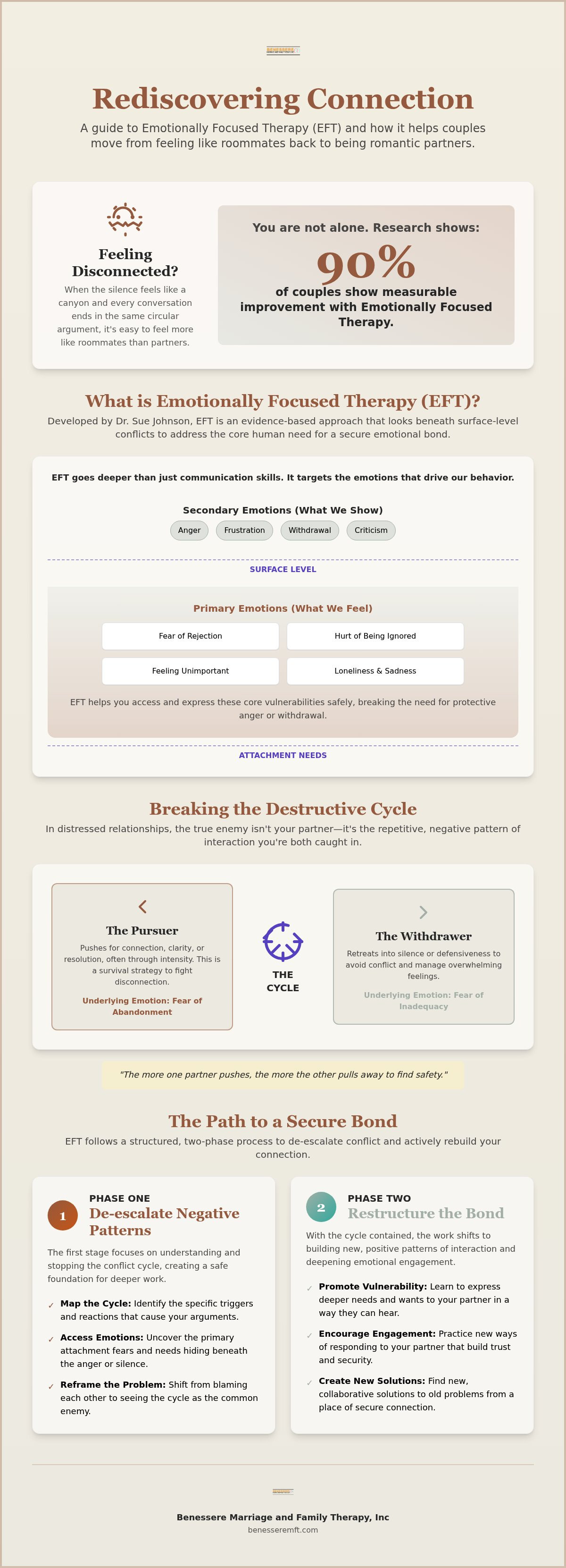
You sit on the same sofa, yet the silence between you feels like a vast, cold canyon where words once flowed with ease. It's a heavy, isolating sensation to feel like roommates rather than romantic partners, especially when every attempt to bridge the gap ends in the same circular argument. If you've reached this point, you aren't alone; research indicates that approximately 90% of couples show measurable improvement when they engage in emotionally focused therapy for couples. This evidence-based approach is often considered the gold standard of treatment because it looks beneath the surface of your conflict to find the underlying human need for connection.
It's exhausting to feel stuck in a cycle of defensiveness or withdrawal, and it's natural to wonder if that spark of safety can ever return. You deserve a relationship where you feel seen and supported, even during your most stressful moments. This guide explores how Emotionally Focused Therapy (EFT) helps you identify the negative patterns that keep you apart and provides the tools to build a secure, lasting bond. We'll examine the mechanics of attachment, how to reach for your partner effectively, and why this restorative path is helping so many couples in Roseville rediscover their intimacy.
Table of Contents
Understanding Emotionally Focused Therapy (EFT) for Couples
Relationship distress often feels like a puzzle where the pieces no longer fit. While many approaches try to fix the surface level of these interactions, Emotionally Focused Therapy (EFT) digs deeper into the biological roots of human connection. Developed by Dr. Sue Johnson in the 1980s, this structured, short-term model is designed to help partners move from isolation to a state of secure emotional attachment. It's built on the understanding that humans have an innate, lifelong need for a safe emotional bond with a significant other.
Most couples have tried traditional communication tactics before seeking professional help. They've practiced active listening and "I-statements," yet they still find themselves caught in the same painful loops. By focusing on the innate human need for a safe emotional bond, emotionally focused therapy for couples transforms the relationship from the inside out. Research supports this restorative path; data shows a 70-75% recovery rate from significant distress, with approximately 90% of couples showing measurable improvement.
The Core Principles of EFT
In an EFT session, the focus remains on the present-moment emotional experience between the partners. Your therapist acts as a process consultant, observing the "dance" between you and your partner to identify where the steps go wrong. The goal is to establish a secure base within the relationship. This is a psychological safe harbor where both individuals feel valued, understood, and consistently heard. It allows for a level of vulnerability that was previously too risky to express, creating a foundation for lasting change.
Why Emotions are the Key to Change
Emotions are the fastest route to shifting relational patterns because they drive our behaviors. When couples engage in emotionally focused therapy for couples, they learn that their emotions aren't obstacles, but signals. Often, what we see on the surface are "secondary emotions" like anger, frustration, or cold withdrawal. These serve as a shield for "primary emotions" such as the fear of rejection or the deep hurt of being ignored. When we address these core vulnerabilities, the need for the protective shield of anger naturally disappears. EFT utilizes these raw emotional experiences as a transformative tool to rewire the way partners respond to one another rather than treating them as symptoms to be suppressed.
Breaking the Cycle: How EFT Addresses Relationship Conflict
In most distressed relationships, conflict follows a predictable and repetitive script. We refer to this as "the cycle." It's the invisible engine driving your arguments and the primary reason why even small disagreements can escalate into multi-day silences. In emotionally focused therapy for couples, the focus shifts from blaming a partner to identifying this destructive pattern. We operate under a fundamental premise: your partner is not the enemy; the cycle is the enemy. When you stop seeing each other as the adversary, you can finally team up to dismantle the patterns pulling you apart.
In many Roseville couples, we observe a common "Pursuer-Withdrawer" dynamic. One partner might push for connection, clarity, or resolution through intensity, while the other retreats into silence to avoid further conflict. This creates a painful feedback loop. The more one partner pushes, the more the other pulls away to find safety. It's a survival strategy, not a lack of love. Therapy helps identify the specific triggers, a tone of voice, a certain look, or a heavy sigh, that start this downward spiral, allowing you to catch the cycle before it takes over.
Phase 1: De-escalation of Negative Patterns
The initial stage of EFT focuses on cooling the immediate flames of conflict through a structured three-step process. First, we map out your unique negative interactional cycle to see exactly how you both get stuck. Second, we work to access the unacknowledged emotions fueling these reactions. Often, the "pursuer" is acting out of a fear of abandonment, while the "withdrawer" is reacting to a deep sense of inadequacy. Finally, we reframe the problem. Instead of viewing your partner as "too critical" or "too distant," the problem becomes the cycle itself and the unmet attachment needs it hides.
Phase 2: Restructuring the Bond
Once the cycle is de-escalated, we move into the restorative work of rebuilding trust. This phase involves learning how to express deep-seated needs in a way that doesn't trigger your partner's defenses. It's about creating "bonding moments" where vulnerability leads to increased closeness rather than rejection. By focusing on emotional responsiveness, we strengthen the marriage and family therapy Roseville CA experience. Partners learn to reach for each other effectively, turning the relationship back into a safe harbor. If you find yourself trapped in these repetitive arguments, you can explore our couples therapy services to begin your journey toward a more secure connection.
The Science of Attachment: Why EFT is the Gold Standard
While many people view love as a mysterious force, emotionally focused therapy for couples treats it as a biological imperative. This approach is grounded in Attachment Theory, pioneered by John Bowlby and Mary Ainsworth. They discovered that the need for a secure bond isn't a childhood phase but a lifelong requirement for human health. In a relationship, "emotional isolation" isn't just a preference or a personality quirk; the brain perceives it as a literal survival threat. When we feel disconnected from our partner, the same parts of our brain that signal physical pain and danger are activated.
Clinical data confirms that EFT is remarkably effective because it addresses these primal needs. Research shows a 70-75% recovery rate from relationship distress, and unlike some therapies where progress fades over time, EFT results tend to be long-lasting. This is because the therapy doesn't just provide "tips" or serve as a referee for venting. Instead, it fundamentally shifts the emotional landscape of the relationship, preventing a relapse into old, defensive habits. It's a methodical process of moving from a state of alarm to a state of calm, reliable connection.
Adult Attachment Styles in Relationships
We all enter relationships with an "attachment style" formed by our life experiences. Those with an anxious attachment style often have a high drive for constant reassurance, fearing that distance means abandonment. Conversely, individuals with an avoidant attachment style tend to pull away when things get "too close," viewing vulnerability as a risk to their independence. The goal of both individual psychotherapy Roseville and our couples work is to move toward secure attachment. This is a state where both partners feel safe enough to be vulnerable without fear of rejection or loss of self.
EFT and Neurobiology
Conflict often triggers what neuroscientists call an "amygdala hijack." When you're in the middle of a heated argument, your brain's "panic button" takes over, shutting down the logical prefrontal cortex. This is why logic alone cannot solve emotional distress; you can't reason with a brain that feels it's under attack. During successful emotionally focused therapy for couples interventions, we work to lower this physiological arousal. As partners begin to offer comfort and responsiveness, the brain releases oxytocin, the hormone responsible for building trust and social bonding. This biological shift is what allows for true, restorative change that goes far beyond surface-level communication tactics.
What to Expect in an EFT Session at Benessere MFT
Walking into our Roseville office, you'll immediately notice that the environment is designed to be a calm, secure harbor for your relationship. In emotionally focused therapy for couples, the therapist doesn't simply sit back and take notes while you vent. Instead, we're active participants in your journey, functioning as process consultants who help you slow down the frantic pace of an argument. This high level of engagement ensures that sessions don't devolve into the same bickering you experience at home. We provide the clinical structure necessary to handle even the most volatile emotions with precision and warmth.
The Initial Assessment Phase
The journey begins with a thorough assessment phase. This isn't just a formality; it's where we gather the data needed to understand your relationship's unique story and interactional patterns. We start with joint sessions to observe your "dance" in person. Following these, we meet with each partner individually. These private sessions are vital for understanding your personal attachment history and how your past experiences influence your current reactions. Once we have this complete picture, we build a collaborative roadmap that outlines the specific restorative steps we'll take to reach your goals.
The Restorative Approach to Healing
One of the most transformative elements of our work involves "enactments." These are structured moments where you practice reaching for your partner in a new way, right there in the session. When you're able to express a vulnerability and receive a supportive response in real-time, it creates a powerful new neural pathway for connection. It's much more effective than simply talking about your problems; you're actually experiencing the solution. This is why emotionally focused therapy for couples is so successful at creating lasting change.
We often integrate narrative therapy during this phase to help you move away from a story where you're "the problem" and toward a shared narrative of growth and agency. Our therapists are committed to maintaining a neutral, supportive space where both individuals feel equally heard and respected, even in high-conflict situations. If you're ready to experience this restorative path and rebuild your bond, you can schedule your initial consultation at our Roseville location to begin the process.
Reclaiming Your Bond: Starting Couples Therapy in Roseville
Recognizing the need for professional guidance is a courageous act of resilience rather than a sign of failure. For many couples in Placer County, the decision to seek help follows months or years of feeling like they're living parallel lives. If you find yourselves trapped in the circular arguments we've explored, or if the silence in your home has become heavy, it's likely time to reach out. Choosing a local Roseville therapist offers more than just convenience; it provides a consistent, physical sanctuary where you can focus entirely on your relationship away from the distractions of daily life.
Our clinical approach often finds that EFT is a powerful companion to trauma therapy Roseville. For partners living with PTSD or the echoes of past relational trauma, emotional triggers can feel like an insurmountable wall. EFT provides the necessary safety to navigate these triggers together, ensuring that trauma doesn't become a permanent barrier to intimacy. It's never too late to begin this path toward restoration. Even relationships that have endured significant distress can find their way back to a state of secure connection through a methodical, compassionate process.
Is EFT Right for Your Relationship?
This evidence-based model is ideal for couples facing chronic conflict, emotional distance, or the painful aftermath of infidelity. It's a collaborative process that works best when both partners are committed to the journey of discovery. In some instances, we may suggest individual therapy as a helpful prerequisite or companion to our work together. This ensures that each person has the internal stability needed to engage fully in the relational "dance." When both individuals are ready to stop blaming the person and start addressing the cycle, emotionally focused therapy for couples yields profound and lasting results.
How to Get Started at Benessere MFT
Starting your journey at our Roseville office is a straightforward, supportive process. We've designed our intake to be as low-stress as possible, allowing you to focus on the healing ahead. You don't need to arrive with a list of grievances or a perfectly polished history. We simply ask that you bring yourselves and an open mind. Our team will handle the clinical structure and guide you through each step of the initial assessment with precision and warmth. Ready to reconnect? Schedule your first couples session with our Roseville team today. We're here to help you move from isolation back to a secure, lasting bond.
Rebuilding the Foundation of Your Relationship
Reclaiming intimacy requires moving beyond surface-level arguments and addressing the core emotional needs that drive our interactions. We've explored how identifying your negative cycle and understanding the science of attachment can transform conflict into a bridge for connection. By utilizing emotionally focused therapy for couples, you can move from a state of defensive isolation to a secure, lasting bond where both partners feel truly seen and supported. This restorative path isn't about learning to argue better; it's about creating the emotional safety that makes those arguments unnecessary.
Our Roseville office provides a compassionate, evidence-based clinical approach tailored to the unique stories of couples throughout Placer County. With specialized training in EFT, our team is dedicated to guiding you through this methodical process with both scientific precision and human warmth. Take the first step toward a more secure connection; book a consultation at Benessere MFT today. Your relationship has an inherent capacity for growth, and we're here to help you rediscover the resilience and joy that first brought you together.
Frequently Asked Questions
Is Emotionally Focused Therapy effective for all couples?
EFT is remarkably versatile, but it's not a universal fix for every situation. It is contraindicated in relationships where there is active physical abuse or an ongoing, unaddressed addiction that prevents emotional engagement. For the vast majority of partners facing chronic conflict or distance, however, this evidence-based approach provides a clear path back to connection. Success largely depends on a shared willingness to explore the vulnerable emotions beneath the surface of daily disagreements.
How many sessions of EFT are typically required to see results?
Results vary based on the depth of the distress, but emotionally focused therapy for couples is generally considered a short-term, structured model. Most couples complete the process within 8 to 20 sessions. This timeframe allows for the initial de-escalation of conflict followed by the deeper work of restructuring the emotional bond. Some partners may choose to continue longer to reinforce their new patterns, while others find significant relief in just a few months.
Does EFT work if one partner is reluctant to come to therapy?
Therapy often begins with one partner feeling more hesitant than the other. This reluctance is frequently a secondary emotion reflecting a fear of being blamed or misunderstood. A skilled EFT therapist validates these feelings rather than pushing them aside. By creating a neutral, non-judgmental space, the therapy helps the reluctant partner feel safe enough to engage. Once they realize the cycle is the enemy, not them, their defensive barriers usually begin to lower.
Can EFT help with recovering from an affair or broken trust?
Rebuilding trust after an affair is one of the most challenging relational hurdles, but EFT provides a specific protocol for healing these attachment injuries. The process allows the hurt partner to express the depth of their pain while helping the other partner offer genuine, restorative responsiveness. By addressing the core breach of safety, couples can move beyond the trauma of betrayal to establish a bond that is often stronger and more transparent than before.
What is the difference between EFT and the Gottman Method?
The primary difference lies in the focus of the intervention. The Gottman Method often emphasizes behavioral tools, such as communication exercises and conflict management skills. In contrast, emotionally focused therapy for couples prioritizes the underlying emotional attachment. While skills are helpful, EFT aims to change the way partners feel about each other at a core level. When the emotional bond is secure, the need for complex communication tactics often diminishes because the connection feels safe.
Is EFT suitable for couples dealing with trauma or PTSD?
EFT is highly effective for couples where one or both partners live with PTSD. Trauma often creates a sense of constant alarm that can inadvertently trigger conflict or withdrawal in a relationship. This therapy helps partners recognize these trauma responses as signals rather than personal attacks. By fostering a sense of mutual safety, the relationship becomes a restorative resource that supports individual healing and strengthens the couple's collective resilience against outside stressors.
How do I know if my therapist in Roseville is properly trained in EFT?
You should look for a therapist who has completed formal training through the International Centre for Excellence in Emotionally Focused Therapy (ICEEFT). This typically includes a four-day externship and subsequent core skills training. At Benessere MFT, our clinicians prioritize specialized training in this model to maintain high clinical standards. Feel free to ask about specific certification levels or experience during your initial consultation to ensure a professional fit for your unique needs.
Can we do EFT sessions virtually or must they be in-person?
You have the flexibility to choose the format that best supports your lifestyle. While our Roseville office provides a dedicated, neutral space for in-person work, we also offer secure telehealth sessions. California regulations require that clients be physically located within the state during virtual therapy. Many couples find that the convenience of telehealth makes it easier to attend sessions consistently, which is a critical factor in the overall success of the therapeutic process.


Comments