
How to Deal With a Controlling Parent and Set Boundaries

A parent can love you and still struggle to respect your independence. Control in adulthood may stem from worry, long-standing family roles, or difficulty accepting that your decisions are yours to make. Learning how to deal with a controlling parent starts with recognizing the pattern and taking your feelings seriously, without assuming you must end the relationship.
It can be confusing when a parent calls their involvement help or concern, but you feel pressured, guilty, or unable to choose freely. Wanting more privacy and autonomy doesn’t make you ungrateful. It means you’re recognizing what you need to feel respected.
This article explores why controlling behavior may continue into adulthood, how to recognize its effects, and how to communicate boundaries with firmness and care. You’ll also find ways to build independence at a manageable pace and protect your well-being, whether you hope to improve the relationship or feel more grounded in your decisions.
Table of Contents
Why do parents control us in adulthood?
Control can persist when a parent struggles to adjust to an adult child’s independence. Understanding the family dynamic may help explain the behavior, but it doesn’t make its emotional effects any less real.
A parent may rely on familiar roles long after their child begins making independent choices. Anxiety, fear of losing closeness, or a belief that advice can prevent mistakes may contribute to repeated criticism or interference. For example, a parent might treat an adult child’s career decision as a family decision rather than recognizing that the choice belongs to the child. Psychology can help explain this dynamic without excusing behavior that crosses boundaries.
Guilt-Tripping and Emotional Manipulation
Guilt-tripping uses blame, obligation, or emotional pressure to influence someone’s choices. A parent might say, “After everything I’ve done, you can’t visit this weekend?” You may feel guilty for having separate needs, even when your parent’s disappointment is genuine. Distinguishing an expression of hurt from pressure meant to control your decision can help you respond thoughtfully and set boundaries.
Emotional Regulation and Defensiveness
Difficulty regulating emotions can make disagreement feel threatening, while defensiveness shifts attention away from the original concern. A parent who hears “Please call before visiting” as rejection might respond with anger, criticism, or silence. The conversation can then become about managing the parent’s reaction instead of discussing the boundary. Recognizing this pattern can help you pause, stay focused, and avoid taking defensiveness as proof that your needs are unreasonable.
Active listening means letting a parent finish speaking, paying attention without judgment, and responding to what they said. It doesn’t mean agreeing or giving up your decision. You might say, “I hear that you’re worried about my move. I’ve considered your concerns, and I’m still making this choice.” Emotional detachment isn’t indifference. It means recognizing a parent’s feelings without taking responsibility for resolving each one. That distinction can reduce reactive arguments and support a more balanced relationship.
For minors in the United States, legal rights and protections depend on state law and the circumstances. Controlling behavior alone doesn’t establish abuse. A minor experiencing abuse can seek help from a trusted adult or emergency services.
After you set a boundary, guilt, anxiety, or conflict may arise as the family dynamic changes. Pause before replying, identify what you’re feeling, and return to your original message rather than withdrawing it just to end the discomfort.
If someone faces a medical emergency in the United States, call 911, according to the National 911 Program. For suicide-related crisis support, call or text 988, according to the Substance Abuse and Mental Health Services Administration.
Setting and communicating boundaries
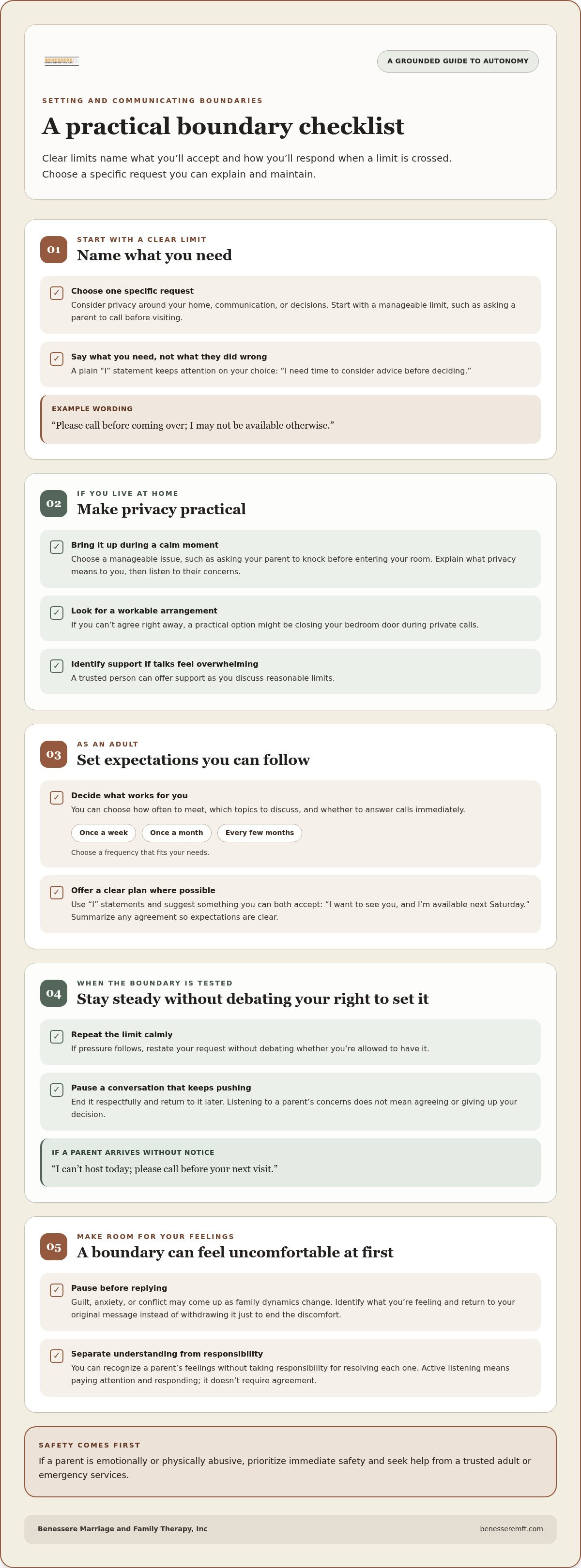
Boundaries clarify what you’ll accept and how you’ll respond when a limit is crossed. Learning how to deal with a controlling parent often starts with choosing a specific request you can explain and maintain.
Privacy and Personal Boundaries
Privacy boundaries define which parts of your home, communication, and decisions remain personal. You can ask a parent to call before visiting or keep your messages private. State your request plainly and explain what you’ll do: “Please call before coming over; I may not be available otherwise.” Clear limits protect your mental health and can strengthen trust when both people respect them.
Describe your need rather than accusing your parent. Saying, “I need time to consider advice before deciding,” keeps attention on your choice. If pressure follows, repeat the limit without debating your right to set it. A calm tone can help you stay focused, even if your parent disagrees or shifts the conversation toward blame.
Boundaries While Living at Home
Living at home means setting limits within shared spaces and household expectations. Choose a manageable issue, such as asking a parent to knock before entering your room, and bring it up during a calm moment. Explain what privacy means to you, then listen to their concerns. If you can’t agree right away, suggest a practical arrangement, such as closing your bedroom door during private calls.
How can you deal with a controlling parent while living at home? Focus on reasonable limits you can maintain, and identify a trusted person to support you if discussions become overwhelming. If a parent is emotionally or physically abusive, prioritize immediate safety and seek help from a trusted adult or emergency services.
Handling a Controlling Parent as an Adult
As an adult, you can decide how often to meet, which topics to discuss, and whether to answer calls immediately. You might suggest meeting once a week, once a month, or once every few months, depending on your needs. A practical part of how to deal with a controlling parent is stating your preference clearly and following through consistently.
Use “I” statements and look for plans you can both accept when possible. For example, say, “I want to see you, and I’m available next Saturday,” instead of defending every choice. Summarize any agreement so expectations are clear. If your parent keeps pushing, end the conversation respectfully and return to it later. You can acknowledge advice while keeping responsibility for your decisions.
Maintaining a boundary means responding consistently when it’s tested. If a parent arrives without notice, you might say, “I can’t host today; please call before your next visit.” If repeated calls interrupt work, respond when you’re available. A boundary doesn’t control another person. It clarifies what you’ll do to protect your privacy, time, and well-being. Choose limits that fit your circumstances, communicate them directly, and change them only when your needs genuinely change.
Signs of controlling parental behavior
Control is easier to recognize in repeated behavior than in a single disagreement. Notice whether your parent respects your choices or repeatedly uses pressure to direct them.
In adulthood, a parent may still expect access to your time, money, or decisions. For example, they might call repeatedly throughout the day and expect an immediate response. Financial support can also become leverage if a parent treats help with rent or bills as authority over your career, relationships, or spending. Look at the pattern: assistance becomes conditional on obedience rather than freely offered support.
Intrusion: repeated calls, messages, or demands for immediate updates disrupt your work or personal time.
Conditional support: a parent connects financial help to your choice of job, partner, or home.
Imposed family expectations: a parent insists that you spend every Sunday together, even when you have other plans.
When recognizing signs of a controlling mother, look for patterns without assuming they’re unique to mothers. For instance, she may criticize an adult child’s partner, then frame the criticism as concern when challenged. She might also interpret a declined invitation as proof of disloyalty. Ask yourself whether you can disagree, make a choice, and communicate it without repeated punishment, blame, or pressure.
A single disagreement about Sunday plans or a worried call doesn’t automatically signal a controlling dynamic. Look at frequency, flexibility, and consequences. Can your parent accept “no” after you explain your decision? Do they adjust when circumstances change? A parent who discusses concerns and respects your autonomy is different from one who repeatedly overrides your choices or makes affection feel conditional.
These patterns can leave you second-guessing everyday decisions. You might delay choosing a class because your mother could disapprove, or feel obligated to report every detail of a date. This ongoing strain can affect confidence and relationships beyond your family. Notice whether you feel tense before calls, hide ordinary choices, or need parental approval for decisions you could otherwise make independently.
Try noting a few specific interactions: what happened, what was said, and how you responded. Concrete examples can help you distinguish a recurring pattern from an isolated conflict. Then choose a strategy, such as stating your preference directly or limiting a conversation that turns critical. Therapy can help you understand the family dynamic and practice communicating while protecting your autonomy.
When both a parent and adult child want to address recurring conflict, family therapy can support discussion about control and healthier family dynamics. It can also help clarify each person’s perspective without making the adult child solely responsible for changing the parent.
Building independence and autonomy
Independence develops through choices you can make and sustain, not one dramatic break. Identify where parental influence most limits your decisions, then choose a manageable place to begin.
Building Independence Gradually
Gradual independence means practicing decisions in manageable steps, which can build confidence and a sense of agency. Choose a quality you want to strengthen, such as self-trust, then identify a step that reflects it. If starting feels difficult, spend two minutes researching a career course or preparing a meal you chose. Small actions can help replace feelings of despair or dependence with evidence that you can act for yourself.
Make a simple plan for one area, such as finances, work, or personal time. If financial dependence complicates your choices, identify a practical next step, like tracking spending or learning which bills you manage. For a career decision, write down what matters to you before asking your parent’s opinion. You can listen to advice while remembering that the decision, and its consequences, are yours.
Respect for a parent doesn’t require handing over control of your life. You may feel guilty when your choices differ from family expectations, especially if a parent has helped you. Notice the feeling without treating it as proof that your choice is wrong. If you make a mistake, take responsibility, learn from it, and decide what you’ll do differently. Avoid blaming every setback on your mother’s control; your own agency can grow alongside an honest understanding of past influence.
Building a Support System
A support system includes people who listen without taking over your decisions. A trusted friend, relative, mentor, or therapist can help you think through a job change or practice saying no. Choose someone who respects your autonomy rather than pressuring you to reconcile, cut contact, or follow their preferred plan. Support is most useful when it helps you hear your own judgment more clearly.
Keep support practical and specific. You might ask a friend to review a résumé, accompany you to view an apartment, or listen after a difficult family conversation. If negative thoughts arise, write down what happened and what you want to do next. A written record gives you concrete examples to discuss with someone you trust, rather than relying only on your parent’s interpretation.
Independence also means allowing relationships to change without treating every disagreement as a final rupture. For example, you can stay in contact while limiting conversations about your career or finances. Review your plan as circumstances shift, and recognize each decision you make without seeking permission. These choices can strengthen self-respect and make autonomy more tangible over time.
Effects on anxiety, self-esteem, and independence
Repeated psychological control can affect how children view their abilities and make decisions. Its effects may continue into adulthood, shaping relationships, confidence, and emotional well-being.
Anxiety and Low Self-Esteem
Anxiety and low self-esteem can develop when a child’s choices are repeatedly questioned or overridden. Perceived psychological control by parents is associated with anxiety and depressive symptoms in children. A person may then seek constant approval, struggle to express feelings, or doubt their sense of self. Recognizing these reactions can help you separate your preferences from years of unsolicited criticism.
A parent’s anxiety may show up as repeated checking, catastrophic warnings, or suspicion about a child’s friends and plans. For example, a parent might interpret a delayed reply as evidence of danger and keep calling. This behavior can feel intrusive, but it doesn’t establish a mental health diagnosis. Focus on what happens and how it affects you, rather than trying to label your parent.
Parental control can reduce children’s perceived competence and increase anxiety. When a parent repeatedly steps in to choose a class, resolve a disagreement, or make a decision, a child has fewer chances to learn through practice. As an adult, you might still feel unable to choose without reassurance. Notice which situations trigger self-doubt, then identify what you already know and can decide independently.
Effects on Independence
Controlling rules can undermine adolescents’ trust in their ability to become independent. Confidence often grows through making choices, handling consequences, and adjusting plans. If you avoid decisions to prevent criticism, start with a manageable choice, such as selecting a weekend activity without seeking permission. Each decision helps you learn about your needs and capabilities.
A study followed 184 children from age 13 to age 32. Adolescents who felt overly controlled by their parents at age 13 exhibited signs of poorer adaptation into mid-adulthood. The study also found that children with controlling parents in their mid-teens were less likely to be in a romantic relationship or achieve academic success by their early 30s. These findings describe associations, not a fixed outcome for every person.
Use these findings as context, not a verdict on your future. If a parent’s unsolicited advice leaves you anxious, pause before accepting it and ask yourself what you think. Write down a decision you made yourself, such as choosing a course or resolving a work problem. Tracking these examples can make your growing sense of self visible and help you recognize where you feel capable. If distress affects daily life, individual psychotherapy can help you explore these patterns and their impact.
Benessere Marriage and Family Therapy, Inc: Individual Psychotherapy
Benessere Marriage and Family Therapy, Inc offers Individual Psychotherapy for people working through the emotional effects of controlling family dynamics. Therapy can provide space to explore how these experiences affect anxiety, self-trust, and relationships, while developing strategies tailored to your needs. Consider individual support if family interactions make it difficult to act on your decisions or setting limits brings ongoing distress.
If you and your parent both want to address recurring conflict, Family Therapy can support conversations about healthier ways to relate. The focus is on understanding each person’s perspective, not assigning blame. Take time to consider what support feels right. Contact Benessere Marriage and Family Therapy, Inc or visit benesseremft.com to learn more.
Choose a Next Step That Supports Your Well-Being
Change doesn’t require resolving every family conflict at once. A useful next step may be noticing one choice you want to make differently, then deciding what support would help you follow through. Learning how to deal with a controlling parent can mean protecting your emotional well-being while allowing the relationship to evolve at a manageable pace.
If you want a dedicated space to understand your responses and strengthen your sense of agency, Benessere Marriage and Family Therapy, Inc offers Individual Psychotherapy. When family members are ready to work together, Family Therapy can support healthier communication. Couples Therapy may help when parental dynamics are affecting your partnership.
You can take time to consider what kind of support feels right for you. When you’re ready, contact Benessere Marriage and Family Therapy, Inc to explore a next step. Your needs matter, and small, intentional choices can help you move toward relationships with more respect and room to be yourself.
Frequently Asked Questions
What are signs that a parent is controlling or overprotective?
A recurring pattern of overriding your judgment, rather than a single expression of concern, can signal controlling behavior. For example, a parent might insist on approving your medical choices or repeatedly criticize your friendships after you’ve asked them to stop. Overprotection may come from worry, but it becomes intrusive when your preferences are dismissed and you feel unable to make ordinary decisions without anticipating conflict.
How can you set healthy boundaries with a controlling parent?
Choose a limit you can state and uphold, such as keeping a particular subject private. You might say, “I’m not discussing my dating life. If it comes up, I’ll change the subject.” Then follow through calmly if the conversation turns intrusive. A boundary explains what you will do rather than trying to force your parent to agree. That makes your response clearer and more consistent.
What should you say to a controlling parent when asserting independence?
Use a direct statement that acknowledges the disagreement while making your position clear: “I understand you would choose differently. I’ve made my decision about this, and I’m not asking you to approve it.” Keep your explanation brief if a longer discussion tends to become persuasion or criticism. You can acknowledge a parent’s feelings without taking back a decision that reflects your priorities.
When should you limit contact or go no contact with a controlling parent?
Consider limiting contact if repeated interactions leave you distressed, interfere with daily functioning, or continue despite clearly stated limits. No contact may be worth considering if communication feels unsafe or harmful, but it’s a personal decision, not a required response to every conflict. Think through practical matters, such as shared responsibilities, and identify emotional support before changing contact. If you face immediate danger, seek emergency help.
How can therapy or family counseling help with a controlling parent?
Individual psychotherapy can help you examine how family conflict affects your emotional well-being and develop ways to respond. Family Therapy offers family members a setting to discuss recurring patterns and work toward healthier communication. Benessere Marriage and Family Therapy, Inc provides both services in Roseville, California. If parental conflict is also affecting your partnership, Couples Therapy may help you address its impact together.
What legal rights do minors have if a parent is controlling or abusive in the United States?
Legal rights and protections depend on state law and the circumstances. Controlling behavior alone doesn’t establish abuse. A minor experiencing abuse can seek help from a trusted adult or emergency services.



Comments