
Roseville Counseling for Imposter Syndrome

What if trying harder to prove you deserve your success is making it harder to recognize what you’ve achieved? You may dismiss praise, credit good outcomes to luck, or worry that others will eventually discover you’re not as capable as they think. These doubts can drive perfectionism and overwork, or make it tempting to avoid opportunities where your abilities might be evaluated. Roseville counseling for imposter syndrome offers a thoughtful space to explore what’s behind these patterns.
Imposter feelings can persist even when there’s clear evidence of your competence. Rather than trying to silence self-doubt, it can help to understand the experiences and beliefs that give it meaning in your life. Individualized counseling offers a place to explore those patterns without judgment or pressure to change faster than feels right.
In this article, you’ll learn how imposter feelings can affect wellbeing, how personal patterns may contribute to them, and how counseling can help you develop a more balanced view of your effort, strengths, and achievements. Benessere Marriage and Family Therapy, Inc. provides individual psychotherapy in Roseville, with evidence-based treatment and psychoeducation tailored to each client’s story and needs.
Table of Contents
Roseville Counseling for Imposter Syndrome: What These Feelings Can Look Like
Why Imposter Feelings Persist: The Self-Doubt Cycle Behind Them
Is Imposter Syndrome a Diagnosis? Understanding the Concern Before Seeking Counseling
What to Expect from Counseling for Imposter Syndrome in Roseville
How Benessere Offers Roseville Counseling for Imposter Syndrome
Roseville Counseling for Imposter Syndrome: What These Feelings Can Look Like
A strong record of achievement doesn’t always quiet the fear of being inadequate. You might receive positive feedback, take on greater responsibility, or complete a demanding course of study and still feel that your success doesn’t reflect your real abilities. That contradiction can be confusing, especially when others see your competence more clearly than you do.
Imposter feelings are a recurring pattern of doubting your achievements or ability despite evidence of competence. They describe an experience, not a formal diagnosis. The phrase is commonly used to describe this pattern, while a clinician can help assess broader mental health concerns. For additional background on the term and its characteristics, see Imposter syndrome on Wikipedia.
Common signs of imposter feelings
The pattern can appear in different ways. Someone may explain a successful presentation as an easy assignment, brush off a colleague’s recognition, or worry that a future project will expose a lack of ability. These reactions aren’t proof that a person is incapable. They may reflect how difficult it feels to take in evidence of competence.
Perfectionism and overpreparation can become attempts to prevent criticism. A student might repeatedly revise an assignment long after it meets the requirements; a caregiver returning to work might feel pressure to master every new task immediately. Others may turn down a leadership role or avoid asking questions because being evaluated feels too risky. These are possible responses, not a checklist everyone experiences.
When self-doubt begins to affect everyday life
It’s common to feel uncertain before a challenge, such as starting a new job, taking an exam, or adjusting to a major life change. Often, that nervousness eases as you gain experience or receive feedback. A persistent pattern may deserve attention when worry follows you through the day, makes it hard to rest, diminishes satisfaction in your work, or makes ordinary decisions feel unusually high-stakes.
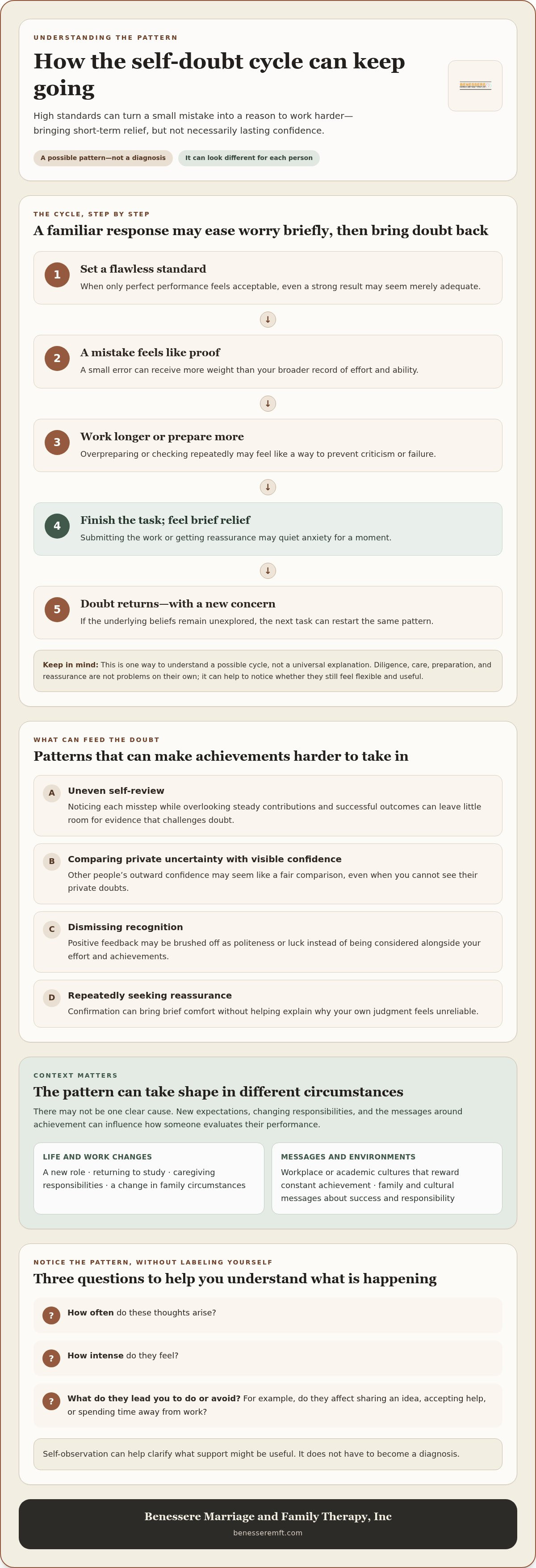
Notice the pattern without trying to label yourself. How often do these thoughts arise? How intense do they feel, and what do they lead you to do or avoid? For example, consider whether fear of making a mistake affects your willingness to share an idea, accept help, or spend time away from work. The answers can help you understand what support might be useful without turning self-observation into a diagnosis.
If self-doubt is persistent or distressing, Roseville counseling for imposter syndrome can provide a collaborative setting to explore your experiences and their effect on daily life. You don’t need to prove that your concern is serious enough before discussing it. The conversation can begin with what you’re noticing and what you hope to understand.
Why Imposter Feelings Persist: The Self-Doubt Cycle Behind Them
Imposter feelings can continue even after you meet a goal because success doesn’t always change the standards you use to judge yourself. If you expect flawless performance, a strong result may feel merely adequate, while a small mistake seems like evidence of inadequacy. You may then give more weight to the error than to your broader record of effort and ability.
One way to understand this is as a possible cycle: high standards create fear of making a mistake; fear leads to overpreparation or working longer than necessary; completing the task brings brief relief; then doubt returns, often with a new concern to manage. This isn’t a universal explanation or diagnosis. It’s a framework for noticing whether a familiar response eases distress only temporarily.
Perfectionism, overwork, and fear of mistakes
Diligence and care aren’t problems on their own. Strain may arise when preparation feels compulsory, rest seems undeserved, or no achievement is allowed to count as enough. Someone who checks a presentation repeatedly may feel calmer once it’s submitted, but conclude that all those extra hours were necessary to avoid failure. That conclusion can strengthen the fear, even when the work was already sound.
Comparison can add another layer. You may measure your private uncertainty against other people’s visible confidence, or notice each misstep while overlooking steady contributions and successful outcomes. In that uneven review, positive feedback can be dismissed as politeness or luck, leaving little evidence available to challenge the doubt.
Short-term reassurance may quiet anxiety for a moment, but it can leave the beliefs beneath self-doubt unexplored. Asking for repeated confirmation, for example, might bring brief comfort without helping you understand why your own judgment feels unreliable. The aim isn’t to reject reassurance or stop preparing; it’s to notice whether these strategies remain flexible and useful.
How personal context can shape the pattern
Imposter feelings can develop in different contexts, and there may not be one clear cause. A new role, a return to study, caregiving responsibilities, or a change in family circumstances can bring unfamiliar expectations. Workplace or academic cultures that reward constant achievement may also influence how you evaluate your performance. Family and cultural messages about success, responsibility, or belonging can shape that inner measure, too.
Consider what tends to happen before doubt becomes intense. Does it rise when expectations change, when you’re being evaluated, or when you compare your progress with someone else’s? Noticing these connections isn’t about assigning blame or assuming a particular past experience. It can make the pattern more understandable and reveal where a different response might be possible.
If you’d like support exploring these experiences, individual psychotherapy in Roseville offers a setting to consider your personal patterns with care. Roseville counseling for imposter syndrome can help you examine how expectations, self-evaluation, and coping habits connect, at a pace suited to your needs.
Is Imposter Syndrome a Diagnosis? Understanding the Concern Before Seeking Counseling
The term “imposter syndrome” can help describe a recognizable experience, but it isn’t a standalone mental health diagnosis. Researchers often use “imposter phenomenon” for this reason. Naming the experience may help you talk about it, but the label alone doesn’t explain why it’s happening or establish a clinical condition.
A descriptive label captures a pattern someone recognizes; a clinical assessment considers a person’s broader symptoms, context, and daily functioning. Similar self-doubt may occur alongside anxiety, low mood, or other concerns, but it doesn’t automatically mean any of them are present. Only a qualified clinician can assess a mental health condition. You don’t need to determine the right label before seeking support.
Imposter feelings and mental health diagnoses are not interchangeable
A phrase used in everyday conversation can offer a starting point for reflection, not a diagnosis. A clinician may consider how long distress has been present, how intense it feels, what else is happening in your life, and whether it affects relationships, work, sleep, or other routines. This broader picture matters because similar feelings can have different meanings for different people.
It’s reasonable to discuss persistent, distressing, or disruptive concerns even if you’re unsure what to call them. Counseling isn’t reserved for a crisis. If self-doubt makes daily decisions harder or consistently interferes with your wellbeing, that impact is worth taking seriously without assuming it points to a particular condition.
What counseling can and cannot promise
Counseling can offer a collaborative space to explore thoughts, emotions, personal context, and the ways you respond to self-doubt. In individualized psychotherapy, that exploration can help clarify what feels most relevant to you. The process isn’t a standardized program, and you don’t need to arrive with a diagnosis or a perfectly clear explanation of what’s wrong.
There isn’t a guaranteed timeline or a quick confidence fix. Progress varies, and counseling can’t promise that difficult feelings will disappear. Instead, it may help you better understand your experience and consider responses that fit your needs. General reflection or self-help practices may be useful for some people, but they don’t replace individualized care when distress is persistent or significantly affecting daily life.
Before seeking support, you might note what you’ve been experiencing, when it tends to arise, and which parts of everyday life feel affected. These observations can give you a starting point for a conversation; they aren’t a test you need to pass. You can also begin simply by saying that you’ve been struggling to trust your abilities or feel at ease with your achievements.
For people considering Roseville counseling for imposter syndrome, the focus can be on understanding the person behind the label rather than trying to fit an experience into a category. Benessere Marriage and Family Therapy, Inc. provides individual psychotherapy in Roseville, using evidence-based treatment, psychoeducation, and interventions tailored to each client’s story and needs.
What to Expect from Counseling for Imposter Syndrome in Roseville
Starting counseling doesn’t require a complete explanation of why you doubt yourself. The process can begin with what feels most pressing, such as anxiety around feedback, difficulty accepting achievements, or pressure to meet expectations that keep shifting. From there, you and your therapist can explore when these concerns arise and what they mean in the context of your life.
Counseling is collaborative, not a fixed sequence of steps or a standardized program. You may identify a concern, consider the situations and expectations connected to it, notice recurring thoughts or responses, and explore alternatives that feel realistic. The conversation can shift as your needs and understanding develop.
How individualized psychotherapy may explore self-doubt
In individual psychotherapy, you might examine how you interpret success, mistakes, praise, or constructive feedback. For example, you could explore whether a small error feels like useful information or proof that you don’t belong. Your therapist can help you look at the assumptions involved without dismissing your feelings or treating one interpretation as the whole story.
Psychoeducation can make patterns easier to recognize by offering accessible ways to understand thoughts, emotions, and responses. This isn’t about applying a label to every reaction. It can provide context for considering why a particular situation feels threatening and what might help you respond with more flexibility. At Benessere, interventions are tailored to each client’s story and needs, with an emphasis on evidence-based treatment.
Small reflections to bring into a first conversation
If it feels useful, take a few notes before a conversation. You don’t need a complete record. A brief example or a question can be enough to begin exploring what’s happening.
Which situations tend to bring up self-doubt, and what thoughts or actions follow?
What does success mean to you, and what are you afraid others might notice?
How does this pattern affect your work, relationships, rest, or choices?
What would you like to feel more able to do, even if uncertainty remains?
These prompts are starting points, not homework or a test. You don’t need to arrive with a diagnosis, a polished explanation, or certainty about what you want from counseling. It’s enough to share what you’ve noticed and what you hope might become clearer.
For a closer look at the practice’s approach, explore individual psychotherapy in Roseville. If you’re considering Roseville counseling for imposter syndrome, learn about counseling at Benessere as a possible next step, at your own pace.
How Benessere Offers Roseville Counseling for Imposter Syndrome
Persistent self-doubt can be a meaningful concern to bring to individual psychotherapy, even though imposter syndrome is not a standalone diagnosis and isn’t the same experience for everyone. is a Roseville practice providing individual psychotherapy. Its approach emphasizes evidence-based treatment, psychoeducation, and interventions tailored to each client’s story and needs.
Here, Roseville counseling for imposter syndrome can mean exploring the experiences and beliefs connected to self-doubt, rather than applying a label or expecting one standard response. The work can begin with the situations that feel difficult now, then develop through a collaborative conversation about what matters to you and what you would like to understand.
A personalized approach grounded in your story
Two people may question their competence for very different reasons. One may feel unsettled after moving into a new role; another may be responding to long-standing expectations about achievement or responsibility. A personalized process makes room for those differences. Benessere’s therapists are trained and mentored to tailor interventions to individual needs, rather than relying on one-size-fits-all advice.
Psychoeducation can help put thoughts, feelings, and responses into accessible context. Together, you can consider how you interpret feedback, what standards you hold yourself to, and how self-doubt affects your choices. Evidence-based treatment provides a foundation for this work, while attention to your individual circumstances helps keep the exploration respectful and relevant. The purpose isn’t to judge your reactions or promise a particular outcome, but to make room for greater understanding.
You might begin by naming one question you hope to explore: “Why is it difficult to accept positive feedback?” or “What do I fear would happen if I made a mistake?” You don’t need to know the answers in advance. Questions can help focus a conversation, while your experiences and needs guide what becomes useful to discuss.
Taking a considered next step in Roseville
Before deciding what support might feel right, consider what you would like counseling to help you understand or change. Perhaps you want to make sense of recurring doubt, respond differently to expectations, or feel less constrained by fear of evaluation. Your hopes can be modest and still matter. They can also change as you learn more about what is contributing to your distress.
Learning about individual psychotherapy in Roseville can help you understand the practice’s approach. If you’d like to take another step, explore care at Benessere in your own time. You don’t need to have everything figured out before beginning a conversation.
Make Room for a More Balanced View of Your Strengths
You don’t have to wait until self-doubt becomes overwhelming to take it seriously. A useful next step can be noticing what you want to understand better: how you respond to success, what makes evaluation feel difficult, or what might help you treat yourself with greater fairness. You can begin with questions rather than certainty.
Roseville counseling for imposter syndrome can offer space to explore these concerns in a way that respects your pace and personal experience. Seeking support isn’t a declaration that something is wrong with you. It can be a thoughtful choice to understand yourself more fully and consider new ways forward.
If you’re ready to learn more, explore individual psychotherapy in Roseville with
Frequently Asked Questions
Is imposter syndrome a mental health diagnosis?
No. “Imposter syndrome” is a common description of persistent self-doubt, not a standalone mental health diagnosis recognized in the DSM-5 or ICD. A clinician doesn’t determine a diagnosis from that phrase alone; they consider a person’s broader experiences, symptoms, context, and daily functioning. You can still seek support for the feelings themselves without having a diagnosis or deciding which label fits.
Can counseling help with imposter syndrome?
Counseling can help you examine how self-doubt affects your choices and how you interpret your experiences. For example, you might explore why a promotion brings more worry than satisfaction, even though you wanted the opportunity. Individual psychotherapy offers a place to look at that response in context and consider what may feel helpful. The process is personal, so a particular outcome or timeline can’t be guaranteed.
How do I know if my self-doubt is affecting my daily life?
Look for patterns in what self-doubt leads you to do. You might repeatedly delay sending routine work, avoid sharing an idea in meetings, or find it difficult to make a decision without seeking reassurance. For a short period, note when these moments occur and what they interrupt. If the pattern regularly affects rest, responsibilities, relationships, or choices, discussing it with a clinician may be useful.
What happens in counseling for imposter feelings?
Counseling often begins with a conversation about what prompted you to seek support and what you’d like to be different. You could bring a recent moment, such as receiving feedback and immediately assuming it was undeserved. Together, you and your therapist can consider your reaction and its context, then identify areas to explore. You don’t need prepared notes or a precise explanation to start.
Can perfectionism and fear of failure be connected to imposter feelings?
Yes, they can be connected, though the relationship differs from person to person. For instance, someone who fears being judged may keep revising a task after it meets the stated requirements. The extra effort may reflect care, but it can also become burdensome if stopping feels unsafe or mistakes seem unacceptable. A therapist can help explore what standards mean to you and how they influence your wellbeing.
How can I find counseling for imposter syndrome in Roseville?
provides individual psychotherapy from its Roseville office, with evidence-based treatment, psychoeducation, and interventions tailored to each client’s story and needs. If you’re considering Roseville counseling for imposter syndrome, reflect on what you’d like support to help you understand, then learn more about individual psychotherapy at Benessere.



Comments