
How to Manage Anger in Relationships: A Practical Guide

Updated: 4 days ago
What if anger is less a sign that your relationship is failing and more a signal that something needs attention? In the heat of an argument, it can be difficult to understand what that signal is saying. You may both react before either of you can explain what hurts, what feels unfair, or what needs to change. Learning how to manage anger in relationships isn’t about pretending you’re not angry or simply telling yourself to calm down. It’s about noticing the emotion and choosing how to respond.
If an angry reaction is followed by regret, distance, or the same unresolved tension, you’re not alone in finding the pattern hard to break. Anger can sometimes sit on top of more vulnerable feelings, such as hurt, fear, or rejection. Recognizing what may be underneath can help you express a concern or boundary more clearly, without excusing behavior that causes harm.
This guide explores what anger may be communicating, how to pause when conflict starts to escalate, and ways to repair after an argument. It also explains when individual psychotherapy or couples therapy may offer a supportive setting to understand recurring patterns and practice communication skills.
Table of Contents
How to Manage Anger in Relationships Without Suppressing It
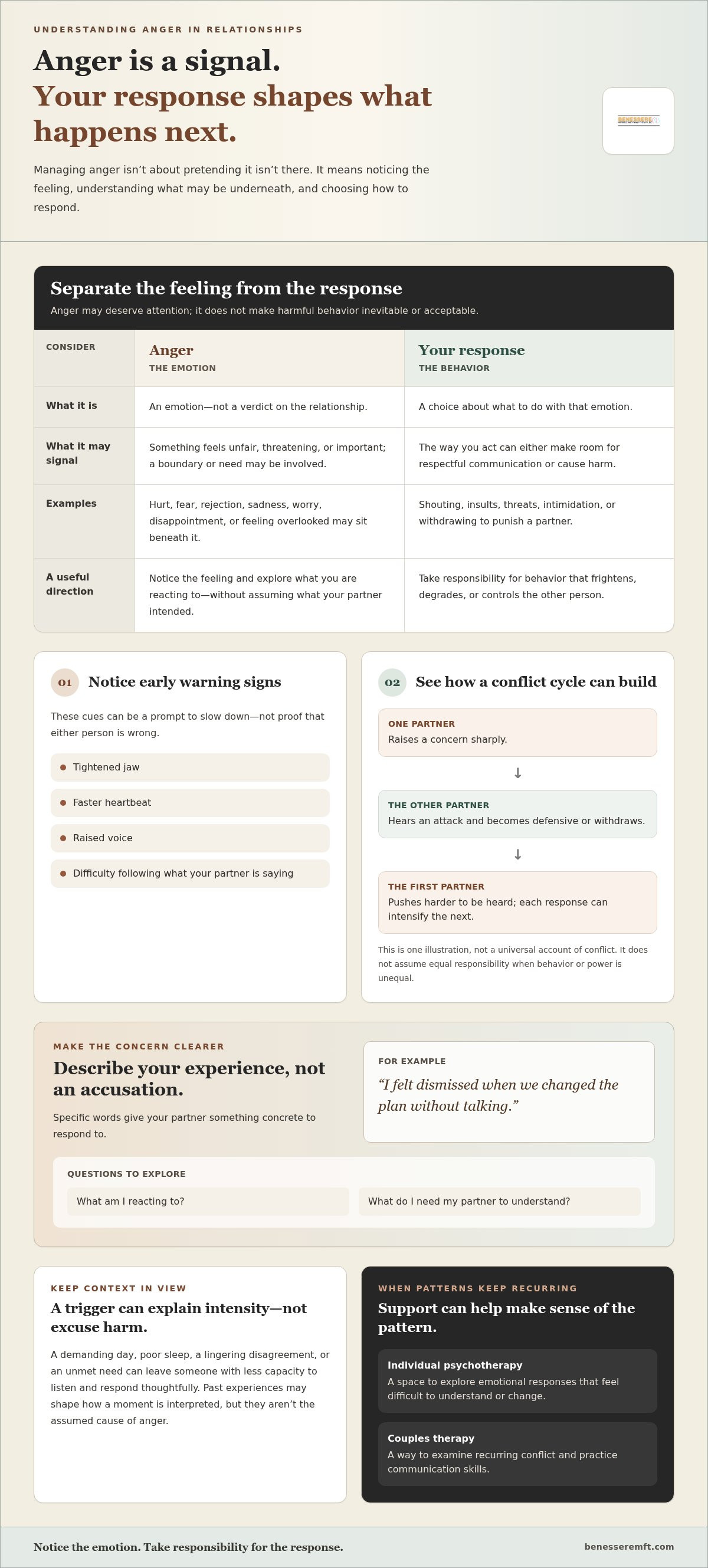
Anger is an emotion, not a verdict on your relationship. It can arise when something feels unfair, threatening, or important, and it may alert you to a concern worth discussing. What matters is how you respond. Shouting, insults, threats, intimidation, or withdrawing to punish a partner are behaviors, not inevitable expressions of anger. Learning how to manage anger in relationships means making room to understand the feeling while taking responsibility for your actions.
Anger is a feeling; harmful behavior is a choice about what to do with that feeling. This distinction doesn’t mean every reaction is easy to control in the moment or that the emotion should be pushed away. It offers a useful starting point: you can acknowledge anger and still work toward a response that respects both people. The Anger Management overview also discusses approaches to understanding and managing anger.
Feeling angry doesn’t automatically mean a relationship is unhealthy or beyond repair. Partners can disagree, become frustrated, and still treat one another with care. A more concerning pattern is conflict that repeatedly escalates or remains unresolved. Over time, partners may become less willing to be open, trust that they’ll be heard, or seek closeness after a disagreement. The issue isn’t simply that anger appears; it’s whether the relationship has room for respectful communication and repair.
What can anger signal in a relationship?
Anger may prompt you to look more closely at what feels wrong, but it isn’t proof of what your partner intended. You might wonder whether a boundary felt crossed, a need went unmet, or fear or hurt was stirred. Treat these as possibilities to explore, not conclusions about either person. Pausing to ask, “What am I reacting to, and what do I need my partner to understand?” can make the next conversation more precise.
Specific words often open a clearer path than a broad accusation. “I felt dismissed when we changed the plan without talking” gives a partner something concrete to respond to. Naming sadness, worry, disappointment, or feeling overlooked may also help explain what sits beneath the anger. The aim isn’t to find a hidden emotion every time, but to describe your experience as accurately as you can.
When does anger begin to harm connection?
Pay attention when disagreements regularly turn into contempt, intimidation, personal attacks, or silence that prevents any return to the issue. These patterns can make it harder for either partner to speak honestly and rebuild trust. Stress, past experiences, or emotional pain may help explain why a reaction happened, but they don’t remove responsibility for its impact. Each person remains accountable for behavior that frightens, degrades, or controls the other.
You don’t need to label yourself or decide the future of your relationship based on one argument. Instead, notice whether the pattern repeats, whether both partners can acknowledge harm, and whether efforts to repair lead to a more respectful conversation. If anger feels difficult to understand or change, individual psychotherapy can offer space to explore your emotional responses. Couples therapy can help partners examine recurring conflict and practice communication skills, while specialized options such as Balazs Varga Workshop offer personal consultations and relationship workshops centered on personal growth and interpersonal dynamics.
Why Anger Escalates Between Partners: Triggers, Stress, and Conflict Cycles
Arguments rarely unfold in isolation. A demanding day, poor sleep, a lingering disagreement, or an unmet need can leave someone with less capacity to listen and respond thoughtfully. Past experiences may also shape how a moment is interpreted, but they aren’t the assumed cause of anger. Context can help explain why a reaction felt intense; it doesn’t excuse insults, threats, or other harmful behavior.
Recognizing a trigger doesn’t dictate your response; it gives you a moment to choose one. That moment may be brief, so it helps to notice your own early warning signs. A tightened jaw, faster heartbeat, raised voice, or difficulty following what your partner is saying can signal that the conversation is becoming harder to navigate. These cues aren’t proof that either person is wrong. They’re prompts to slow down before reacting.
How do personal triggers shape arguments?
Look for patterns rather than assigning blame. Notice which topics recur, what tends to happen just before tension rises, and what meaning you attach to the moment. A delayed reply might feel like disregard to one partner and like an ordinary consequence of being busy to the other. Ask yourself what you observed, what you assumed, and what feeling or need may be involved. The same disagreement can carry different meanings for each person.
How does a conflict cycle keep repeating?
One possible cycle begins when a partner raises a concern sharply. The other hears an attack and becomes defensive or withdraws; the first partner then pushes harder to be heard. Each response can intensify the next, even if neither person set out to hurt the other. This is an illustration, not a universal account of conflict. Each partner can examine their own choices without assuming equal responsibility when behavior or power is unequal.
To understand a recurring pattern, describe the sequence as neutrally as you can: “I bring up the missed plan, you go quiet, then I repeat myself more forcefully.” This creates room to consider how the interaction shifts, rather than debating whose reaction started everything. It can also help you identify where a different response might interrupt the cycle, such as asking a clarifying question or saying you need a pause.
Stress and assumptions can narrow attention, making it easy to respond to what you fear a comment means instead of what was actually said. Check your interpretation: “I’m hearing this as criticism. Is that what you meant?” If the exchange is already escalating, noticing that you’re overwhelmed or struggling to stay present may be a cue to pause and return when you can listen again.
When these patterns keep returning, marriage and family therapy in Roseville can offer a supportive setting to explore recurring conflict and practice communication skills. At Benessere Marriage and Family Therapy, couples therapy is tailored to partners’ needs and can help them understand how their interactions develop. Learn about couples therapy in Roseville as one way to begin that exploration.
Is Anger Always the Problem? Separate Emotion, Behavior, and Safety
Anger can be uncomfortable, but feeling it is different from acting in ways that frighten, demean, or control a partner. A person may feel angry and still express the concern respectfully. Insults, threats, coercion, intimidation, and physical aggression are behaviors that require accountability. Stress or emotional pain may be part of the context, but neither makes harmful conduct acceptable.
This distinction matters because ordinary disagreements and safety concerns need different responses. A conversation about frustration may benefit from listening and repair. Fear, threats, or violence call for a focus on safety, not simply better communication.
How can partners express anger with accountability?
Use clear, specific language: “I felt overwhelmed when we discussed this in front of the children. I’d like us to talk privately.” Then make room for the other person’s perspective. Listen before preparing a rebuttal, and ask for clarification if you’re unsure what they mean. Accountability also includes repair: a sincere apology acknowledges the impact, avoids excuses, and names a realistic change, such as taking a pause before continuing a heated conversation.
These skills can support respectful disagreement, but they don’t guarantee that both partners will respond safely or constructively. Learning how to manage anger in relationships includes recognizing when a conversation is no longer the right tool for addressing what’s happening.
When should relationship safety come first?
Fear, threats, physical aggression, or coercive control are serious warning signs. If you or someone else faces immediate danger, move toward safety if possible and contact local emergency services or appropriate crisis support. You don’t need to wait for an incident to become more severe before seeking help.
Communication exercises and couples conversations aren’t a solution to abuse or immediate danger. In those circumstances, safety-focused support should come first, and it may be important to seek help independently. If you’re unsure how to assess what’s happening, consider speaking confidentially with a qualified support professional who can help you think through options without pressuring you to make a particular relationship decision.
What to Do During and After an Angry Argument
A pause can keep an argument from becoming more hurtful, but it works best when both partners understand what it means. A timeout isn’t punishment, abandonment, or a way to make the other person wait indefinitely. It’s a planned break from the conversation so each person can settle enough to return and address the concern. If either partner feels unsafe, prioritize safety rather than trying to continue or resolve the argument together.
How can you pause before anger takes over?
Notice signs that you’re becoming overwhelmed, such as a tight jaw, racing thoughts, a raised voice, or an urge to send a sharp message. If you can, stop speaking and agree on when you’ll reconnect. For example: “I want to work this out, but I’m getting too upset to listen. Can we take a break and talk after dinner?” If a specific time isn’t realistic, agree on a clear check-in point instead of leaving the return open-ended.
During the pause, choose something that helps you become more present. You might try slow breathing, grounding yourself by noticing what you can see and hear, or taking a brief walk. These are options, not guaranteed ways to feel calm. Avoid composing a rebuttal or sending messages that keep the argument going. If you need more time, communicate that and suggest another return point rather than disappearing from the conversation.
How do you return to the conversation and repair?
Once you’re both ready to listen, keep the discussion focused on one issue. Describe a specific event and its effect without using global accusations such as “you always” or “you never.” Before offering your own interpretation, reflect what you heard: “You felt left out when I made that decision without checking with you. Did I understand?” Then share your perspective and invite a response.
Repair doesn’t require solving every related disagreement in one conversation. Acknowledge your part, make a specific apology if you caused harm, and identify a small next step, such as agreeing to discuss schedule changes before making plans. If another concern surfaces, note it and choose a calmer time to return to it.
A pause-and-repair process:
Notice the signs that the argument is escalating.
Pause safely and say why you need a break.
Regulate in a way that helps you become more present.
Agree when to return, with a clear time or check-in point.
Discuss one concern, listen to understand, and agree on a next step.
This sequence offers a practical starting point for how to manage anger in relationships, though it can take practice to use consistently. Couples therapy can provide a supportive setting to understand recurring conflict and practice communication skills together. Explore couples therapy with Benessere.
How Therapy Can Help Couples Manage Anger and Rebuild Communication
When anger repeatedly disrupts connection, it can be difficult to change the pattern using good intentions alone. Couples therapy offers a collaborative setting to look at what happens between partners during conflict, understand each person’s perspective, and practice more constructive ways to communicate. The work is tailored to the couple’s needs; it doesn’t promise reconciliation or a particular outcome.
At Benessere Marriage and Family Therapy in Roseville, couples therapy helps partners explore recurring conflict and build communication skills. A therapist may help slow down familiar interactions so each person can notice what they’re reacting to, how they communicate a concern, and what might make a repair attempt easier to hear. The aim is greater understanding and more intentional choices, not deciding who is “the problem.”
What can couples explore in therapy?
Partners can examine situations that tend to trigger anger, the meanings each person attaches to them, and the communication needs that may be difficult to express. They can also consider what happens after conflict, including whether apologies or attempts to reconnect feel genuine and useful. Psychoeducation and evidence-based interventions may help make these patterns easier to understand, while the therapist tailors the work to each person’s story and needs.
Sometimes a person also wants space to understand their own emotional responses outside the couple’s conversations. Individual psychotherapy in Roseville can provide an opportunity for personal exploration, including how anger develops and what responses feel more aligned with one’s values.
When might professional support be useful?
You might consider support if arguments repeatedly harm closeness, if you struggle to put concerns into words without escalation, or if efforts to shift the pattern haven’t helped. Seeking therapy doesn’t mean you’ve failed or that your relationship is beyond repair. It can be a proactive way to better understand what’s happening and consider what each person needs to participate in change.
Learning how to manage anger in relationships is a process. Benessere Marriage and Family Therapy offers couples therapy in Roseville to help partners explore recurring conflict and communication patterns.
Take the Next Step at Your Own Pace
Change doesn’t require you to have every answer before you begin. A useful next step may be noticing one moment when you want to respond differently, or acknowledging that a familiar pattern feels difficult to shift alone. Small, thoughtful choices can create room for a different kind of conversation over time.
Learning how to manage anger in relationships is personal work, and support should respect the people and circumstances involved. Benessere provides psychotherapy for individuals, couples, and families, with therapeutic interventions tailored to each client’s unique story and needs. Exploring support doesn’t commit you to a particular decision about your relationship; it can offer space to consider what would be helpful.
If you’re ready to work on recurring conflict, contact Benessere Marriage and Family Therapy about couples therapy in Roseville.
Frequently Asked Questions
Is it normal to feel angry at your partner?
Yes, anger can arise in close relationships, including over ordinary differences in priorities, plans, or expectations. The feeling alone doesn’t determine the health of a partnership. Consider how often it appears, what you do when it does, and whether you can discuss the issue without fear. For example, feeling frustrated about uneven household tasks can prompt a conversation about sharing responsibilities rather than a judgment about the relationship as a whole.
Can taking a break during an argument help?
Yes, a break can help if it gives both partners time to settle and includes a clear plan to reconnect. For example, agree to stop texting about the issue and check in later that evening. If one person needs longer, they can suggest another specific time to talk. In learning how to manage anger in relationships, the return matters: a pause is useful when it creates space for discussion, not indefinite avoidance.
How do I apologize after getting angry at my partner?
Offer an apology that names what you did and recognizes its impact, without adding a “but” that shifts responsibility. You might say, “I raised my voice and interrupted you. I can see that made it harder for you to share what you needed.” Then identify a realistic change, such as asking to pause before you reach that point. Allow your partner to respond in their own time; an apology doesn’t obligate immediate forgiveness.
Can past trauma contribute to anger in a relationship?
Past trauma can shape how someone experiences conflict, but it isn’t the explanation for every angry reaction. A disagreement may feel especially threatening or activating for reasons connected to earlier experiences, though only the person can explore what fits their story. Notice what situations intensify your response and whether certain interpretations recur. Individual psychotherapy can provide a supportive place to examine these reactions without assuming a cause or minimizing responsibility for present-day behavior.
What if my partner refuses to talk about our arguments?
If your partner isn’t ready to talk, repeated attempts in the heat of the moment may increase tension. Ask whether they’d be willing to choose a time to discuss one specific issue, or offer to write down what you hope to address. If they continue to decline, you can explain what you need for the relationship to feel workable and consider individual support to clarify your options. You can invite conversation, but you can’t make someone participate.
When should anger in a relationship be treated as a safety concern?
Treat it as a safety concern if you feel afraid, face threats or physical aggression, or experience behavior that restricts your choices through intimidation or control. Don’t rely on a communication exercise to resolve danger. If there’s immediate risk, move to a safer place if possible and contact local emergency services or crisis support. A trusted person or a domestic violence support service can help you consider safety options at a pace that feels manageable.
Can couples therapy help when anger keeps returning?
Couples therapy may help partners examine recurring interactions and practice different ways to communicate, particularly when attempts to change the pattern together haven’t lasted. It can offer a structured setting to explore what each person experiences and what skills may be useful. It doesn’t guarantee reconciliation or a specific result. Couples therapy in Roseville may be an option to consider if both partners are willing to participate and the relationship is safe for joint conversations.


Comments