
How to Stop Being a People Pleaser Without Losing Your Kindness

Updated: Oct 10
What if setting a boundary could be an act of care, rather than a sign that you’ve stopped caring? If you say yes automatically and then feel overwhelmed or resentful, it makes sense to wonder how to stop being a people pleaser without disappointing the people who matter to you. The answer isn’t to become less kind. It’s to make room for your needs and values alongside other people’s.
People-pleasing patterns can develop around fears of rejection, conflict, or letting others down. Recognizing them isn’t about blaming yourself or treating kindness as a flaw. It’s a way to understand what may be driving your responses and begin making choices more deliberately.
This article explores common roots of people-pleasing and offers practical ways to pause before agreeing, decline respectfully, and communicate your limits. You’ll also learn how to notice needs and preferences that may have become hard to hear, and when individual psychotherapy could help you explore persistent patterns. Change can happen gradually while your compassion for others remains intact.
Table of Contents
What Does It Mean to Be a People Pleaser?
Accommodating others can feel protective, familiar, or necessary, especially if keeping the peace has helped you feel secure in important relationships. Being considerate is not, by itself, a problem. People-pleasing describes a recurring pattern in which someone prioritizes others’ approval or comfort while setting aside their own needs, preferences, or limits.
Helpful kindness considers other people without erasing yourself; people-pleasing silences your needs to reduce the risk of disapproval. The difference often lies not in a single yes, but in whether you feel free to choose. You might willingly help a friend and still recognize when you don’t have the capacity. A pattern may be present when agreeing feels automatic, even as you feel uneasy or overextended.
The related concept of Sociotropy describes a tendency to place strong value on relationships and others’ approval. It can offer context for understanding approval-seeking, but it doesn’t mean that everyone who is accommodating shares the same traits or has a mental health diagnosis. People’s experiences are individual.
Common Signs of People-Pleasing in Everyday Life
People-pleasing can show up in small, repeated choices: saying yes before checking your schedule, apologizing when you haven’t done anything wrong, or struggling to say what you’d prefer. You might take on extra work to avoid disappointing a colleague, agree with friends despite wanting something different, or change family plans because expressing your preference feels uncomfortable.
Other signs include overcommitting, closely monitoring others’ moods, and feeling responsible for keeping everyone comfortable. Any one of these behaviors can happen occasionally. Look for a repeated pattern, and notice how you feel after agreeing.
How the Pattern Can Affect Well-Being and Relationships
Repeatedly setting aside your needs can contribute to stress, fatigue, or resentment, though these effects aren’t inevitable. You may feel frustrated with others even when they don’t know you’re struggling, because the limits you needed were never clearly expressed.
Unspoken preferences can also make communication less clear. A loved one may believe you’re comfortable with an arrangement while you’re quietly wishing it would change. Noticing this gap isn’t a reason to criticize yourself. It’s an opportunity to get curious about what you’re feeling and what you may need. That awareness is a useful starting point as you explore how to stop being a people pleaser without giving up genuine care for others.
Why People-Pleasing Develops and What Keeps It Going
People-pleasing can take shape for different reasons, and there isn’t one explanation that fits everyone. Family expectations, cultural values, past relationships, and other life experiences may influence how safe it feels to disagree or express a need. Accommodating others may once have helped someone preserve connection or avoid tension, even if the same response feels limiting now.
Understanding how a pattern developed doesn’t require assigning blame; it can help you see what the response has been trying to do for you. This perspective makes room for curiosity about your own history without assuming that a particular family dynamic or experience must be the cause. For those interested in exploring how attachment and emotional dependency shape these relational habits, resources like glauciasantana.com provide valuable psychoanalytic perspectives.
Fear of Conflict, Rejection, or Disapproval
If you anticipate that someone may react badly to a refusal, agreeing immediately can feel safer in the moment. For example, a person might accept an extra responsibility at work because they worry their manager will see hesitation as a lack of commitment. That choice may bring temporary relief, but the underlying worry remains. Saying yes can become the familiar response the next time a similar request comes along.
A pause can interrupt that cycle. Rather than answering while anxious, you might say, “Let me check and get back to you.” The space gives you time to notice your feelings and consider your capacity before responding. Learning how to set healthy boundaries can also involve identifying what you’re comfortable with and communicating it clearly.
Learned Roles and Personal Expectations
Being praised as easygoing, helpful, or dependable can feel affirming. Over time, though, someone may begin to expect themselves to remain agreeable, even when they have a different preference or need. Relationship norms and cultural expectations can shape what feels polite or acceptable, but their influence varies from person to person. It’s best not to assume a particular history or psychological explanation without understanding someone’s individual experience.
When accommodating others is followed by relief, that short-term easing of tension can reinforce the response. Later, unaddressed needs may contribute to frustration, making the next request harder to meet. This isn’t a personal failing. It’s a pattern that can be examined and changed gradually.
If you’re beginning to explore how to stop being a people pleaser, individual psychotherapy may offer a collaborative space to understand what sustains the pattern and consider responses that fit your needs. Benessere Marriage and Family Therapy, Inc provides individual psychotherapy in Roseville, with interventions tailored to each client’s story. Learn more about individual psychotherapy in Roseville.
Does Setting Boundaries Make You Selfish?
No. A respectful boundary is not automatically a rejection of another person. It communicates what you can offer, what you’re comfortable with, or what you need, while leaving room to care about the other person’s feelings. Someone may feel disappointed when you say no, but disappointment alone doesn’t determine whether your limit is fair.
The distinction often comes down to choice and consideration. A compromise makes room for both people’s needs; self-abandonment happens when you repeatedly ignore your own capacity mainly to avoid disapproval. Care for others and care for yourself don’t have to compete.
Kindness, Compromise, and Self-Abandonment Are Not the Same
Imagine a friend asks for help moving on a day you had planned to rest. You might choose to help for an hour, suggest another time, or decline because you need the rest. Each response can be caring if it reflects an honest choice. Saying yes while feeling pressured, depleted, or afraid that your friend will withdraw is different from freely offering help.
As you consider how to stop being a people pleaser, ask yourself: “Am I choosing this because I want to, or mostly because I’m worried about the reaction if I don’t?” The answer isn’t a verdict. It can clarify whether you’re making room for both people or setting your own needs aside.
What a Respectful Boundary Can Sound Like
Clear limits can be warm and brief. You don’t need to blame someone, provide an elaborate defense, or promise to change their behavior. For example:
“I can’t commit to that this week, but thank you for asking.”
“I need some time to think before I answer.”
“I understand this matters to you. I’m not available to help today.”
Direct boundary-setting isn’t equally safe or practical in every situation. Power differences, dependency, or concerns about someone’s reaction may affect how you communicate a limit. You can consider a safer approach, seek support, or take time to decide what feels appropriate. A boundary is not a demand that another person feel pleased; it’s a way to communicate your own limits with care.
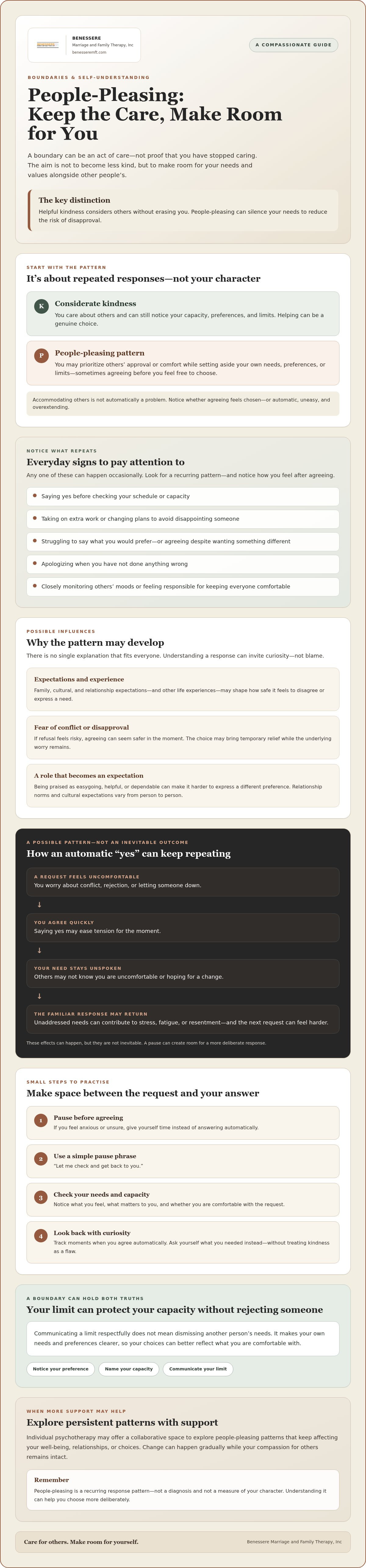
How to Stop Being a People Pleaser: Small Steps to Practise
Changing a familiar response doesn’t require you to transform every relationship at once. Treat each new response as an experiment: something to practise, observe, and adjust to your circumstances. A useful sequence is: pause, check your capacity, choose a response, and reflect afterward.
You can keep a brief, nonjudgmental record of situations where you agreed automatically. Note what was asked, what you said, what you felt, and whether a need or limit went unspoken. The aim isn’t to grade yourself. It’s to notice patterns that may be difficult to see in the moment.
Pause Before Agreeing
Try a neutral delay phrase such as, “Let me check my schedule and get back to you.” Even a short pause can create room to distinguish genuine willingness from urgency, guilt, or fear of someone’s reaction. Practise first in lower-stakes situations, such as deciding whether you can take on a small favor. You don’t need to feel completely calm before taking time to think.
Practise Naming Needs and Saying No
Before accepting a request or making a plan, identify one preference or limit. Ask yourself whether you have the time, energy, or interest to take part. Then choose language that fits what you need to communicate:
Declining: “I can’t commit to that right now.”
Negotiating: “I can help with one part, but I can’t take on the whole task.”
Asking for time: “I’d like to think about it before I answer.”
Afterward, reflect on what you communicated and how it felt. Another person’s reaction may give you information about the interaction, but it isn’t proof that you failed or that your limit was unfair.
Build Tolerance for Discomfort Without Self-Punishment
A respectful response can still feel unfamiliar, and you may feel guilty or uneasy afterward. Try grounding yourself by taking a few slow breaths, noticing what’s around you, or reminding yourself why you chose that response. Speak to yourself with the same understanding you’d offer someone practising a difficult skill.
There’s no guarantee that others will respond positively or immediately. Adapt these exercises to your relationships and circumstances, and seek support if the pattern feels hard to shift alone. If you’re in Roseville, explore individual psychotherapy with Benessere Marriage and Family Therapy, Inc, where support is tailored to each client’s needs.
When Therapy Can Help With People-Pleasing Patterns
People-pleasing isn’t a disorder, and therapy isn’t necessary for everyone who finds it hard to say no. Still, individual support may be worth considering if the pattern repeatedly affects your well-being, relationships, or everyday decisions. You might notice that you’re often agreeing to commitments you can’t manage, avoiding important conversations, or struggling to identify what you want apart from others’ expectations.
Therapy can provide a collaborative space to explore these experiences without treating them as a character flaw. Rather than following a single formula for how to stop being a people pleaser, you and your therapist can consider what feels relevant to your circumstances and identify possible ways forward at a manageable pace.
What You Might Explore With an Individual Therapist
Conversations may focus on situations where you feel pressure to agree, the emotions that arise when you consider setting a limit, and the values you want your choices to reflect. You might also explore communication patterns and practise expressing needs in ways that feel clear and respectful. A therapist can tailor conversations and interventions to your individual story and needs. Learn more about individual psychotherapy in Roseville.
Personal stories can shape how someone understands their role in relationships, though each person’s experience is distinct. If you’re curious about how meaning and perspective might be part of that exploration, read about narrative therapy and personal agency.
Choosing a Next Step That Feels Manageable
You don’t need to arrive with a complete explanation or a specific goal. It may be enough to consider what you’d like support to help you understand or practise. For example, you might want to notice your needs sooner, feel more prepared to pause before answering, or communicate a limit with less self-doubt. These intentions can help begin a conversation, and they can evolve over time.
If you’re in Roseville and considering individual psychotherapy, Benessere Marriage and Family Therapy, Inc offers a possible next step. Its approach emphasizes evidence-based treatment and support tailored to each client’s needs, without promising a particular outcome. If it feels right for you, explore support from Benessere in Roseville.
Make Room for Your Needs, One Choice at a Time
Learning how to stop being a people pleaser doesn’t mean becoming less compassionate. It means making choices that can honor both your care for others and your own capacity. A pause before answering, a clearer sense of what you need, and a respectful boundary can help you respond with intention rather than habit.
People-pleasing patterns can have different roots, so noticing yours is a starting point, not a reason for self-criticism. Practise gradually, and remember that discomfort or another person’s disappointment doesn’t automatically mean you’ve done something wrong. If the pattern keeps affecting your well-being, relationships, or daily choices, individual psychotherapy may offer a collaborative space to explore it. Benessere Marriage and Family Therapy, Inc provides evidence-based care tailored to individual needs in Roseville.
Explore individual psychotherapy with Benessere Marriage and Family Therapy, Inc in Roseville if you’d like to consider support. You can move at a pace that feels right, and kindness can include you, too.
Frequently Asked Questions
Is people-pleasing a mental health disorder?
People-pleasing is commonly used to describe a pattern of behavior, not a diagnosis by itself. A few accommodating choices don’t establish a mental health condition, and a list of signs can’t diagnose you. If the pattern is causing persistent distress or interfering with relationships, well-being, or daily life, consider discussing it with a qualified mental-health professional. They can consider your full context, since people’s experiences and reasons for accommodating others vary.
Can you stop being a people pleaser without hurting your relationships?
You can practise changing people-pleasing responses without becoming uncaring or changing every relationship abruptly. Small, respectful shifts, such as asking for time before you answer, can make communication clearer. Others may need time to adjust, and no approach can guarantee that every relationship will respond well. Consider the relationship and your safety before deciding how directly to express a boundary; you can choose a method that feels appropriate to your circumstances.
How do I say no without feeling guilty?
Guilt can arise even when your decision is reasonable, especially if saying yes has become automatic. Pause, check your capacity, then use a brief response such as, “I can’t commit to that this week.” Practising how to stop being a people pleaser doesn’t mean waiting for guilt to disappear before setting a limit. Acknowledge the feeling without treating it as proof you’ve done something wrong, and begin with lower-stakes situations.
What is the difference between being kind and being a people pleaser?
Kindness can include care for others while leaving room for your needs and free choice. People-pleasing describes a recurring pattern of prioritizing approval or avoiding disapproval, sometimes at personal cost. One behavior doesn’t define a person. For example, freely offering a friend help because you want to is different from agreeing while feeling unable to decline. The distinction often depends on whether you feel able to choose honestly.
Why do I feel responsible for other people’s feelings?
People may learn to monitor others’ emotions for many reasons, including family, cultural, or relationship expectations, but no single explanation applies to everyone. Caring about someone’s feelings doesn’t mean you’re solely responsible for changing them or preventing every disappointment. Notice when you assume another person’s mood is yours to fix, and consider where that belief may come from. If it causes ongoing distress, a therapist can help you explore its context.
How can therapy help with people-pleasing?
Individual therapy may offer a collaborative space to explore recurring responses, personal needs, and relationship patterns. A therapist can tailor conversations and possible interventions to your circumstances rather than assume one explanation fits everyone. Therapy isn’t necessary for every person who struggles to say no, and outcomes can’t be guaranteed. For readers in Roseville, Benessere Marriage and Family Therapy provides individual psychotherapy, with evidence-based care tailored to each client’s needs.
What should I do if someone reacts badly to my boundary?
Another person’s disappointment or frustration can feel difficult, particularly when setting limits is new. If it feels appropriate, consider whether your words were clear and respectful, but don’t assume you must withdraw the boundary because someone disliked it. Their reaction alone doesn’t determine whether your limit is fair. If the situation involves intimidation, coercion, or safety concerns, prioritize appropriate support and avoid direct confrontation if it may put you at risk.



Comments