
How to Trust Again After Being Hurt: A Gentle, Practical Guide

Updated: 4 days ago
What if trusting again doesn’t mean lowering your guard or pretending the hurt didn’t happen? If you’re searching for how to trust again after being hurt, it may be because part of you wants connection while another part stays alert for signs of danger. That caution can be a reasonable response to what you’ve experienced, even when it leaves you unsure how to move forward.
Rebuilding trust isn’t a test of how quickly you can forgive or open up. It can start with listening to your discomfort, noticing what helps you feel safe, and letting trust grow through consistent actions over time. You don’t have to erase the past to make room for new experiences.
This guide explores why trust can feel difficult after a painful experience and how to rebuild it gradually, without dismissing your boundaries or rushing your healing. You’ll find practical ways to strengthen self-trust, recognize the difference between protective caution and feeling stuck, and consider when individual psychotherapy or couples therapy in Roseville might support your next steps.
Table of Contents
Why It Can Feel So Difficult to Trust Again After Being Hurt
After someone has hurt or deceived you, closeness can feel uncertain, even when you still want connection. You may watch for changes in someone’s tone, look for inconsistencies, or hold back from sharing something personal. This caution can be an understandable attempt to protect yourself based on what happened. It doesn’t, by itself, mean something is wrong with you.
Learning how to trust again after being hurt doesn’t require ignoring warning signs or reconciling with the person who caused harm. Trust grows gradually in response to what someone shows through their behavior over time. The work may also involve more than deciding whether another person is trustworthy. It can mean learning to trust your own perceptions, needs, and choices again.
What Does It Mean to Trust Again?
Trusting again means becoming willing to rely on someone in a particular way as their actions show honesty, reliability, and respect over time. It isn’t certainty that the person will never make a mistake. Rather, it means having enough reason to believe concerns can be discussed and boundaries respected. The social science of trust also considers how trust shapes relationships and cooperation.
Why Hurt Can Change How Safe Connection Feels
A familiar situation, a delayed reply, or a promise that sounds like one that was broken before may bring up worry, doubt, or a wish to pull away. These reactions don’t necessarily mean you’ve reached a final conclusion about the person in front of you. They may reflect how an earlier experience has shaped what feels safe now.
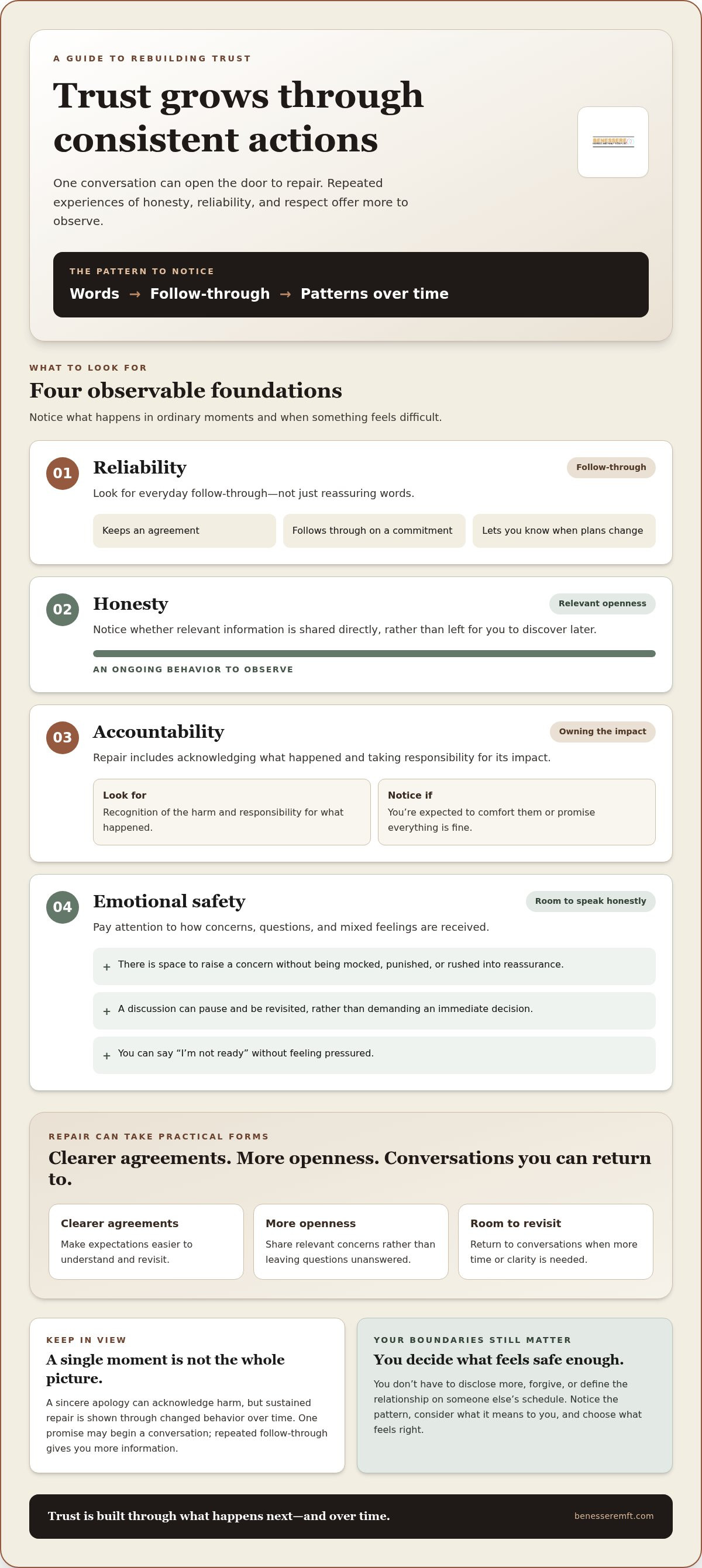
Trust can grow through repeated, observable experiences of honesty, reliability, and respect. A caring conversation can be a starting point, but a pattern over time offers more information. Notice what happens when you express a concern: does the other person listen, respond honestly, and try to understand the impact, or dismiss your experience and pressure you to move on?
Self-trust can feel unsettled, too. You might question why you didn’t notice a problem sooner, or wonder whether your unease is a useful signal or a reaction to past hurt. You don’t have to answer immediately. Try separating what you know from what you fear: what happened, what you’re noticing now, and what remains uncertain. That can help you consider your judgment without demanding complete certainty.
There’s no single pace that proves you’re healing. You might feel open one day and guarded the next, especially when something reminds you of the hurt. Rather than treating caution as failure, consider what it may be asking you to notice. Your observations can help you decide what feels safe enough to share, what boundaries you need, and whether trust in this relationship is being earned.
How Trust Rebuilds Through Emotional Safety and Consistent Actions
After a breach of trust, a conversation can open the door to repair, but words alone can’t show what will happen next. Emotional safety grows when you can raise concerns, ask questions, and express mixed feelings without being mocked, punished, or rushed into reassurance. Trust involves vulnerability: sharing honestly includes some uncertainty, so it matters whether the other person responds with care and respect.
Safety isn’t a feeling you can force, and no single gesture proves a relationship is secure. Observe how someone responds over time and decide what those experiences mean to you. Repair might include clearer agreements, more openness about relevant concerns, or a willingness to revisit conversations when needed. Your boundaries remain important throughout.
The Role of Reliability, Honesty, and Accountability
Reliability shows up in ordinary moments: a person keeps an agreement, follows through on a commitment, or tells you when plans change. Honesty means sharing relevant information rather than leaving you to discover it later. Accountability includes acknowledging the impact of what happened and taking responsibility without making you comfort them or promise that everything is fine.
A sincere apology can acknowledge harm, but sustained repair is shown through changed behavior over time. One promise may begin a conversation; repeated follow-through gives you more information. As you consider how to trust again after being hurt, notice whether actions align with words, including when keeping an agreement is inconvenient. No single behavior proves a relationship is safe, and you’re allowed to keep observing.
How to Notice Whether Emotional Safety Is Growing
Pay attention to what happens when you disagree or ask for clarity. Can both people speak honestly, even if they have different feelings about the past? Is there room to pause a discussion and return to it, rather than demanding an immediate decision? The psychology of trust helps frame trust as involving vulnerability, not certainty that you’ll never feel uneasy.
You might notice small changes: you can ask a question with less fear of the response, or say “I’m not ready” without feeling pressured. Progress may be uneven. A difficult day doesn’t automatically erase earlier efforts, just as a calm conversation doesn’t resolve everything. Look for patterns and give yourself time to understand them.
Trust also includes trusting your own choices. You can set a limit, see how it is received, and decide what to do next. You don’t have to disclose more, forgive, or define the relationship on someone else’s schedule. When both partners want support understanding patterns and communicating about repair, couples therapy in Roseville can provide a collaborative space to explore next steps at a pace that respects each person’s needs.
Trust, Forgiveness, and Boundaries: What Rebuilding Does, and Does Not, Require
Trusting someone again doesn’t mean forgetting what happened, minimizing its impact, or agreeing that everything is resolved. You can recognize the harm clearly and still decide, in your own time, whether you want contact or repair. Learning how to trust again after being hurt does not require reconciling with the person who hurt you.
These ideas are related, but they describe different choices. Distinguishing them can ease the pressure to make one decision stand in for all the others.
Is Forgiveness the Same as Trust or Reconciliation?
Forgiveness, trust, and reconciliation aren’t interchangeable. Forgiveness may be a personal process of relating differently to resentment; it doesn’t excuse what happened or require renewed closeness. Trust concerns whether you feel able to rely on someone in a particular way. Reconciliation is a mutual choice to continue or restore a relationship, with ongoing decisions about contact, accountability, and boundaries.
You may choose one of these without choosing the others, or decide that none feels right now. Reconciliation requires participation from both people; it isn’t something one person can create by forgiving harder. You don’t owe anyone renewed access to you, and there’s no universal timeline for deciding what comes next.
When Boundaries Help You Rebuild Trust in Yourself
A boundary is a clear statement about what you need or what you’ll do to care for your well-being. It can create clarity rather than serve as punishment. For example, you might ask for direct communication about a concern, or say, “I need to pause this conversation and return to it when I feel ready.”
Following through on a boundary can help you act in line with your needs and values, even when another person disagrees. You might need more time, less contact, or a specific change before considering further repair. A boundary doesn’t control another person’s response; it clarifies what you will do if the situation doesn’t feel respectful or manageable.
If past trauma is affecting your sense of safety or making it difficult to understand what you need, trauma therapy in Roseville can be part of exploring supportive next steps. You can consider your choices without treating forgiveness or reconciliation as the required outcome.
Practical Steps for Rebuilding Trust Without Rushing Your Healing
There isn’t a fixed schedule for deciding whether trust can return. Think of rebuilding it as a series of small choices that help you understand what happened, what you need now, and whether the other person’s behavior supports repair. You can pause, change your mind, or take a different step if new information emerges.
A gentle sequence can offer structure without becoming a test you have to pass:
Name the impact. Describe what happened as clearly as you can, including what felt painful or destabilizing. Separate what you know from what you’re still unsure about.
Identify what you need now. Ask yourself what would help you feel respected, such as more direct communication or time to think before making a decision.
Choose one manageable next step. You might share a specific concern, set a limit, or wait and observe rather than trying to resolve everything at once.
Reflect on what follows. Notice how the other person responds and whether their actions over time align with what they said. One conversation can provide information, but it can’t tell the whole story.
Small Steps That Support Self-Trust
Self-trust can strengthen when you make room for your feelings without treating them as unquestionable proof or dismissing them as overreaction. Pause to ask, “What am I feeling, and what might I need?” Then consider whether your next choice reflects your values, such as honesty, care, or self-respect.
Keep small commitments to yourself, too. If you decide to take a break when a conversation becomes overwhelming, follow through. If you aren’t ready to share something personal, let yourself wait. These choices can help you experience your needs as worthy of attention, regardless of how quickly someone else wants an answer.
How to Talk About Repair and Set a Boundary
If a conversation feels appropriate, make your request clear and specific. You might say: “When I learned that the plan had changed after the fact, I felt unsettled. I need you to tell me directly if plans change. Can we talk about how to do that?” This names the impact, states a need, and invites a response without promising forgiveness or a particular outcome.
You can also set a limit around the conversation itself: “I want to discuss this, but I need to pause if we start interrupting each other.” A boundary describes what you need and what you’ll do; it doesn’t guarantee how the other person will respond. Their response is information you can consider, not an instruction to disregard your limits.
When both people want help communicating and exploring relationship repair, couples counseling in Roseville can offer a collaborative space. For personal reflection about self-trust, individual psychotherapy with Benessere provides a setting to consider your needs and next steps.
When Therapy Can Help You Trust Again After Being Hurt
Working out how to trust again after being hurt can feel difficult to do alone, especially when you’re unsure whether your caution is protecting you or keeping you from connection. Therapy can offer a steady, collaborative space to understand what the experience changed for you, clarify what you need now, and consider your choices without pressure to forgive, reconcile, or decide on someone else’s schedule.
Choosing Individual or Couples Support for Trust Concerns
Individual psychotherapy can focus on your emotional responses, personal boundaries, and relationship with your own judgment. It may offer room to explore what you need to feel respected and how past hurt influences your present choices. Couples therapy is different: it can support communication and repair when both partners choose to participate. It doesn’t require either person to commit to reconciliation or a particular relationship outcome.
A Gentle Next Step With Benessere in Roseville
Benessere Marriage and Family Therapy, Inc provides individual psychotherapy and couples therapy in Roseville, California. Its therapists tailor evidence-based care to each client’s story and needs, creating a collaborative setting to explore concerns and consider next steps at a workable pace. You can start by reflecting on what you hope to understand or change; you don’t need to have every answer before seeking support.
If you’re considering therapy, it may help to think about whether you want space for personal reflection, support with communication as a couple, or a place to sort through uncertainty. The starting point can be a conversation about your experiences and priorities. You don’t need to arrive with a decision about the relationship, and seeking support doesn’t mean your healing has to follow a set timeline.
Benessere provides therapy support in Roseville for individuals and couples exploring personal or relationship concerns.
Let Your Next Step Reflect What You Need
There may not be a single moment when you suddenly feel ready to trust. Sometimes the next step is smaller: noticing what feels comfortable, asking for space, or seeking support while you sort through uncertainty. You can move toward connection without abandoning your judgment, and change direction as you learn more about what you need.
If you’re still wondering how to trust again after being hurt, try meeting that question with patience rather than demanding an immediate answer. Healing can include curiosity about what a safer, more respectful connection would look like for you, whether that connection is with another person or with yourself.
In Roseville, Benessere offers a supportive space to explore personal and relationship concerns through care tailored to individual needs. You don’t have to rush your way toward trust. A thoughtful next choice is enough for now.
Frequently Asked Questions
Is it normal to have trouble trusting someone after being hurt?
Yes, feeling cautious or alert after a painful experience is understandable and doesn’t automatically mean something is wrong with you. You might notice it most in situations that resemble what happened, such as feeling uneasy when plans change unexpectedly. Pay attention to whether these reactions affect sleep, concentration, or relationships. If they feel difficult to manage, a therapist can help you explore them without judging or labeling your response.
Can you rebuild trust without forgiving someone?
Yes, trust and forgiveness are separate, and you don’t have to forgive on a schedule to decide what contact feels right. For example, you might choose to communicate only about practical matters while you consider what you want. If you’re open to rebuilding trust, notice whether the other person acknowledges the impact and makes reliable changes. You can also decide that distance best supports your well-being.
How long does it take to trust again after being hurt?
There’s no universal timeline for how to trust again after being hurt. The pace may depend on what occurred, how interactions feel now, and what support you have. Instead of setting a deadline, check in with yourself after meaningful conversations: Do you feel heard? Is communication clearer? Can you raise a concern without abandoning your own needs? These reflections can help you notice change without treating healing like a race.
What are signs that trust may be rebuilding?
Possible signs include being able to ask for clarification, share a different perspective, or discuss an uncomfortable subject with less fear of the response. You might also spend less time trying to interpret every interaction. These changes are observations, not guarantees that the relationship will continue or that the hurt has disappeared. Consider whether they persist across different situations before drawing conclusions.
Can therapy help after a betrayal or relationship hurt?
Yes, therapy can provide a space to process what happened and consider what you want next. Individual psychotherapy may help you explore your own responses, while couples therapy can support communication if both partners choose to participate. Neither requires you to forgive or remain in the relationship. Benessere Marriage and Family Therapy, Inc offers evidence-based care in Roseville, tailored to each client’s story and needs.
What should I do if I want to trust again but still feel afraid?
You can want connection and still feel afraid; you don’t need to force closeness to prove you’re healing. Identify one situation that feels difficult and what might make it more manageable, such as having a conversation in a calm setting or taking time before responding. Keep your choices small enough to feel within your control. If fear is interfering with daily life, a therapist can help you explore ways forward.
Can you learn to trust yourself again after someone hurt you?
Yes, self-trust can be strengthened through small decisions that honor your feelings and values. For instance, notice when you feel uneasy, write down what you know, and choose whether you need more information or a pause. You can reflect on what you might do differently without blaming yourself for another person’s choices. A therapist can help you make sense of the experience and build confidence in your own judgment.



Comments