
Managing Social Anxiety at Work: 2026 Practical Strategies

Updated: Oct 11
You may know exactly what you want to say in a meeting, then feel your mind go blank when everyone turns to you. If conversations, presentations, or workplace events bring up a fear of being judged, managing social anxiety at work can feel like a choice between pushing through distress and holding back from opportunities.
That response doesn’t mean you lack skill or ambition. Social anxiety can shape how you communicate, connect with colleagues, and approach career decisions, but it doesn’t have to define what you’re capable of. Strategies tailored to the situation can help you understand your reactions and take part with more confidence, even if you still feel nervous.
This article will help you identify workplace triggers and anxiety responses, then explore practical ways to prepare for meetings, navigate conversations, and approach social events at a manageable pace. You’ll also learn when professional support may be helpful and what individual psychotherapy can involve, including a collaborative process for understanding anxiety patterns and practicing relevant skills.
Table of Contents
How Social Anxiety at Work Shows Up Beyond Everyday Nervousness
Workplace social anxiety is a persistent fear of being scrutinized, embarrassed, or negatively evaluated during work-related interactions. It can involve anxious thoughts, physical stress responses, and efforts to avoid situations that feel exposing. The broader picture of social anxiety disorder includes more than shyness, but feeling nervous or experiencing a symptom does not, by itself, establish a diagnosis.
Responses vary from person to person. Someone might worry for hours that a comment sounded foolish, feel their heart race when asked to speak, or hold back a useful idea. Others may replay an interaction afterward or prefer written communication because it feels less exposing. These reactions can happen occasionally without indicating a disorder. Their frequency, intensity, and effect on a person’s life matter.
Which workplace situations can trigger social anxiety?
Triggers depend on the person, their role, workplace culture, and past experiences. Meetings may feel difficult when there’s pressure to respond quickly, while presentations can bring attention and performance concerns. Networking, calls, informal conversations with coworkers, or one-to-one discussions with a supervisor may also prompt worry, especially when expectations feel unclear. None of these situations is a diagnostic sign on its own.
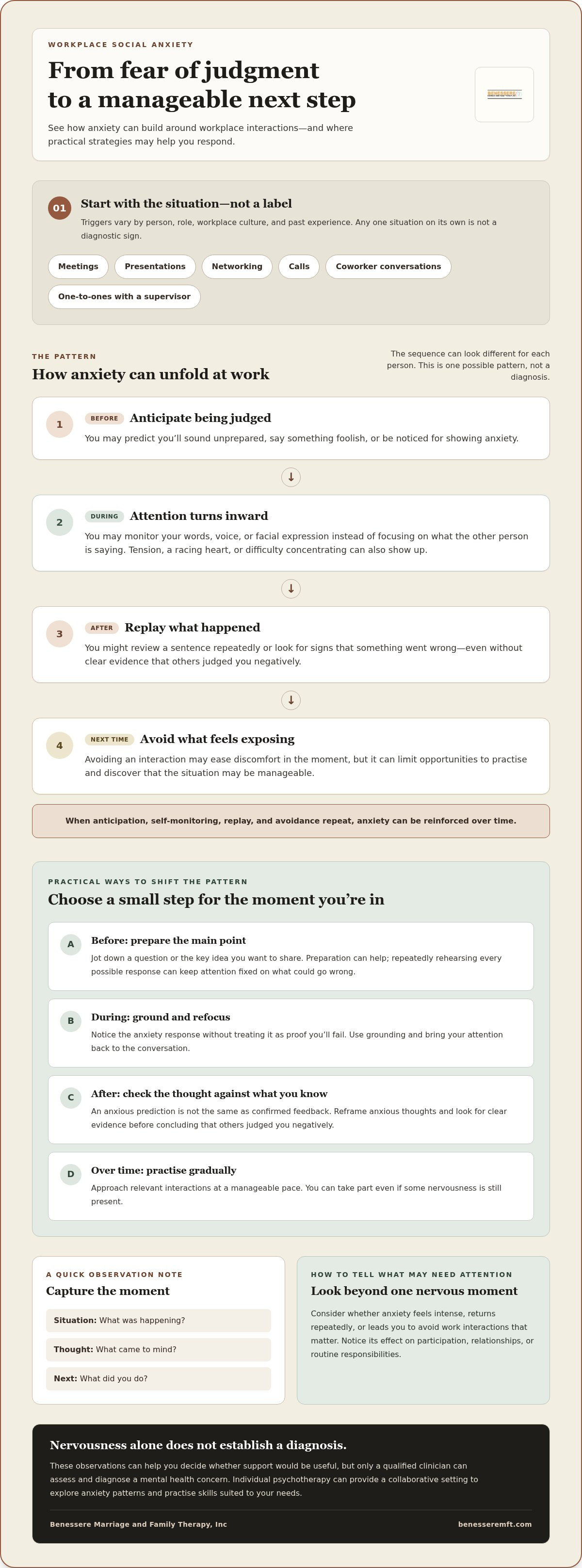
Notice the specific moment anxiety rises. Is it before speaking, during a pause, when receiving feedback, or afterward as you review what happened? You might jot down the situation, the thought that came up, and what you did next. That gives you a practical starting point, rather than labeling yourself as “bad at people.”
When is workplace nervousness more than a passing reaction?
Everyday nerves often ease as a situation passes. Consider whether anxiety feels intense, returns repeatedly, or leads you to avoid interactions that matter to your work. It may also affect relationships, participation, or routine responsibilities. These observations can help you decide whether support would be useful, but they can’t confirm a condition. Only a qualified clinician can assess and diagnose a mental health concern.
If anxiety is narrowing your choices or causing ongoing distress, you don’t have to wait until work feels unmanageable to seek help. Individual psychotherapy in Roseville offers a collaborative setting to explore your experiences, understand anxiety patterns, and consider skills suited to your needs. A clearer understanding of what you’re experiencing can support more personalized steps toward managing social anxiety at work.
Why Social Anxiety Can Make Workplace Interactions Feel So Difficult
A difficult interaction can begin well before it happens. You might anticipate being judged, predict that you’ll sound unprepared, or worry colleagues will notice your hands shaking. During the conversation, attention can turn inward: you monitor your words, facial expression, or voice instead of focusing on what the other person is saying. That self-monitoring can make it harder to respond naturally, then leave you reviewing the interaction afterward for signs that something went wrong.
These predictions can feel convincing, but they aren’t the same as confirmed feedback or evidence about your actual performance. The National Institute of Mental Health statistics page provides information about social anxiety disorder as a recognized mental health concern, not a measure of someone’s professionalism or ability. Anxiety can affect capable people; it doesn’t define their skills.
How fear of judgment shapes thoughts and behavior
Preparation can make an interaction feel more manageable. You might jot down a question before a meeting or identify the main point you want to share. But repeatedly rehearsing every possible response can keep your attention fixed on what could go wrong. Afterward, replaying a sentence again and again may extend the worry, even when you have no clear evidence that others judged you negatively.
Avoidance can reduce discomfort in the moment, but it can also limit opportunities to practise and discover that an interaction may be manageable. This isn’t a sign of weakness or lack of ability; it’s one way anxiety can narrow choices over time.
Why the same workplace trigger affects people differently
A supervisor conversation may feel high-stakes to someone whose role depends on evaluation, while a team discussion may be more difficult for a person who has previously been interrupted or criticized. Current stress, job demands, past experiences, and workplace culture can all shape how safe or exposed an interaction feels. No single explanation applies to everyone.
Work arrangements can change the pressure, too. In person, someone may feel observed while speaking or entering a group conversation. Remote work can reduce some face-to-face demands, yet video calls may heighten self-consciousness, and fewer informal interactions can make connection feel less natural. Role expectations matter as well: a job requiring frequent presentations creates different social demands from one centered on independent work.
When anxiety rises, the nervous system’s threat response may prepare the body to deal with perceived danger. This can bring tension, a racing heart, or difficulty concentrating, even when the situation isn’t physically dangerous. Noticing this response with curiosity, rather than treating it as proof that you’ll fail, can be a starting point for managing social anxiety at work. Individual psychotherapy can offer a collaborative space to explore anxiety and consider how it affects your work interactions.
Which Strategies Help Manage Social Anxiety at Work?
A useful strategy depends on what feels difficult and what you need in that moment. Preparation can make a task clearer, grounding can help you pause and reconnect with the present, thought reframing can loosen the grip of a fearful prediction, and gradual practice can help you approach interactions in manageable steps. None has to make anxiety disappear to be worthwhile.
Practical preparation helps you take part; it doesn’t require you to eliminate all anxiety before you act.
What can help before a meeting, presentation, or difficult conversation?
Set one achievable goal, such as asking a prepared question or sharing one relevant point. Keep notes brief rather than scripting every possible exchange. Before joining, take a grounding pause and remind yourself, “I can feel nervous and still contribute.” After the interaction, measure success by whether you took the step you chose, not by whether you felt completely calm. These strategies can help you stay oriented, but they aren’t a guarantee of calm.
How can gradual practice build confidence over time?
Create a personally paced sequence, perhaps moving from greeting a coworker to contributing in a small meeting, then speaking in a larger group. Adjust the steps to your needs. Don’t force yourself into an overwhelming situation or wait for perfect performance. Afterward, reflect on what you attempted and learned, including whether the outcome matched your prediction. For example, if you expected a brief comment to draw criticism, note what actually happened without dismissing your effort.
How to Handle Social Anxiety in Common Work Situations
A practical plan can make an interaction feel more approachable without requiring you to perform perfectly. Beforehand, choose one small action. During the interaction, return your attention to the task or conversation. Afterward, reflect on what you tried rather than judging yourself for feeling anxious. Adapt the details to your role, workplace norms, and needs.
Meetings and presentations
Before: Write down one point or question you’d like to contribute. For a presentation, prepare your opening sentence and key ideas, not a script for every possible response. During: Look for a natural pause to speak, and focus on conveying your message rather than monitoring how you appear. If workplace norms allow, sharing a thought in writing can be another way to participate. After: Note what you contributed and what you learned. If you catch yourself replaying the meeting, distinguish specific feedback from guesses about what others thought.
One-to-one conversations
Before: Identify the purpose of the conversation and one question you want answered. A few notes can help you stay oriented, especially when speaking with a supervisor. During: Listen for the other person’s main point, and allow yourself a moment to think before responding. After: Separate what was actually said from what you fear it meant. If uncertainty about expectations is adding pressure, asking for clarification can make the next step more concrete.
Informal coworker contact
Small talk doesn’t need to become an extended conversation. Try a brief opener connected to shared work, such as asking how a project is going, or choose a neutral topic like a nearby lunch spot. Short, repeated exchanges can build familiarity gradually. You can also end a conversation warmly when you need to return to work. Networking events and social gatherings don’t have to be the measure of your professional worth.
Some adjustments, such as receiving an agenda in advance, having a clear role in a meeting, or contributing in writing when appropriate, can support meaningful participation. A boundary can protect your capacity while keeping you connected to what matters. By contrast, if avoiding every meeting or conversation is shrinking your options, consider a smaller way to re-engage rather than forcing yourself into the most difficult situation at once.
Progress may mean taking a valued action while anxiety is still present. Individual psychotherapy can help you apply these strategies to your own work experiences and consider which steps fit your needs.
When to Seek Support for Managing Social Anxiety at Work
Consider seeking support if workplace anxiety is persistent, causes substantial distress, or repeatedly leads you to avoid activities that matter to you. You might find yourself declining opportunities, struggling to participate in meetings, or spending considerable time worrying before and after routine interactions. You don’t need to wait until your work is unmanageable. A qualified clinician can help you understand what’s happening and whether it may reflect a mental health condition.
What can individual therapy help you explore?
Past experiences can sometimes shape how present-day interactions feel, though that isn’t true for everyone. If this connection feels relevant, learning about trauma therapy in Roseville may offer additional context. The focus of individual psychotherapy can be tailored to your own story, needs, and priorities; it isn’t a promise of a particular result.
What is a gentle next step for getting support in Roseville?
You can begin by talking about the situations that feel difficult, what you’d like to change, and any questions you have about support. You don’t need to arrive with a perfect explanation or a fully formed goal. Benessere offers individual psychotherapy in Roseville, California, with evidence-based psychoeducation and interventions tailored to each person’s needs.
Seeking help is one way to understand your anxiety and develop strategies that support the work life you value. You can take that step at your own pace. Learn about individual psychotherapy with Benessere.
Take the Next Step at Your Own Pace
Managing social anxiety at work begins with understanding your patterns, not judging yourself for having them. Noticing which situations bring up fear can help you choose a practical response, whether that’s preparing one point for a meeting, grounding yourself before a conversation, or taking a gradual step toward an interaction you value. Progress doesn’t require anxiety to disappear; it can mean participating in a way that feels more aligned with your goals.
If distress or avoidance is limiting your work life, personalized support may help you explore what’s happening and practice relevant skills. Benessere provides evidence-based individual psychotherapy and psychoeducation, with care tailored to each person’s story and needs. The Roseville, California practice offers a collaborative space to consider your goals and questions without pressure to have everything figured out first.
Taking a first step can be as simple as talking through what you’re experiencing and what you hope will change. Contact Benessere to explore individual psychotherapy in Roseville.
Frequently Asked Questions
How can I manage social anxiety before a meeting at work?
Choose one manageable goal, such as asking a question or sharing a relevant point, and jot down a few brief notes to support it. Before the meeting, pause to notice your breathing and the feeling of your feet on the floor. These steps may help you feel more prepared, though they can’t guarantee you’ll feel calm. Afterward, focus on what you tried and learned, rather than criticizing yourself for feeling anxious.
Is social anxiety at work the same as being shy?
No. Shyness can describe a preference for quieter or slower-paced social interaction, while social anxiety involves fear of scrutiny or negative evaluation that may cause persistent distress or avoidance. They can overlap, but a quiet personality or discomfort in one situation doesn’t automatically indicate a disorder. A qualified clinician can assess whether someone’s experience meets diagnostic criteria and consider how it affects daily life and work.
Can social anxiety affect job performance even when I am good at my job?
Should I tell my manager that I have social anxiety?
That decision is personal and may depend on your workplace, your level of trust, and what support you hope to receive. You might start by describing a practical need, such as wanting meeting topics in advance or sharing some input in writing, without discussing a diagnosis. Consider what you’re comfortable disclosing and what outcome you want. If you’re uncertain, a mental health professional can help you think through your options.
What can I do if I feel anxious speaking up in meetings?
Prepare one point or question, then look for a natural pause to contribute. Keep a brief note nearby to help you stay focused, and, where workplace norms allow, follow up in writing if speaking in the moment feels difficult. Try directing attention to the discussion rather than monitoring your voice or expression. Afterwards, reflect on what you managed to do with curiosity, not harsh self-criticism.
Does CBT help with social anxiety at work?
Cognitive behavioral therapy (CBT) is an approach that helps people notice how thoughts, feelings, and behaviors interact. For workplace anxiety, therapy may involve examining feared predictions, developing coping skills, and practicing situations in manageable steps. The focus can be tailored to your concerns and goals; no approach guarantees a particular result. A clinician can discuss whether CBT or another evidence-based approach may fit your needs.
When should I seek therapy for social anxiety at work?
Consider therapy if anxiety is persistent, causes ongoing distress, or leads you to avoid work activities that matter to you. Individual psychotherapy can help you explore triggers, understand anxiety patterns, and practice skills connected to your personal goals. Benessere provides tailored individual psychotherapy and psychoeducation in Roseville, California. A first step can be a conversation about what you’re experiencing and what you’d like support with; you don’t need to have everything figured out.



Comments