
Narrative Therapy: Rewriting Your Unique Story and Reclaiming Agency

Updated: Jun 19
What if you aren't the depression, the anxiety, or the trauma that has followed you for years? For many, a clinical diagnosis or a history of hardship begins to feel like a permanent character trait rather than a challenge they've endured. You might feel frustrated by traditional medical models that seem to reduce your entire life to a series of symptoms. Narrative therapy provides a restorative shift in perspective, moving away from pathologizing labels toward a collaborative, respectful understanding of your unique life story.
This approach helps you separate your identity from the challenges you face so you can reclaim your agency. You'll discover how to externalize your struggles and identify "unique outcomes," those specific moments where you successfully resisted the problem's influence. We'll explore how this methodology empowers you to build a more resilient future and how to find a therapist in Roseville who utilizes this compassionate, evidence-based framework. By the end, you'll see that while the problem is the problem, the person is never the problem.
Key Takeaways
Shift your perspective from being "the problem" to seeing challenges as external forces you have the power to influence.
Learn the clinical process of externalization, which allows you to name and deconstruct stories that limit your personal growth.
Discover how narrative therapy helps you separate your identity from a diagnosis or past trauma, allowing for a more restorative sense of self.
Explore how shared histories in families and couples can be rewritten to highlight hidden values and collective resilience.
Understand the importance of a collaborative therapeutic relationship where your personal expertise is the foundation of the healing process.
Table of Contents
What is Narrative Therapy? Understanding the Separation of Person and Problem
The Clinical Process: Deconstructing Problem-Saturated Stories
Externalization: Why You Are Not Your Diagnosis or Your Trauma
Narrative Therapy for Couples and Families: Rewriting Shared History
Personalized Narrative Care in Roseville: Finding Your Path to Healing
What is Narrative Therapy? Understanding the Separation of Person and Problem
Narrative therapy is a collaborative and non-pathologizing approach to psychotherapy that prioritizes the lived experience of the individual. Unlike traditional medical models that often focus on internal deficits or psychiatric labels, narrative therapy views people as separate from the challenges they face. This distinction is foundational. It allows for a restorative space where you can examine your life without the heavy burden of being "broken." The process focuses on the stories we develop about ourselves, which often dictate our sense of self-worth and future potential.
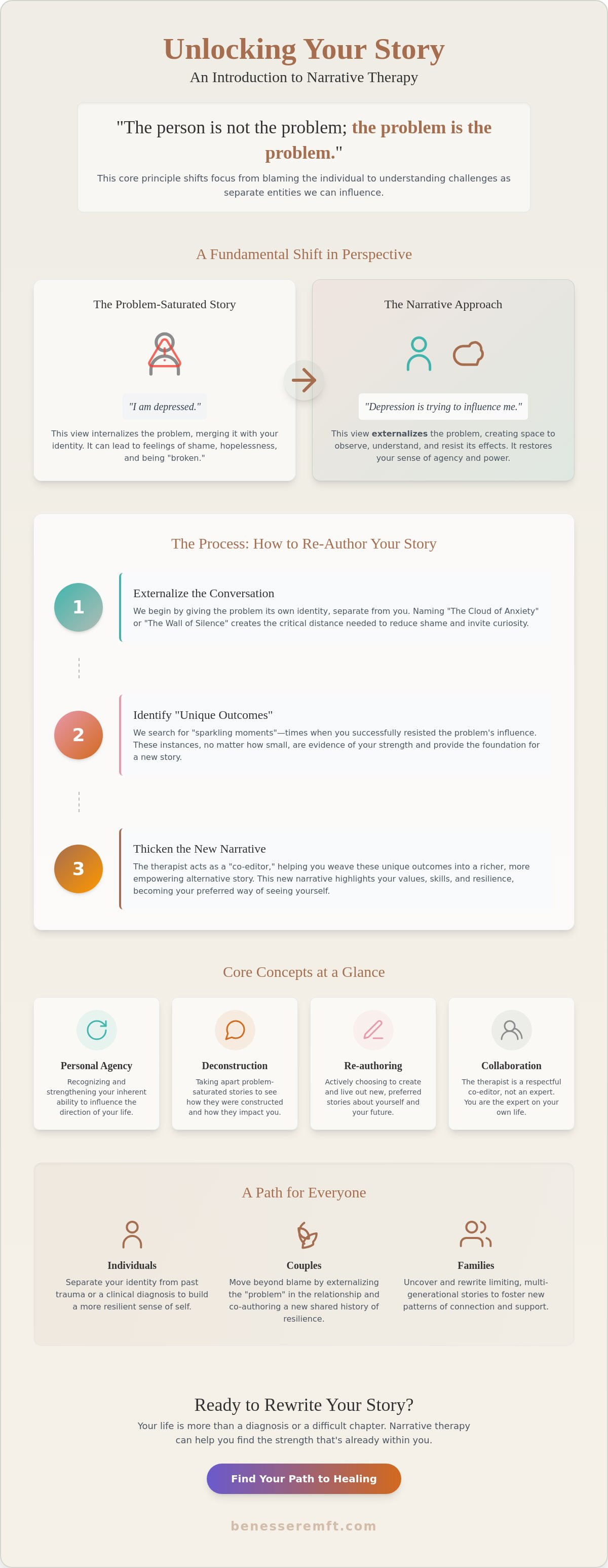
The core philosophy of this practice is simple yet profound: "The person is not the problem; the problem is the problem." When you stop seeing a diagnosis or a pattern of behavior as a fixed part of your character, you gain the clarity needed to address it. Externalizing the issue is the first step toward clinical recovery. It transforms an internal struggle into an external influence that can be mapped, understood, and eventually, resisted. This shift provides immediate relief from the shame that often accompanies long-standing life patterns.
The Origins of the Narrative Approach
Developed in the 1980s by Michael White and David Epston, this framework shifted the focus of therapy from "fixing" a person to "investigating" a problem's influence. It emerged from a desire to respect the client's expertise in their own life. White and Epston rooted their work in social justice, recognizing that many of our "internal" problems are actually reflections of broader social pressures and expectations. This perspective fosters a deep respect for your unique history and the resilience you've already shown. It invites a curiosity that is often missing in more clinical, diagnostic settings.
Key Concepts: Agency and Identity
Central to this work is the concept of agency, which is your inherent ability to influence the direction of your life. Often, we're trapped by "dominant stories," which are narratives shaped by trauma, failure, or societal judgment that limit our view of what's possible. These stories can become so loud they drown out your successes. In narrative therapy, the therapist doesn't act as an all-knowing expert who diagnoses you. Instead, they serve as a "co-editor." Together, you work to identify "alternative stories" that reflect your true values and strengths, helping you reclaim a sense of authority over your own identity.
The Clinical Process: Deconstructing Problem-Saturated Stories
When you enter a therapeutic space, you often carry a "problem-saturated" story. This is a narrative where the struggle has become the protagonist, overshadowing your strengths and values. In the practice of narrative therapy, the first objective is to identify this dominant story and understand how it has organized your life. We look at the history of the problem, but we do so with a clinical distance that allows you to breathe. At Benessere Marriage and Family Therapy, Inc, we integrate these principles into our individual psychotherapy sessions to help you move beyond the labels that have held you back.
Step 1: Externalizing the Conversation
The clinical shift begins with externalization. This involves moving from a statement of identity, such as "I am anxious," to an observation of an external force, like "Anxiety has been visiting me lately." We give the problem a precise name, such as "The Cloud of Anxiety" or "The Wall of Silence," to grant it its own identity. This linguistic change is more than just semantics. It creates a necessary distance that reduces shame and replaces self-judgment with clinical curiosity. By mapping the influence of the problem on your sleep, work, and relationships, we see it as an unwelcome guest rather than a part of your soul.
Step 2: Identifying Unique Outcomes
Once the problem is externalized, we search for "Unique Outcomes." These are often called "sparkling moments," representing times when the problem attempted to take over but you successfully resisted its influence. A Unique Outcome is a clinical turning point where an individual acts in a way that contradicts the dominant, problem-saturated narrative. These victories might seem small, but they provide the raw material for a new identity. There is growing evidence for the effectiveness of narrative therapy in using these moments to foster long term resilience and agency.
Step 3: Thickening the Alternative Story
The final phase involves "thickening" the alternative story. We don't just acknowledge a success; we investigate the values, skills, and hopes that made that success possible. This process builds a robust new narrative that can eventually become more powerful than the problem itself. Therapists help you "recruit an audience" for this story by identifying people in your life who can witness and validate your progress. This reinforces your new identity through evidence-based skillsets and real world connection. It's about moving from a thin, one-dimensional view of yourself to a rich, multi-faceted story of survival and growth.
Externalization: Why You Are Not Your Diagnosis or Your Trauma
When a person lives with a chronic challenge, it's common for "identity stories" to take root. These are narratives where a clinical diagnosis like depression or PTSD becomes the person's entire self-definition. Over time, you might stop seeing yourself as a person who experiences symptoms and start seeing yourself as the symptoms themselves. This fusion is a significant barrier to healing. In the framework of narrative therapy, we work to dismantle these restrictive identities. By viewing a diagnosis as an external condition rather than a character flaw, you create the psychological distance necessary to begin restorative work.
This approach is particularly powerful for those navigating the aftermath of trauma. Trauma often attempts to rewrite a person's history, making the event the only defining feature of their life. Trauma-informed care helps survivors reclaim their history by acknowledging that while the trauma happened, it does not possess the person's future. Clinicians often look to specialized frameworks like Narrative Exposure Therapy for trauma to help individuals process complex histories. This clinical value of non-pathologizing language allows survivors to speak about their experiences without feeling permanently "damaged" by them.
One of the most frequent clinical questions involves the concept of accountability. If we treat the problem as something separate from the person, does that mean you aren't responsible for your actions? In reality, the opposite is true. Externalization actually increases your capacity for responsibility. When you aren't drowning in the shame of being "the problem," you gain the clarity to take a stand against the problem's influence. You aren't escaping your history. You're gaining the agency to decide how you'll respond to it today.
Moving Beyond the Medical Model
Traditional medical models often focus on "what is wrong with you," which can feel cold and reductive. Narrative approaches shift the inquiry toward "what has happened to you," which offers a more compassionate context for human struggle. This shift doesn't ignore clinical realities; instead, it complements evidence-based trauma treatment by normalizing the ways people adapt to hardship. It validates your survival strategies while gently opening the door to new, more helpful ways of being.
The Role of Psychoeducation
Healing also requires an understanding of how the brain "scripts" trauma into our daily lives. Our nervous system often reacts to current events based on old stories of danger. Using clinical psychotherapy to decode these physical and emotional responses is essential. For instance, incorporating psychoeducation for anxiety can help you understand how the brain's survival mechanisms influence the stories you tell yourself. When you understand the mechanics of your reactions, you're no longer at their mercy. You become the author of a more informed and empowered narrative.
Narrative Therapy for Couples and Families: Rewriting Shared History
In the context of relationships, problems often thrive by convincing partners or family members that the other person is the source of their distress. This leads to a cycle of blame and defensiveness that obscures the original bond. Narrative therapy offers a powerful alternative by externalizing these conflicts. Instead of viewing a partner as "the problem," couples learn to see "The Argument" or "The Wall of Resentment" as an unwelcome guest in their home. This clinical shift allows both individuals to join forces against the conflict rather than against each other.
Identifying shared values is a critical component of this process. Often, the presence of a problem like "The Chronic Misunderstanding" actually points to a deeply held value, such as a desire for respect or a need for emotional safety. By investigating what the problem is currently obscuring, families can begin to work together to "outsmart" the problem story. This collaborative approach transforms the family dynamic from one of mutual frustration to one of shared purpose and resilience. It provides a methodical way to break cycles of stress by focusing on the strengths that the problem has attempted to hide.
Healing Relationships in Roseville
When applying these concepts to couples counseling Roseville, the focus shifts toward moving from blame to collaboration. High-conflict marriages often become stuck in a repetitive narrative where each person feels like the villain in the other's story. Through a narrative lens, we help partners develop a "shared story" that honors both of their unique experiences without needing to decide who is "right." This restorative process creates a safe space where intimacy can be rebuilt on a foundation of mutual understanding rather than defensive posturing.
Empowering Parents and Children
For families with younger members, this approach is exceptionally effective because it aligns with a child's natural use of imagination. A child isn't "naughty"; instead, "The Temper" might be visiting them and making it hard to follow rules. By separating the child from "The Worry" or "The Disobedience," parents can become allies in helping the child reclaim control. Strengthening these home bonds focuses on family competencies and previous successes. If you're looking for support in this area, our practitioners provide specialized family therapy Roseville CA to help your household break cycles of stress and rewrite your collective future.
Reclaiming your family's narrative starts with a single step toward collaborative healing. If your shared history has become saturated with conflict, contact Benessere MFT today to begin the process of externalizing your challenges and rebuilding your connection.
Personalized Narrative Care in Roseville: Finding Your Path to Healing
At Benessere MFT, we understand that clinical expertise is most effective when it is paired with a profound respect for the individual's lived experience. Our practice in Roseville integrates narrative therapy with a broader range of evidence-based clinical care, ensuring that your treatment is both scientifically grounded and deeply personal. We don't view you through the lens of a static diagnosis. Instead, we see a person navigating complex circumstances who possesses the inherent wisdom to find a way forward. This integration addresses a common gap in mental health care, where practitioners often prioritize theoretical models over the actual human being in the room.
In your first narrative-informed session, you can expect a conversation that feels markedly different from traditional intake processes. Rather than a checklist of symptoms, we begin by exploring the history of the problem's influence on your life. We work to identify the specific ways a challenge has attempted to define your identity and where you've already begun to push back. This initial meeting is the start of moving from a problem-saturated perspective toward one focused on potential and agency. It's a methodical transition that prioritizes your safety and builds a foundation for lasting change.
Clinical Excellence Meets Human Warmth
Our commitment to individual psychotherapy Roseville is built on the belief that every story deserves a sophisticated, empathetic listener. Our therapists are trained to listen for the "absent but implicit" values in your story. This means that when you speak about your frustrations or pain, we're also hearing the values and hopes that make those feelings so significant. For residents of Placer County, our office provides a safe, professional space to begin this restorative work. We combine scientific precision with a warmth that honors your unique journey and respects your expertise in your own life.
Your Story is Still Being Written
Growth is a restorative possibility at any stage of life, regardless of how long a particular pattern has persisted. A personalized mental health treatment plan at Benessere MFT isn't a rigid document; it's a living narrative that incorporates your goals, strengths, and evolving sense of self. We invite you into a collaborative and educational therapeutic process where you're the primary author. Whether you are engaging in clinical therapy or, for women seeking a spiritual context, exploring storywork through StoryLogian, taking the first step in reclaiming your agency ensures that your future is defined by your values rather than the struggles you've endured.
Embracing a New Chapter of Agency and Growth
The journey toward healing often begins with the simple realization that you are not the problem. Through the restorative lens of narrative therapy, you've learned how to externalize life's challenges and identify the hidden strengths that have carried you through hardship. By deconstructing restrictive stories and "thickening" a new narrative based on your true values, you can move from a state of hopelessness to one of active agency. This process doesn't just change how you see yourself; it changes how you interact with the world and those you love.
At Benessere MFT, we provide a safe space where evidence-based clinical expertise meets compassionate, trauma-informed care. Our local Roseville office serves the Placer County community with a commitment to high-level professionalism and human warmth. Your history is a collection of experiences, but it doesn't have to be a life sentence. Begin rewriting your story with a Benessere therapist in Roseville today. You have always been the expert of your own life, and we are here to help you rediscover the resilient and empowered person who has been there all along.
Frequently Asked Questions
Is narrative therapy a legitimate clinical treatment?
Narrative therapy is a widely respected, evidence-based clinical modality utilized by licensed mental health professionals across the globe. It is grounded in psychological theory and is a core component of many graduate-level clinical training programs. Research indicates its effectiveness in helping individuals manage complex emotional states by fostering a sense of personal agency and resilience. It is not merely a conversational technique; it is a methodical clinical framework for sustainable psychological change.
How many sessions of narrative therapy do I typically need?
A typical course of treatment with a licensed professional usually consists of 12 to 25 sessions. If you're seeking brief narrative therapy focused on a specific, isolated problem, the process may be resolved in 8 to 12 sessions. The exact duration depends on the complexity of your unique story and the specific outcomes you hope to achieve. This unhurried pace allows for the deep, restorative work necessary to rebuild a sustainable sense of self.
Can narrative therapy help with severe depression or PTSD?
This framework is highly effective for severe depression and PTSD, particularly through specialized protocols like Narrative Exposure Therapy (NET). By externalizing the trauma, survivors can process overwhelming events without feeling that the trauma defines their entire character. It provides a safe, structured way to integrate difficult memories into a broader life story that emphasizes survival and strength. This clinical distance is often essential for those who find traditional medical model labeling to be pathologizing.
What is the difference between narrative therapy and CBT?
While Cognitive Behavioral Therapy (CBT) focuses on identifying and changing internal thought patterns, this work views the problem as an external force influenced by social contexts. CBT is often more didactic, providing specific tools to correct "distortions." In contrast, this approach is a collaborative investigation where the therapist and client act as co-editors to uncover hidden strengths. Both are evidence-based, but they offer different paths toward emotional regulation and clinical clarity.
How do I find a narrative therapist in Roseville, CA?
You can find specialized care at Benessere MFT, where we integrate these principles into our clinical practice. Roseville is home to several licensed providers who offer personalized care that incorporates the unique life stories of individuals. When searching for a practitioner in Placer County, it's helpful to look for therapists who emphasize a collaborative, non-judgmental approach and have specific training in externalization techniques and identity reclamation.
Will narrative therapy help me if I feel like I've lost my identity?
Yes, this approach is specifically designed for those who feel their identity has been overshadowed by a "problem-saturated" narrative. It helps you identify "sparkling moments" or times when you successfully resisted a challenge's influence, even in small ways. These moments serve as the foundation for a new, "thicker" identity story that reflects your true values and skills. It's a restorative process that returns the authorship of your life back to you.
Can narrative therapy be used for children and adolescents?
This modality is exceptionally well-suited for children and adolescents because it aligns with their natural affinity for storytelling and externalization. Instead of labeling a child as "disruptive," a therapist might help them name and "outsmart" a problem like "The Temper." This approach reduces defensiveness and invites the child to become an active participant in their own growth. It also empowers parents to become allies against the problem rather than critics of the child.
How does externalizing a problem help in real-life situations?
Externalizing moves the problem from being an internal character flaw to an external influence that can be managed. In real-life situations, this shift reduces the paralyzing weight of shame and self-blame. When you view "The Cloud of Anxiety" as a visitor rather than a part of your soul, you've gained the clarity needed to decide how you'll respond. This distance creates the psychological room necessary to apply practical coping skills and make empowered choices.



Comments