
Trauma Therapy in Roseville: A Restorative Path to Healing and Resilience

Updated: Jun 19
What if the persistent feeling of being "on edge" isn't a personal failing, but your brain's highly specialized attempt to protect you from a world that once felt unsafe? It's common to minimize your own struggles, perhaps believing they aren't "bad enough" to warrant professional support or that you should simply be able to move on. However, when hypervigilance begins to disrupt your peace and emotional triggers start to distance you from the people you love, it's a signal that your system is still searching for a resolution. Seeking trauma therapy in Roseville provides a restorative space to address these deep-seated responses with both scientific precision and human warmth.
You deserve to understand why your mind and body react the way they do, and more importantly, you deserve to feel whole again. We'll explore how specialized, evidence-based clinical care can help you process distressing memories and reclaim a sense of safety. This guide previews the practical tools available to manage daily triggers and explains the path toward building a life that is defined by your resilience rather than your past experiences.
Key Takeaways
Challenge the myth that your experience isn't "bad enough" by understanding how clinical trauma therapy validates and addresses diverse forms of emotional distress.
Explore the biological "stuck state" to understand how your brain’s survival mechanisms, like the fight-flight-freeze response, can be recalibrated through professional care.
Identify how specialized trauma therapy Roseville utilizes evidence-based clinical modalities to provide more targeted resolution than traditional talk therapy.
Prepare for your recovery journey by learning what to look for in a therapeutic alliance and how the healing process unfolds in a professional setting.
Discover a restorative path toward long-term resilience that focuses on integrating your past experiences into a whole and purposeful present.
Table of Contents
Understanding Trauma Therapy: Why "Bad Enough" is a Myth
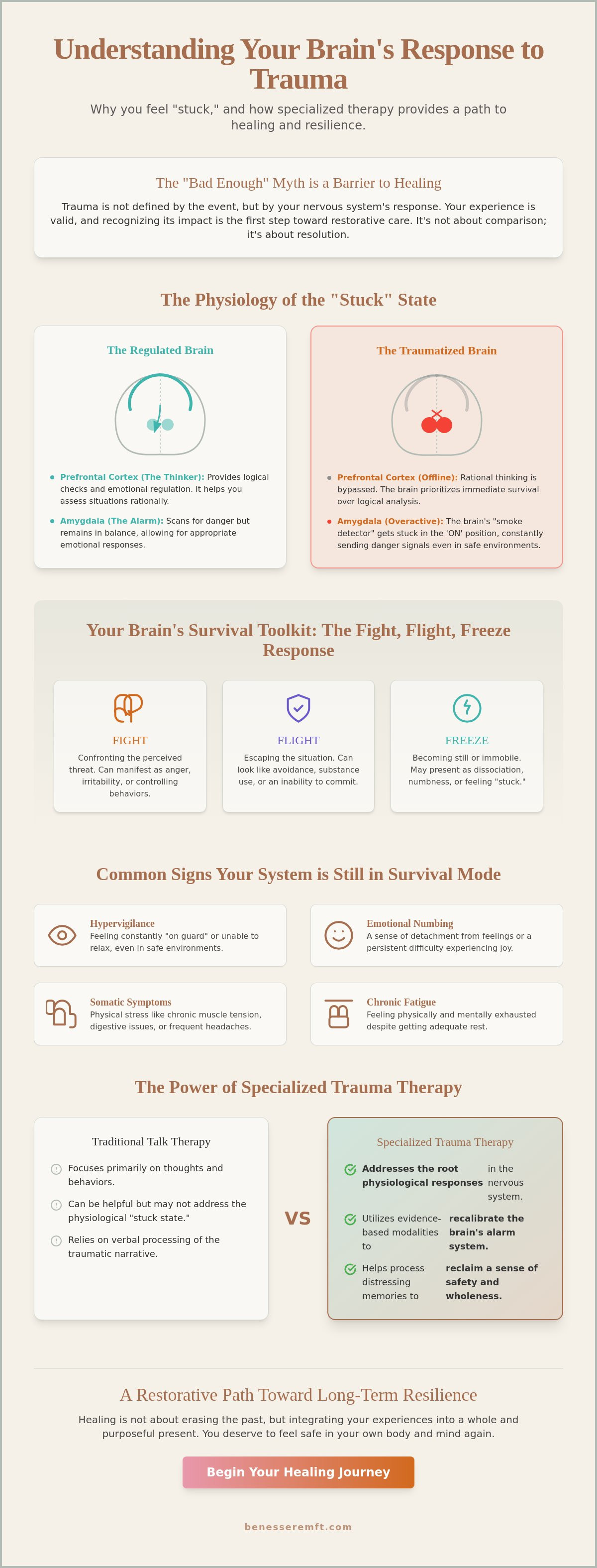
Many individuals hesitate to seek professional support because they carry a quiet belief that their experiences don't qualify as "real" trauma. They might compare their history to survivors of combat or natural disasters, concluding that their own struggles are merely personal failings. This internal comparison creates a significant barrier to healing. In reality, trauma is not defined by the event itself, but by how your nervous system processes and stores that experience. Starting trauma therapy Roseville provides a specialized clinical process designed to resolve the lingering effects of any distressing event that has overwhelmed your internal ability to cope, regardless of how it compares to others' stories.
Your current emotional state is a natural response to an unnatural amount of stress. Whether you've faced a singular life-altering crisis or a series of smaller, cumulative stressors, your brain's priority is survival. When these experiences aren't fully processed, they remain "stuck" in the body, manifesting as a persistent sense of unease. Recognizing that your struggle is valid is the first step toward restorative care through trauma therapy Roseville.
The Spectrum of Traumatic Experiences
Clinical professionals often distinguish between different types of traumatic stress to better tailor the healing process. Acute trauma typically stems from a single, high-intensity event. Conversely, complex trauma arises from prolonged exposure to stressful situations, such as ongoing family conflict or systemic instability. Understanding Psychological Trauma involves recognizing that relational experiences, including childhood neglect or the betrayal of a partner, can be just as impactful as physical threats. Two people may witness the same event but have vastly different responses based on their personal history, support systems, and biological resilience. This variance is expected and respected within a clinical framework.
Signs You Might Benefit from Trauma-Informed Care
Trauma often leaves a visible footprint on your daily life, though the signs aren't always obvious. While some people experience intrusive thoughts or flashbacks, others navigate "invisible" symptoms that are easily misattributed to personality traits or general stress. Choosing trauma therapy Roseville can help you decode these signals and find a path toward relief. Common indicators include:
Hypervigilance: Feeling constantly "on guard" or unable to relax, even in safe environments.
Emotional Numbing: A sense of detachment from your feelings or a persistent difficulty experiencing joy.
Chronic Fatigue: Feeling physically and mentally exhausted despite getting adequate rest.
Unexplained Anxiety: A sudden surge of panic or dread in situations that don't seem to warrant it.
Somatic Symptoms: Physical manifestations of stress, such as chronic muscle tension, digestive issues, or frequent headaches.
These symptoms are your body's way of communicating that it's still operating in a survival state. By addressing these signs through evidence-based care, you can move toward a sense of being whole again, rather than feeling defined by what you've endured.
The Physiology of the Stuck State: How Trauma Impacts the Brain
When you experience a distressing event, your brain's primary objective is immediate survival. This triggers the "fight-flight-freeze" response, a sophisticated biological alarm system designed to protect you from harm. While this mechanism is vital during a crisis, trauma occurs when the brain remains in this heightened state long after the threat has passed. It's as if your internal alarm system has become stuck in the "on" position, making it difficult to feel truly safe even in secure environments. Engaging in trauma therapy Roseville helps bridge the gap between biological survival and emotional peace by addressing these deep-seated responses through a clinical lens.
This "stuck" state is governed by the relationship between two key areas of the brain: the amygdala and the prefrontal cortex. The amygdala acts as a smoke detector, constantly scanning for danger. In a healthy state, the prefrontal cortex provides a logical check, helping you realize when a situation is safe. However, trauma can cause the amygdala to become hyper-reactive while the prefrontal cortex struggles to stay "online." This imbalance is why "just moving on" is rarely a matter of willpower. It's a biological reality that requires professional intervention to recalibrate. Utilizing specialized Trauma and PTSD Treatment allows you to address these neurological patterns with precision and care.
Why Memories Feel "Present" Instead of "Past"
Standard memories are typically stored as chronological narratives; you remember them as things that happened in the past. Traumatic memories are often stored differently, appearing as fragmented sensations, intense emotions, or vivid images. Because these memories lack a clear "time stamp," your brain may react to a current trigger as if the original event is happening right now. This is the essence of emotional regulation difficulties. Your system is reacting to a perceived repeat of the past, making it nearly impossible to remain grounded in the present moment without the specific tools provided by trauma therapy Roseville.
The Path from Survival to Integration
The transition from a state of survival to a state of thriving is made possible by the brain's remarkable ability to change. This process relies on the concept of neuroplasticity. Neuroplasticity is the brain’s inherent capacity to reorganize itself in response to new experiences and therapeutic learning. The clinical work involved in trauma therapy Roseville focuses on this neurological reorganization, helping your brain finally categorize traumatic events as "finished." For those who find that a more immersive, residential environment is needed to catalyze this change, the New Paradigm Mental Health Retreat offers a dedicated space for intensive healing. This allows you to integrate your story into a present where you feel whole, capable, and secure.
Evidence-Based Approaches to Trauma Therapy in Roseville
Effective healing requires more than just conversation; it demands a structured, scientific framework that respects the delicate nature of the nervous system. While general counseling offers valuable emotional support, trauma therapy in Roseville utilizes evidence-based skillsets that provide a clear roadmap for measurable progress. These clinical modalities are specifically designed to address how the brain stores distressing memories, ensuring that the therapeutic process remains restorative rather than overwhelming. By following a trauma-informed approach, practitioners prioritize your safety and stabilization, creating a foundation where you can process the past without being flooded by it.
The strength of evidence-based care lies in its predictability and focus on results. Research indicates that specialized trauma therapies show success rates between 60% and 83% in significantly reducing PTSD symptoms. This data-driven approach offers a sense of security, as it moves away from vague goals and toward specific, achievable milestones. Every individual's history is unique, which is why a tailored plan is essential. We combine clinical authority with deep empathy to ensure the chosen methods respect your specific story while providing the technical precision needed for true neurological change.
Trauma-Informed Cognitive Behavioral Therapy (CBT)
Cognitive Behavioral Therapy for trauma focuses on the intersection of your thoughts, feelings, and behaviors. Trauma often leaves behind "stuck" thoughts-distortions such as "I am unsafe everywhere" or "this was my fault"-that dictate your daily reactions. CBT helps you identify these cognitive patterns and gently reframe them through a more balanced lens. This process isn't about forced positivity; it's about reclaiming a sense of mastery over your own mind. By building practical coping skills, you gain immediate tools to manage distress, allowing you to navigate your environment with a renewed sense of agency and calm.
Narrative Therapy: Rewriting the Story of Survival
Narrative Therapy offers a profound way to externalize the trauma, helping you understand that the problem is the problem, and you are not the problem. Trauma frequently forces a narrative where the survivor feels defined by their worst experiences. This approach invites you to view your life as a broader story, one where you've demonstrated immense resilience and survival skills. By reclaiming your identity as the primary author of your life, you can move from a narrative of victimhood to one of agency. This aligns with our commitment to restorative care, ensuring that your unique story is handled with both scientific precision and human warmth.
Navigating Recovery: What to Expect from a Roseville Therapist
Starting the search for trauma therapy in Roseville is a profound act of self-advocacy. For many in the Placer County area, daily life involves navigating high-pressure careers or intricate family dynamics that leave little room for emotional processing. When you finally decide to seek support, the transition from searching to sitting in a therapist's office should feel like a guided, steady progression rather than a leap into the unknown. A professional intake process is designed to lower your defenses and build a sense of security from the very first interaction.
A high-quality, professional intake should include:
A comprehensive discussion of your goals and current challenges.
Transparency regarding the clinical approach and what to expect in future sessions.
A clear "Good Faith Estimate" of costs, as required by federal law for non-emergency care.
An assessment of your current safety and existing coping strategies.
The success of this work depends heavily on the "therapeutic alliance." This term describes the collaborative relationship between you and your provider. A successful therapeutic outcome is highly correlated with the quality of the bond between the therapist and the individual. It's a partnership where clinical expertise meets your unique lived experience. If you're ready to begin this partnership, you can schedule an initial session for individual psychotherapy to see if our approach aligns with your needs.
Setting the Foundation for Safety
In trauma-informed care, establishing a sense of safety is always the first priority. Before diving into distressing memories, your therapist will focus on stabilization. This often involves learning grounding techniques, which are practical tools used to keep you anchored in the present moment if you begin to feel overwhelmed. The pace of trauma therapy in Roseville is entirely collaborative. A skilled clinician monitors your emotional state carefully, ensuring that the work progresses only as fast as your nervous system can handle. This methodical approach prevents "re-traumatization" and ensures that therapy remains a restorative experience.
Finding the Right Fit in Roseville
Choosing a local therapist in the Roseville area offers the benefit of in-person connection, which can be vital for building a strong therapeutic bond. During your initial consultation, don't hesitate to ask specific questions to gauge the fit. You might ask, "How do you approach trauma processing?" or "What techniques do you use to help clients stay grounded?" These questions help you determine if the practitioner’s style matches your personality and clinical needs. Trusting your intuition during this phase is an important part of the healing journey.
Restorative Care at Benessere Marriage and Family Therapy, Inc: Healing Your Unique Story
At Benessere Marriage and Family Therapy, Inc, we believe that your story, however fragmented it may feel, holds the capacity for restoration. Our approach to trauma therapy Roseville is built on the foundation that clinical authority and deep-seated empathy are not mutually exclusive. We provide a space where complex emotions are handled with scientific precision, ensuring that the healing process is as methodical as it is compassionate. Our practitioners are mentored to provide personalized, evidence-based interventions that respect the nuances of your history while providing the stability needed for growth. This balance inspires the confidence necessary to face difficult memories, knowing you aren't doing so alone.
We view trauma recovery as a holistic endeavor rather than a simple checklist of symptoms. It isn't just about addressing a single event; it's about the integration of all your life experiences into a cohesive and resilient present. This restorative focus moves beyond mere survival to help you reclaim a sense of purpose and wholeness. By grounding our work in psychological literacy, we help you understand the mechanics of your mental health, which naturally reduces the shame often associated with traumatic responses. Every session is an invitation into a collaborative and educational process designed to lower your defenses and build long-term security.
A Collaborative Path to Resilience
We invite you into a collaborative process where you are an active participant in your own healing. Trauma rarely exists in isolation; it often manifests as persistent anxiety or creates friction within family systems. Whether you're seeking individual psychotherapy or specialized trauma therapy Roseville, our goal is to help you manage these interconnected challenges. By addressing how trauma impacts your relationships and your sense of self, we help you build a more stable foundation for your future. Our local office provides a calm, safe environment for residents of Placer County, offering a dedicated space to step away from daily pressures and focus on your restorative journey.
Taking the Next Step Toward Peace
The path toward recovery is rarely linear, yet it's always possible. Whether you're dealing with the aftermath of a single event or the cumulative weight of long-term stress, there's a way forward that doesn't require you to be defined by your past. We're here to guide you through that progression with patience, expertise, and a steady, non-judgmental presence. Growth and restoration are within reach, and the first step is simply deciding that your well-being is worth the investment.
Embracing a Future Defined by Resilience
Healing is a deliberate process of moving from a state of survival to one of integration and wholeness. By acknowledging that your experiences are valid and understanding the biological mechanisms behind your responses, you strip away the weight of shame. We have explored how the brain's "stuck state" can be recalibrated through structured, scientific frameworks that prioritize your safety and pace. Seeking trauma therapy in Roseville offers more than just a listening ear; it provides a roadmap for lasting neurological change.
Our practice is rooted in a compassionate, non-judgmental approach where every therapist receives specialized trauma-informed mentorship. We utilize evidence-based clinical skillsets to ensure your unique story is met with the precision and warmth it deserves. You don't have to carry the past as a permanent burden. Growth remains an inherent possibility. A more peaceful, grounded life is within your reach.
Frequently Asked Questions
How do I know if I have PTSD or just "normal" stress?
PTSD is distinguished by the persistence and intensity of symptoms that interfere with your daily life for more than a month after a distressing event. While stress is a temporary reaction to pressure, PTSD involves a nervous system that remains in a survival state, leading to flashbacks, avoidance, or a constant sense of being "on edge." A clinical assessment is the most reliable way to understand these patterns and determine if specialized intervention is necessary to help you feel whole again.
Will I have to talk about every detail of my trauma in the first session?
No, the initial session is focused on establishing a sense of safety and building a therapeutic alliance rather than recounting every detail of your past. Trauma-informed care prioritizes stabilization, meaning we work at a pace that prevents you from feeling overwhelmed or re-traumatized. You have full agency over what you share and when you choose to share it, ensuring the process remains restorative and controlled from the start.
How long does trauma therapy typically take to show results?
The duration of therapy varies based on the complexity of your history, but evidence-based modalities are designed for efficient and measurable progress. Research indicates that 84% to 90% of single-trauma victims no longer have PTSD after just three sessions of specialized care. While multiple-trauma victims may require more time, approximately 77% are PTSD-free after six sessions. We focus on providing practical tools that offer relief in your daily life as we work toward long-term resilience.
Is trauma therapy covered by insurance at Benessere Marriage and Family Therapy, Inc?
Benessere Marriage and Family Therapy, Inc operates as an out-of-network provider, which means we don't bill insurance companies directly for our services. However, we provide a "superbill" that you can submit to your insurance provider for potential reimbursement according to your plan's benefits. We comply with federal law by providing a "Good Faith Estimate" before you begin trauma therapy in Roseville, ensuring you have clear information regarding the expected cost of your clinical care.
Can trauma therapy help with relationship or family issues?
Yes, trauma therapy is highly effective for resolving relational distress, as past experiences often dictate how we connect with partners and family members. Traumatic stress can manifest as difficulty with trust, emotional distance, or reactive communication patterns that strain your household. By addressing the root cause of these triggers through Individual Psychotherapy or Family Therapy, you can build healthier, more secure attachments and improve the overall emotional health of your relationships.
What is the difference between general counseling and trauma therapy?
General counseling often focuses on current life stressors and supportive listening, whereas trauma therapy is a specialized clinical process aimed at resolving deep-seated neurological patterns. Trauma-informed care uses specific evidence-based techniques to address how distressing memories are stored in the body and brain. This targeted approach is essential for recalibrating a nervous system that has become stuck in a survival response, providing tools that standard talk therapy might not offer.
What should I do if I feel triggered between therapy sessions?
Developing a "toolbox" of grounding techniques and self-regulation strategies is a primary focus of early therapy sessions to help you manage triggers in real time. We work with you to identify specific sensory or cognitive anchors that can bring you back to the present moment when you feel overwhelmed. If you're in an immediate crisis, we encourage contacting local emergency services or a crisis hotline, as our practice doesn't provide 24/7 after-hours care.
Do you offer trauma therapy for children or teenagers in Roseville?
Yes, we provide specialized support for younger clients who have experienced distressing events through our Individual Psychotherapy and Family Therapy services. Children and adolescents often process trauma differently than adults, frequently expressing distress through behavioral changes, academic difficulties, or social withdrawal. Our trauma therapy Roseville practitioners use age-appropriate, evidence-based methods to help youth build resilience and reclaim a sense of safety within their home and school environments.



Comments