
Resolving Marriage Conflict: A Clinical Guide to Restoring Connection

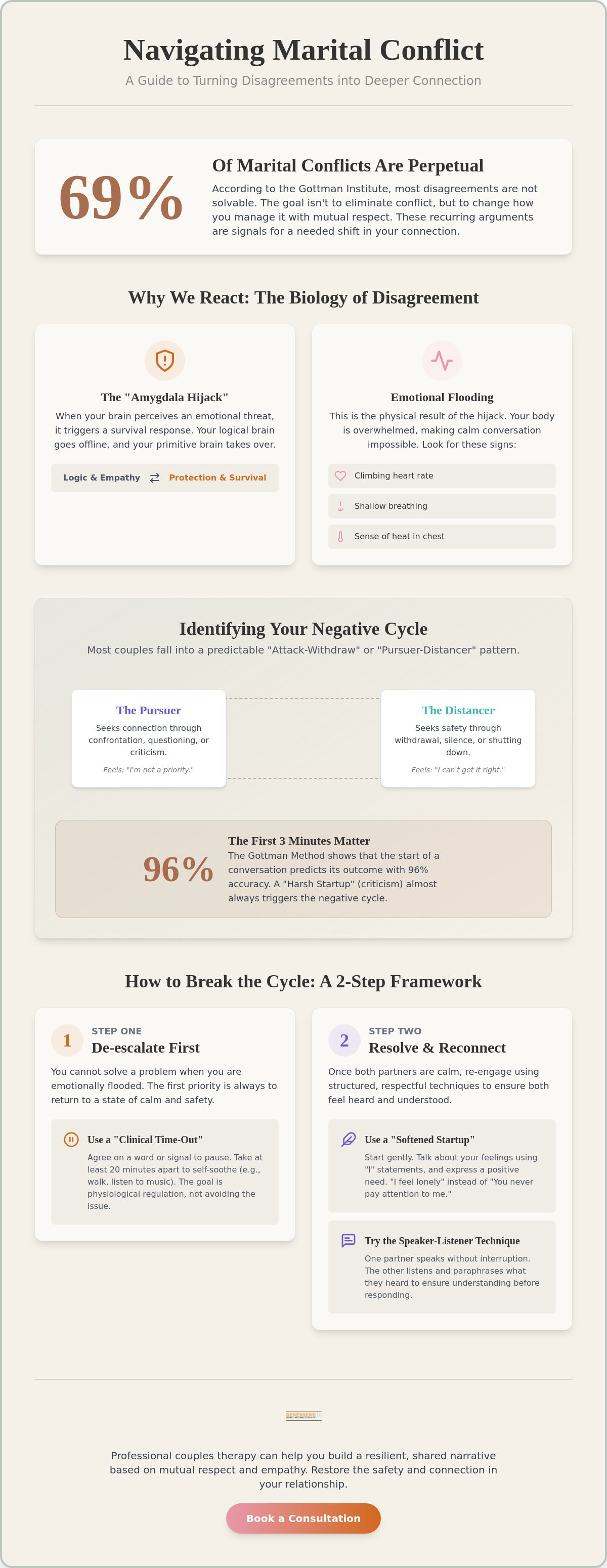
What if the recurring arguments that leave you feeling emotionally exhausted aren't actually signs that your marriage is failing, but are instead biological signals for a needed shift in your connection? When you're caught in a cycle of blame, the path toward resolving marriage conflict can feel obscured by a fog of defensive reactions and hurt feelings. It's understandable to fear that frequent tension means the end of your story; however, research from the Gottman Institute suggests that 69% of marital conflicts are actually perpetual. This means the goal isn't necessarily to eliminate every disagreement, but to change how you relate to them through a lens of mutual respect.
You've likely felt the weight of unresolved tension and the drain of trying to be heard in a space where both partners feel misunderstood. This guide offers a restorative approach to these struggles, providing you with evidence-based strategies to transform repetitive fights into moments of genuine intimacy. You'll discover practical tools to de-escalate tension before it spirals and gain a deeper understanding of your partner's internal world. By the end of this article, you'll have a clear, methodical framework for restoring the sense of safety and connection that originally brought you together.
Table of Contents
Understanding the Biology of Marital Disagreements
Conflict in a partnership is rarely about the dishes or the schedule. Instead, it's the natural intersection of two unique life stories, each carrying its own set of values, triggers, and expectations. While many feel that a lack of friction is ideal, the presence of disagreement is actually among the signs of a healthy relationship when handled with care. It signals that both individuals feel safe enough to express their distinct needs and perspectives. The goal isn't to reach a state of perpetual silence, but to foster a dynamic where differences are explored rather than suppressed.
The primary challenge in resolving marriage conflict lies in our biology. When a disagreement turns into a confrontation, the brain's amygdala may perceive a threat to our emotional safety. This "amygdala hijack" shifts the body's resources away from the logical prefrontal cortex and toward survival centers. In this state, the brain prioritizes protection over connection. This is why a simple misunderstanding can rapidly escalate into a high-stakes battle where logic seems entirely absent. Professional couples therapy often focuses on identifying these moments before the brain loses its capacity for empathy and reason.
The Fight, Flight, or Freeze Response in Marriage
During a heated moment, your body may enter a state of flooding. You might notice your heart rate climbing, your breathing becoming shallow, or a sudden sense of heat in your chest. These are physical indicators that you've moved outside your "Window of Tolerance," which is the narrow range where you can process emotions effectively. When you're biologically unsafe, logical problem-solving becomes impossible. You aren't being difficult; your nervous system is simply trying to survive a perceived threat. Recognizing these signs allows you to pause before the conversation turns destructive.
Why We Repeat the Same Arguments
Most couples find themselves arguing about the same few topics for years. These repetitive fights usually stem from "core themes" such as a need for respect, autonomy, or security. Past trauma can heighten these reactions, making a partner's silence feel like abandonment or their critique feel like an attack on one's worth. Emotional flooding is the physiological state where a person's nervous system is so overwhelmed by stress that they can no longer process information or communicate calmly. Understanding these biological underpinnings is the first step toward resolving marriage conflict with empathy and precision.
Identifying the Conflict Cycle in Your Relationship
When two individuals interact, they often fall into predictable, repetitive patterns that dictate the outcome of their disagreements. Understanding these patterns is essential for resolving marriage conflict effectively. Most couples find themselves in a "Pursuer-Distancer" or "Attack-Withdraw" dynamic. In this cycle, one partner seeks connection through confrontation or questioning, while the other seeks safety through withdrawal or silence. This isn't a reflection of a lack of love, but rather a clash of coping mechanisms that leaves both parties feeling isolated.
Identifying your "starting move" is the first step toward change. Does the disagreement begin with a sharp observation about a partner's character? Or does it start with a heavy silence that invites pursuit? Research within The Gottman Method highlights that the first three minutes of a conversation determine its success with 96% accuracy. When we understand the story we tell ourselves about our partner’s intentions, perhaps assuming they are being "dismissive" rather than "overwhelmed," we can begin to interrupt the cycle before it gains momentum.
The Anatomy of a "Negative Cycle"
A negative cycle often begins with a "harsh startup," where an issue is raised using criticism rather than a request. This immediately triggers the physiological flooding discussed earlier. For example, a small trigger like a forgotten chore leads to a thought: "I am not a priority." This thought fuels a critical comment, which then leads the other partner to stonewall or shut down to avoid further pain. This sequence creates a disconnect that lingers long after the initial topic is forgotten. Over time, these interactions erode marital longevity by making the relationship feel like a place of judgment rather than refuge.
Externalizing the Conflict
By utilizing principles of narrative therapy, couples can learn to view the argument as an external force. Instead of seeing your spouse as the problem, you name the pattern itself, perhaps calling it "The Wall" or "The Escalator." This shift in perspective allows you to move from a "You vs. Me" stance to an "Us vs. The Pattern" alliance. Naming the cycle to gain collective agency over recurring arguments is a powerful step in resolving marriage conflict. If you find yourself stuck in these repetitive loops, engaging in professional couples therapy can provide the objective roadmap needed to navigate your way back to connection.
De-escalation vs. Resolution: Knowing When to Pause
A common pitfall in resolving marriage conflict is the attempt to solve a problem while the biological "fire" is still burning. It's essential to distinguish between immediate de-escalation and long-term resolution. De-escalation is the act of lowering the emotional temperature to ensure safety, whereas resolution is the collaborative work of addressing the root cause. Attempting to fix a complex issue while either partner is flooded is like trying to repair a leaky pipe while the basement is actively flooding. You must shut off the main valve first.
The "Clinical Time-Out" serves as that primary valve. It's a structured tool for emotional regulation that prevents a disagreement from spiraling into a destructive cycle. This isn't a passive withdrawal but a deliberate, agreed-upon pause. Research into physiological cooling suggests that once the heart rate exceeds 100 beats per minute, the brain's ability to process information is compromised. A 20-minute rule is often recommended, as this is the minimum time the human body needs to metabolize stress hormones and return to a state of calm. During this break, the focus should be on individual self-soothing rather than rehearsing the argument in your head.
The Art of the Productive Pause
For many, a partner's request for space can trigger a profound fear of abandonment. To call a time-out effectively, you must provide a "bridge" to the return. Use a script that validates the relationship while stating your needs. For example, saying, "I'm feeling too overwhelmed to listen well right now, so I'm taking a 20-minute break. I'll be back at 4:30 to continue this," offers the security of a definite return. During the pause, employ grounding exercises or deep breathing to lower your heart rate. Establishing these ground rules beforehand ensures that the pause feels like a restorative tool rather than a rejection.
When to Seek Professional De-escalation
While self-management tools are vital, some cycles become too high-conflict to navigate alone. If every disagreement leads to days of silence or intense volatility, it may be a sign that the "safety first" strategy requires an objective third party. Seeking couples counseling in Roseville can provide a neutral environment where de-escalation is facilitated by a clinician. In these settings, the priority is establishing a secure base before attempting any problem-solving. Resolving marriage conflict is a skill that can be learned, and professional guidance ensures that the path to resolution remains safe and respectful for both partners.
Evidence-Based Techniques for Resolving Marriage Conflict
Once the emotional temperature has been lowered through a productive pause, the work of resolving marriage conflict transitions into the mechanics of structured dialogue. The most common barrier to a successful conversation is the "harsh startup," where an issue is raised through the lens of a partner's character flaw. To bypass immediate defensiveness, clinicians recommend a "Softened Startup." This involves stating what you feel about a specific situation and what you need, rather than what your partner did wrong. By leading with vulnerability rather than accusation, you invite your partner to listen rather than defend.
A precise tool for this is the XYZ Formula: "When you did X in situation Y, I felt Z." For instance, instead of saying "You always ignore me," one might say, "When you stayed on your phone during dinner last night, I felt lonely and disconnected." This shift focuses on the speaker's internal experience, which is inherently less threatening to the listener's nervous system. It provides a clear, methodical way to share hurt without igniting a new cycle of blame.
The Speaker-Listener Technique
This technique provides a safe structure for high-stakes topics that often lead to flooding. The Speaker's role is to use "I" statements and keep points brief enough for the listener to track. The Listener's sole responsibility is to paraphrase what they heard before responding, ensuring the Speaker feels understood. It's vital to remember that the goal is understanding, not necessarily agreement. You don't have to agree with your partner's perspective to validate that it's their reality, and this validation is often the bridge to a compromise.
Making and Noticing Repair Attempts
A repair attempt is any statement or action, whether silly or serious, that aims to diffuse tension. It could be a self-deprecating joke, a brief touch, or a vulnerable admission like, "I'm sorry, I'm getting defensive." While making these attempts is important, the ultimate success of a relationship often depends on the reception of repairs. When a partner offers an olive branch, even a small one, acknowledging it can derail an escalating argument and steer the relationship back toward safety. These small gestures are the "glue" that maintains connection during difficult seasons.
Implementing these clinical tools requires practice and patience as you unlearn old habits. If you're finding it difficult to move beyond the theory and into consistent action, professional Couples Therapy can provide the guided practice and objective feedback necessary to master these communication mechanics.
Moving Toward Restorative Healing in Roseville
Resolving marriage conflict is a sophisticated skill set rather than an inherent personality trait. In the communities of Roseville and throughout Placer County, many couples endure the weight of repetitive arguments without realizing that these patterns are often predictable and manageable. Normalizing the act of seeking professional guidance is a vital step toward long term relational health. Clinical psychotherapy provides a safe, restorative container where the most complex emotions are handled with both scientific precision and deep seated empathy.
A restorative approach focuses on the inherent possibility of growth within every challenge. By viewing friction as a biological signal for a needed shift in your shared narrative, you can move away from the drain of mutual blame. This process fosters resilience, allowing you to integrate difficult life experiences into a stronger, more flexible bond. When you commit to this collaborative work, you aren't just ending a disagreement; you're building a foundation of emotional intelligence that will serve your partnership for years to come.
When Self-Help Reaches Its Limits
While the techniques discussed in this guide provide a strong framework, there are moments when self help reaches its natural limit. Relationships often encounter "gridlocked" problems, which are deep seated issues tied to core values or personality differences that feel impossible to move. These differ from "solvable" problems that have a clear, situational resolution. An objective, clinical third party helps break these deadlocks by identifying the underlying emotional needs that both partners may be too overwhelmed to see on their own. Therapy allows you to rewrite the story of your marriage, turning a history of hurt into a narrative of mutual support.
Finding Local Support at Benessere Marriage and Family Therapy, Inc
For those seeking a professional path to connection, the team at Benessere Marriage and Family Therapy, Inc offers a compassionate and evidence based approach right here in Roseville. Our collaborative process is designed to lower your defenses and build a sense of security from the very first session. We utilize proven methods to help you master the mechanics of resolving marriage conflict in a way that feels authentic to your unique story. This isn't about assigning blame or deciding who is right; it's about creating a peaceful home where both individuals feel heard and valued. If your efforts to connect are consistently met with tension, we invite you to take a steady, guided step toward lasting healing.
Building a Future of Shared Understanding
Transitioning from a cycle of repetitive friction to a state of genuine connection is a methodical process that requires both patience and clinical precision. You've explored how the body's survival instincts can hijack logic and how naming your negative cycle allows you to reclaim agency as a collaborative team. By implementing structured de-escalation and evidence-based dialogue, the process of resolving marriage conflict becomes a manageable skill set rather than an insurmountable burden. These tools don't just stop arguments; they create the safety necessary for intimacy to flourish once again.
While these psychological strategies provide a vital framework, the support of an objective clinician can often accelerate your progress. Benessere Marriage and Family Therapy, Inc provides a compassionate, non-judgmental environment in Roseville where complex emotions are handled with scientific precision. Our trauma-informed restorative approach and evidence-based clinical expertise offer the stability needed to rewrite your shared story. We invite you to begin your restorative journey with professional couples counseling in Roseville. A more peaceful, connected home is not just a hope; it's a physiological and emotional possibility that you can begin building today.
Frequently Asked Questions
Is it normal for a healthy marriage to have conflict?
Yes, conflict is an inherent and even necessary component of a healthy partnership where two distinct individuals interact. It serves as a biological signal that boundaries need adjustment or that emotional needs require attention. When disagreements are handled with mutual respect, they become opportunities to strengthen the relationship's resilience rather than signs of its failure.
How do I know if my marriage conflict requires professional therapy?
You should consider professional support when your disagreements become "gridlocked" or if you find yourselves consistently stuck in a cycle of blame that you cannot exit independently. If the emotional temperature remains high for days or if you feel a persistent sense of unsafety, a clinician can provide the objective framework necessary for resolving marriage conflict effectively.
What is the best way to start a difficult conversation with my spouse?
The most effective approach is to lead with a "Softened Startup" that focuses on your internal experience rather than your partner's perceived flaws. Begin by stating your feelings about a specific situation and then follow with a clear, positive need. For example, "I've been feeling a bit lonely lately, and I'd love for us to have some dedicated time together this weekend."
How can we resolve conflict if my partner refuses to talk about it?
When a partner withdraws, it's often a physiological response to feeling flooded or unsafe rather than a lack of care. Instead of pushing for immediate dialogue, try to create a sense of security by acknowledging their need for space and proposing a specific time to talk later. Focusing on your own emotional regulation can lower the overall tension, making it easier for them to re-engage.
What is the difference between healthy disagreement and emotional abuse?
Healthy disagreement involves mutual respect, where both partners feel safe to express differing views without fear of retribution. In contrast, emotional abuse is characterized by a pattern of control, intimidation, or persistent degradation intended to undermine a partner's sense of self-worth. If the interaction involves threats, isolation, or extreme volatility, it has moved beyond the realm of typical marital friction into a space that requires immediate safety planning.
Can marriage conflict actually improve our relationship in the long run?
Conflict can serve as a powerful catalyst for deeper intimacy when it is viewed as an opportunity for mutual understanding. By successfully navigating disagreements, couples build a shared history of resilience and prove to one another that their bond can withstand tension. This process of rupture and repair often leads to a more robust and flexible connection over time as partners learn to value each other's unique perspectives.
How long does it typically take to see improvement through couples counseling?
While every relationship is unique, many couples begin to notice a shift in their communication patterns within 8 to 12 sessions. Research on evidence-based approaches shows that 70-75% of couples experience significant improvement after engaging in a structured therapeutic process. The pace of progress depends largely on the consistency of the sessions and the willingness of both partners to practice new skills outside of the clinical setting.
What should I do if we keep fighting about the same thing over and over?
Repetitive arguments usually indicate an underlying "core theme," such as a need for respect or security, that hasn't been addressed. To break this cycle, move away from the surface-level topic and try to identify the deeper emotional need that feels threatened. Resolving marriage conflict in these instances requires shifting the focus from the "what" of the argument to the "why" of the emotional reaction, which often uncovers a path toward compromise.


Comments