
Signs of Clinical Anxiety: A Comprehensive Checklist for Understanding When to Seek Support

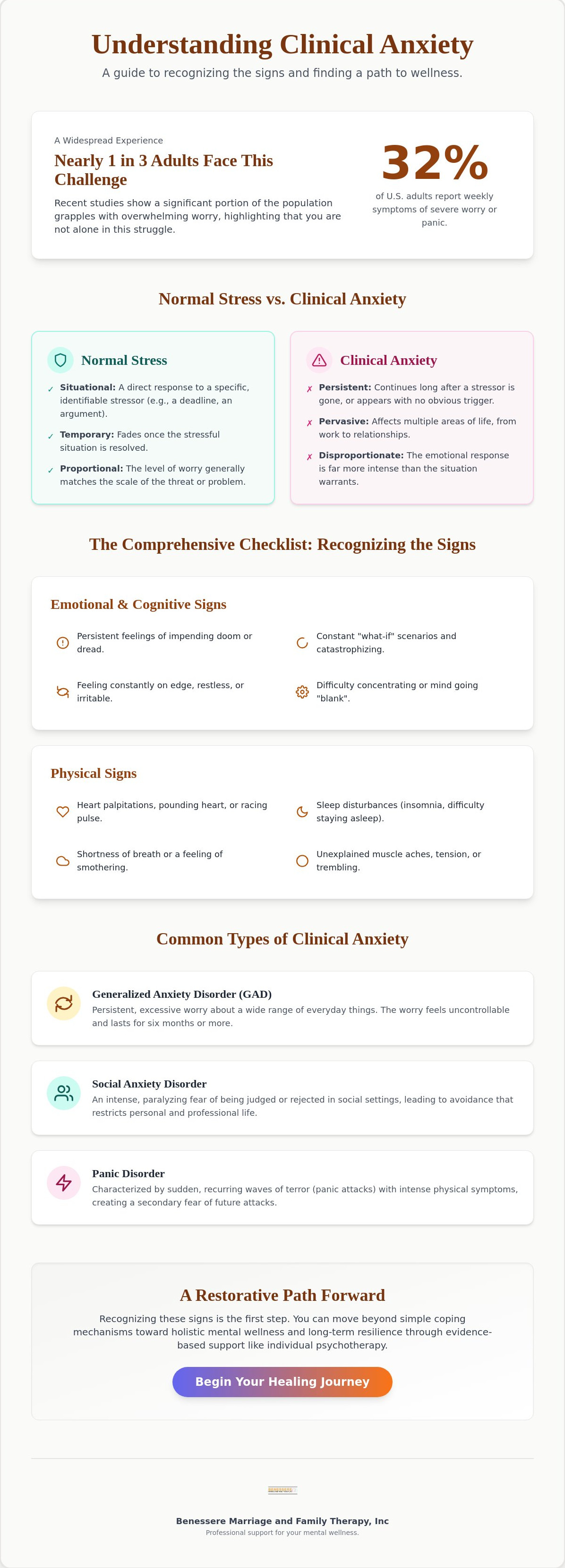
Nearly 32% of adults in the United States report experiencing symptoms of severe worry or panic on a weekly basis, according to recent mental health statistics. If you find yourself trapped in a cycle of persistent, uncontrollable worry, you aren't alone in this experience. Recognizing the specific signs of clinical anxiety is often the first step toward moving from a state of constant high alert into a space of restorative healing. It's common to wonder if your physical symptoms, like heart palpitations or chronic sleep loss, are merely reactions to a demanding life or something more complex that warrants professional attention.
You deserve to feel validated in your internal struggle, especially when the weight of your emotions feels invisible to those around you. This article provides a comprehensive checklist to help you identify the subtle and overt indicators of clinical anxiety while outlining a clear, non-judgmental path toward reclaiming your mental wellness. We'll examine how these symptoms manifest in daily life and discuss the transition toward support through evidence-based approaches like individual psychotherapy or trauma treatment, ensuring you have the clarity to move forward with confidence.
Table of Contents
What is Clinical Anxiety? Defining the Boundaries of Persistent Worry
The Comprehensive Checklist: Recognizing the Signs of Clinical Anxiety
Normal Stress vs. Clinical Anxiety: Understanding the Threshold
The Functional Impact: How Anxiety Shapes Your Relationships
The Restorative Path: Navigating Healing through Psychotherapy
What is Clinical Anxiety? Defining the Boundaries of Persistent Worry
Anxiety is a fundamental human emotion. It's a natural response designed to protect us from harm, functioning as an internal compass that alerts us to potential threats. Yet, there's a vital distinction between the fleeting worry we all feel and a clinical condition. While typical anxiety is a reaction to a specific stressor that fades once the situation resolves, clinical anxiety is often disproportionate and persistent. It doesn't just disappear when a deadline is met or a conflict is settled. Instead, it lingers, becoming a pervasive lens through which a person views their world.
When someone experiences the signs of clinical anxiety, their perception often shifts toward expecting the worst-case scenario in every situation. This cognitive filter colors daily life, making neutral interactions feel threatening and minor hurdles feel insurmountable. Decisions that once felt simple can become paralyzed by a constant stream of "what-if" scenarios. This heavy cognitive load is physically and mentally exhausting. It drains the energy needed for work, hobbies, and meaningful connections. By viewing these struggles through a clinical lens, we can begin to strip away the shame often associated with mental health and move toward a more restorative understanding of our internal experiences.
The Biological Mechanism of Anxiety
The brain's architecture plays a central role in maintaining a state of high alert. The amygdala acts as an internal smoke detector, scanning your environment for signs of danger. When it perceives a threat, it triggers a cascade of cortisol and adrenaline to prepare your body for action. In a clinical context, this detector becomes hyper-responsive or over-sensitized. It begins to sound the alarm for non-threatening events, such as an unread email or a change in plans. Clinical anxiety is a persistent state where the brain's alarm system remains active without an immediate threat. This physiological state is a biological reality that requires professional understanding rather than a simple exercise in willpower.
Common Types of Clinical Anxiety Disorders
A diagnosed Anxiety disorder can manifest in several distinct ways. Identifying which pattern fits your experience is a key part of the healing process. Common variations include:
Generalized Anxiety Disorder (GAD): This involves persistent, excessive worry about a wide range of everyday things like health, finances, or family. If this worry feels uncontrollable and has lasted for six months or more, it may meet clinical criteria.
Social Anxiety Disorder: This is far more profound than simple shyness or introversion. It's an intense, paralyzing fear of being judged or rejected in social settings, often leading to avoidance that restricts your personal life.
Panic Disorder: This is characterized by sudden, localized waves of terror. These episodes often include physical symptoms like chest pain or shortness of breath, creating a secondary fear of when the next attack might occur.
Understanding these signs of clinical anxiety through psychoeducation helps normalize your experience. It allows you to move from a place of confusion to a state of agency, where you can seek targeted support like individual psychotherapy to reclaim your wellness.
The Comprehensive Checklist: Recognizing the Signs of Clinical Anxiety
Identifying the signs of clinical anxiety requires looking beyond occasional nervousness to see how worry permeates the body and mind. While temporary stress is a response to external pressure, clinical anxiety often feels like an internal weather system that stays regardless of the forecast. It's a whole-person experience that manifests through emotional, cognitive, and physical channels. By reviewing these indicators, you can begin to differentiate between a difficult week and a deeper pattern that may benefit from professional support.
The emotional landscape of anxiety is often characterized by a persistent sense of impending doom or a feeling of being constantly on edge. You might notice heightened irritability over minor inconveniences, which is often just a reflection of an internal system that's already reached its capacity. While the National Institute of Mental Health provides specific criteria for Generalized Anxiety Disorder (GAD), the lived experience often involves a heavy cognitive load. Common markers include:
Racing thoughts: A mind that moves too fast to catch a single thread of logic.
Catastrophizing: Reflexively jumping to the worst-case scenario in any given situation.
Difficulty concentrating: Feeling as though your focus is fragmented or "blanking out" during important tasks.
Reassurance seeking: An urgent need for others to validate that things will be okay.
If these patterns feel familiar, exploring individual psychotherapy can offer a safe, non-judgmental space to unpack these experiences and find relief.
Physical Symptoms You Might Not Associate with Anxiety
Anxiety isn't just "in your head." It lives in the body. The gut-brain connection means that chronic digestive distress is a frequent companion to mental worry. You might experience heart palpitations or a tightness in your chest that feels alarmingly physical. Sleep often becomes a casualty of this state; many people describe feeling "tired but wired," where the body is exhausted but the mind refuses to power down. This chronic physiological bracing often leads to unexplained aches and persistent muscle tension in the neck, shoulders, or jaw.
Cognitive and Behavioral Patterns
The "mental loop" of repetitive worry consumes significant cognitive bandwidth, leaving little energy for creativity or joy. This often leads to behavioral shifts like procrastination or avoidance. While skipping a social event might provide short-term relief, it's actually a long-term reinforcer of anxiety. It tells the brain that the only way to stay safe is to withdraw. Over time, this leads to hyper-vigilance, where you're constantly scanning your environment for potential "what-ifs," making it nearly impossible to remain present in your own life. Recognizing these signs of clinical anxiety as part of a biological process is the first step toward reclaiming your agency.
Normal Stress vs. Clinical Anxiety: Understanding the Threshold
Discerning the boundary between a stressful season and a clinical condition requires a methodical look at how your body and mind respond to pressure. While stress is a universal part of the human journey, clinical anxiety operates differently, often staying long after a specific problem has been solved. To understand where you fall on this spectrum, we evaluate four primary factors: proportionality, duration, functionality, and recovery time. This process isn't about judgment; it's about providing the clarity you need to seek a path toward restoration.
Proportionality asks if your level of worry is in sync with the actual situation you're facing. For instance, feeling a surge of adrenaline before a major life event is a proportional response. However, feeling that same intensity while sitting in a quiet, safe environment may be one of the signs of clinical anxiety. Duration is equally vital. Clinical standards, such as those found in the DSM-5-TR, typically look for a pattern of distress that has persisted for six months or longer. Reviewing Anxiety disorders symptoms can help you determine if your internal experience matches these recognized clinical benchmarks.
Beyond time and intensity, we look at how anxiety impacts your daily life. Functionality is the measure of whether your worry prevents you from showing up for your family, finishing tasks at work, or achieving restorative sleep. We also consider your "recovery time." In typical stress, the body returns to a baseline of calm once the stressor passes. In a clinical state, the nervous system remains stuck in a high-alert phase, making it difficult to down-regulate and recover even when you're physically safe.
The Spectrum of Human Stress
Validating your experience means acknowledging that stress is often a natural response to life's transitions. In some cases, stress can even be a motivating force that helps us focus. However, this response becomes debilitating when it no longer serves a protective purpose. Clinical anxiety is characterized by its persistence even when the external stressor is removed. While normal stress is tied to the present moment, a clinical state is often tied to a perceived, future threat that never quite arrives.
Self-Reflection Questions for Assessment
To gain more clarity on your own experience, consider these questions as part of a gentle self-assessment. Does my internal alarm system feel like it's stuck in the "on" position regardless of my surroundings? Has worry become my default mode of existence, even during moments that should be peaceful? Is my world becoming smaller because I'm making choices based on what I need to avoid? Recognizing these signs of clinical anxiety is the first step toward reclaiming your agency and moving toward professional support.
The Functional Impact: How Anxiety Shapes Your Relationships
While previous sections focused on the internal experience, it's vital to recognize how these states ripple outward into our most cherished connections. Clinical anxiety rarely exists in a vacuum. It fundamentally alters how we interact with partners, children, and friends. Often, what looks like a sudden personality shift or a lack of interest is actually the weight of an overactive nervous system manifesting in a social context. Understanding this relational impact is a crucial step in moving from a place of conflict toward a state of collaborative healing.
Irritability is one of the most misunderstood signs of clinical anxiety. In family settings, this hair-trigger response is frequently misinterpreted as anger or hostility. In reality, it's the outward expression of an internal system that's constantly over-stimulated and exhausted. This creates a heavy burden of emotional labor for partners, who may feel they must constantly monitor their own behavior to avoid triggering a reaction. This dynamic often leads to a cycle of reassurance-seeking followed by emotional withdrawal, leaving both parties feeling isolated and misunderstood within the home.
Anxiety in Intimate Connections
Intimate connections often suffer when social withdrawal becomes a primary defense mechanism. When one partner avoids shared experiences or social gatherings due to a fear of judgment, the couple's world begins to shrink. The "fog" of persistent worry makes it difficult to remain present during meaningful moments, leading to significant communication breakdowns. Engaging in therapy for social anxiety in Roseville can help couples rebuild these bridges, offering a restorative path back to genuine connection and shared joy.
The Narrative of the 'Anxious Identity'
Families often develop a narrative where one person is labeled "the worrier." This label can be restrictive, reinforcing the clinical state rather than supporting growth. It creates an "anxious identity" that feels impossible to escape. Through the lens of narrative therapy, individuals and their families can learn to separate the person from the struggle. This approach allows the family system to reclaim agency, viewing the anxiety as an external challenge to be managed collaboratively rather than an inherent flaw.
For parents, clinical anxiety often carries the added weight of fearing they'll pass their worries onto their children. This hyper-vigilance about a child's emotional state can inadvertently create a high-pressure environment. Recognizing these patterns within a supportive Family Therapy setting provides the tools needed to break the cycle and foster resilience for the next generation. By addressing the signs of clinical anxiety as a family, you create a safe space where everyone can grow together.
The Restorative Path: Navigating Healing through Psychotherapy
Moving from the identification of symptoms to a state of active healing requires a shift in perspective. While identifying the signs of clinical anxiety provides much-needed validation, the ultimate goal is to move beyond simple coping mechanisms toward a state of holistic wellness. Healing isn't merely the absence of worry; it's the restoration of your ability to engage fully with your life, your relationships, and your unique story. This process is methodical and unhurried, respecting your pace while providing the evidence-based tools necessary for long-term resilience.
A professional therapeutic environment offers more than just a place to talk. It's a structured space where science meets human warmth to address the biological and cognitive roots of your distress. By integrating clinical authority with deep empathy, psychotherapy helps you deconstruct the "mental loops" and physiological bracing discussed in previous sections. This collaborative work ensures that you aren't just surviving your days but are actively building a foundation for a more peaceful future.
Clinical Modalities for Anxiety Recovery
Modern treatment for anxiety often utilizes Cognitive Behavioral Therapy (CBT) to help you identify and reframe the thought patterns that fuel emotional distress. For many, anxiety has deeper roots in past experiences, making trauma-informed care a vital component of a comprehensive treatment plan. This approach ensures that your history is handled with scientific precision and profound respect. Engaging in individual psychotherapy in Roseville provides a secure, non-judgmental environment to explore these modalities and reclaim your sense of agency.
Your Collaborative Healing Process
The clinical hour is designed to be a safe harbor where complex emotions are handled with care. You can expect a blend of professional expertise and genuine human connection, centered around a strong therapeutic alliance. This relationship is the cornerstone of growth, providing the security needed to face challenging internal states. Together with your therapist, you'll set restorative goals that focus on thriving. These objectives go beyond symptom reduction, aiming instead to integrate your experiences into a cohesive narrative where you are the protagonist, not the anxiety. If you've recognized the signs of clinical anxiety in your own life, taking this next step toward professional support is a profound act of self-advocacy and hope.
Your Path Toward Restorative Clarity
Identifying the signs of clinical anxiety is a profound act of self-advocacy that marks the transition from hidden struggle to intentional healing. By understanding the distinction between universal stress and a clinical state, you've already taken the first step toward reclaiming your agency. Whether your challenges manifest as physical tension or a strain on your family dynamics, recognizing these patterns provides the clarity needed to seek professional guidance. This awareness allows you to move beyond simply managing symptoms and toward a life defined by presence and purpose.
At our practice, we provide evidence-based clinical expertise through a team of compassionate, trauma-informed practitioners. From our convenient Roseville location serving all of Placer County, we invite you into a collaborative process designed to foster long-term resilience. Please schedule a consultation for individual psychotherapy in Roseville to begin your restorative journey. You are more than the symptoms you experience; a future characterized by peace and stability is entirely possible.
Frequently Asked Questions
Is clinical anxiety considered a disability?
An anxiety disorder is recognized as a disability under the Americans with Disabilities Act (ADA) if it substantially limits one or more major life activities. This legal framework provides protections and allows for workplace accommodations that support your professional success. Acknowledging anxiety as a disability is a formal way of validating that these symptoms are significant health conditions that require specific support rather than mere personal effort.
Can clinical anxiety go away on its own without professional help?
While minor situational stress often resolves when a problem is solved, clinical anxiety typically persists and may worsen without professional intervention. The nervous system often becomes stuck in a state of hyper-vigilance that is difficult to reset through willpower alone. Engaging in evidence-based therapy provides the tools needed to rewire these biological responses, moving you from a state of constant survival into a restorative and sustainable way of living.
What is the difference between an anxiety attack and a panic attack?
A panic attack is an acute, intense episode of fear that often occurs without an obvious trigger and is characterized by symptoms like a racing heart or shortness of breath. While "anxiety attack" is not a formal term in the DSM-5-TR, people often use it to describe periods of escalating, persistent worry. Panic attacks are usually sudden and localized, whereas anxiety tends to be a more pervasive state that builds over time.
How do I know if my child is showing signs of clinical anxiety?
Children often express the signs of clinical anxiety through behavioral shifts rather than verbalizing their internal worry. You might notice frequent school avoidance, persistent physical complaints like stomachaches, or a significant change in their sleep patterns. If their distress seems out of proportion to their daily challenges or prevents them from participating in age-appropriate activities, it's a helpful indicator that they may benefit from a professional evaluation and support.
Does insurance typically cover individual psychotherapy for anxiety in Roseville?
Most health insurance plans provide coverage for mental health services under the Mental Health Parity and Addiction Equity Act (MHPAEA). This federal law requires that benefits for mental health conditions are not more restrictive than those for medical or surgical care. You should contact your specific provider to verify your coverage details, as many practitioners in the Roseville area offer documentation for reimbursement or participate in various insurance networks to ensure accessibility.
What happens if I ignore the signs of clinical anxiety for too long?
Ignoring these symptoms can lead to a phenomenon where the nervous system becomes increasingly sensitive to stress, making future episodes more frequent or intense. Chronic, untreated anxiety often contributes to secondary challenges like depression, physical health issues, or significant social isolation. Addressing these patterns early is vital for preventing them from becoming deeply entrenched, allowing you to begin the restorative process before your overall quality of life is further diminished.
Can you have both clinical anxiety and depression at the same time?
It's very common to experience both clinical anxiety and depression simultaneously, a state often referred to as comorbidity. The constant exhaustion from being in a high-alert state can naturally lead to the low mood and hopelessness associated with depression. Recognizing the signs of clinical anxiety alongside depressive symptoms allows for the creation of a comprehensive, personalized treatment plan that addresses the full complexity of your unique internal experience.
What is the first step to take if I recognize these signs in myself?
The most effective first step is to schedule a consultation with a mental health professional who specializes in anxiety disorders. This initial meeting provides a safe, non-judgmental space to discuss your experiences and gain clarity on whether you meet clinical criteria. From there, you can collaboratively develop a treatment plan that may include individual psychotherapy or trauma treatment, ensuring you have the expert support needed to reclaim your mental wellness.



Comments