
Therapy for Emotional Regulation: A Clinical Guide to Restoring Internal Balance

What if the sudden surge of anger or the heavy cloud of sadness you experience isn't a lack of willpower, but a physiological response your nervous system hasn't yet learned to navigate? Many people spend years feeling hijacked by their own reactions, only to end the day exhausted from the effort of masking their true feelings to protect their relationships. It's common to feel as though you're constantly bracing for the next emotional wave, wondering why your internal thermostat feels so unreliable. This cycle of reactivity is deeply draining, yet it doesn't have to be your permanent state of being.
Specialized therapy for emotional regulation offers a clinical path toward understanding the biological "why" behind your distress while equipping you with practical skillsets to de-escalate in real time. By engaging in this restorative process, you can move from a place of reactive survival to one of calm agency. This guide explores how evidence-based interventions help you reclaim balance and why finding a trauma-informed expert in Roseville is a vital step in your journey toward lasting resilience and internal peace.
Table of Contents
What is Therapy for Emotional Regulation? Defining Affect Management
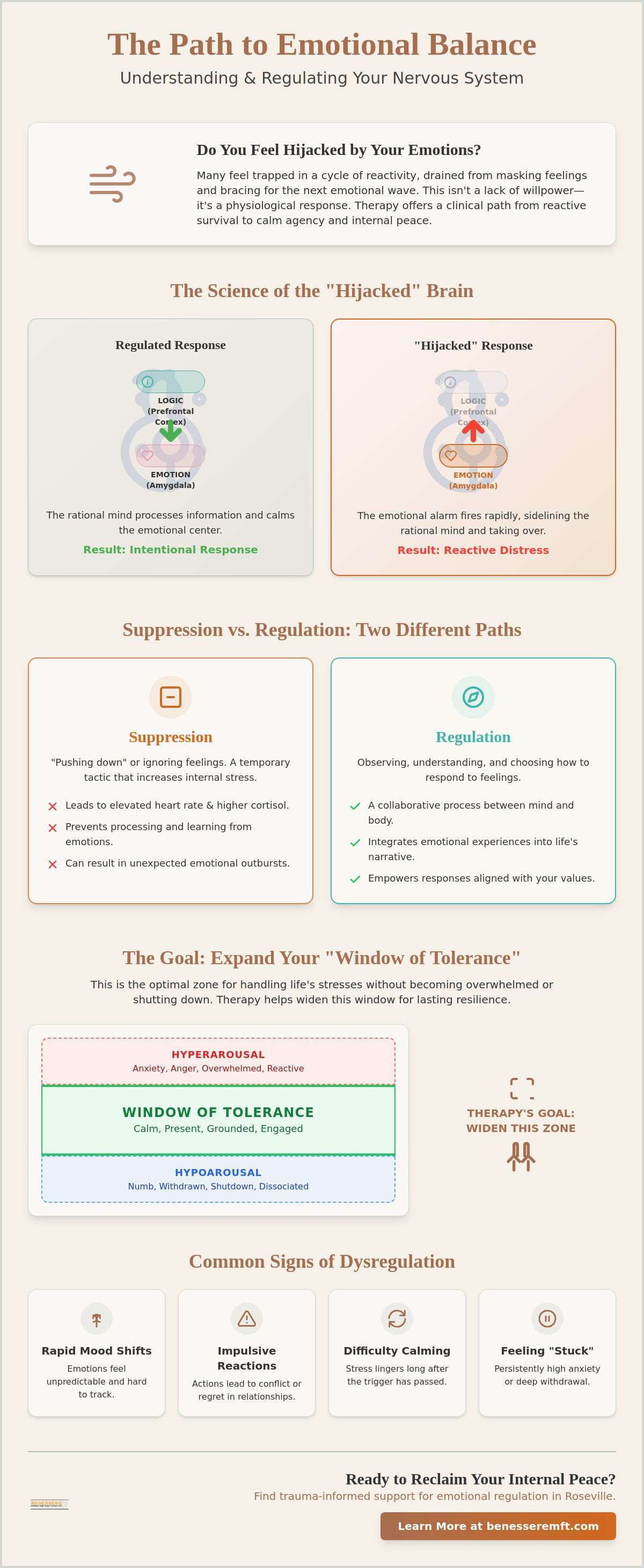
Emotional regulation is often misunderstood as a form of rigid self-control or the total absence of difficult feelings. In a clinical context, it's more accurately described as the ability to influence which emotions we experience and how we process them as they arise. This process, often referred to as Emotional self-regulation, involves a complex interplay between our cognitive thoughts and our physiological responses. When you engage in therapy for emotional regulation, the primary objective is to expand your "Window of Tolerance." This term describes the optimal zone where you can handle the stresses of daily life without becoming overwhelmed by anxiety or retreating into a state of emotional numbness.
The ultimate goal of this therapeutic work is to transition from a reactive "autopilot" state to one of intentional response. Instead of being swept away by a sudden wave of anger or sadness, you learn to observe the emotion, understand its message, and choose a path forward that aligns with your values. It's about moving from being a passive recipient of your moods to an active participant in your internal life.
The Difference Between Suppression and Regulation
Many people attempt to manage their feelings by "just pushing them down," a tactic known as emotional suppression. While this might offer a temporary sense of control, research suggests that suppression actually increases physiological stress, leading to elevated heart rates and higher cortisol levels. True regulation is a collaborative process between the mind and the nervous system that seeks to process, rather than ignore, internal states. Affect regulation is a restorative mental health service that empowers individuals to integrate their emotional experiences into a cohesive and manageable life narrative.
Why We Struggle: Common Signs of Dysregulation
Emotional dysregulation isn't a character flaw. It's often a physiological response to past trauma or prolonged periods of high stress. When life feels unpredictable, the brain's alarm system can become overly sensitive. This sensitivity can manifest in several ways:
Rapid and unpredictable mood shifts that feel impossible to track.
Impulsive reactions in relationships that lead to regret or conflict.
A persistent difficulty calming down once a stressor has passed.
Feeling "stuck" in a state of high anxiety or deep withdrawal.
Identifying these patterns is the first step toward healing. For many residents in our community, seeking individual psychotherapy Roseville provides the necessary space to explore these reactions without judgment. Normalizing these struggles as natural biological responses allows for a move toward therapy for emotional regulation with curiosity rather than shame. It's a shift from asking "what is wrong with me?" to "how can I better support my nervous system?"
The Science of the "Hijacked" Brain: Why We Lose Balance
When you experience an emotional surge, it often feels as if a switch has been flipped, leaving your rational mind struggling to catch up. This isn't a failure of character, but a biological reality governed by the relationship between the amygdala and the prefrontal cortex. The amygdala serves as your brain's alarm system, constantly scanning for threats. When it detects danger, it can "hijack" the brain, temporarily sidelining the prefrontal cortex, which is responsible for logic, planning, and impulse control. Understanding the Importance of Emotional Regulation in Mental Health is central to recognizing how this alarm system can become overactive, leading to the reactive distress many feel in their daily lives.
The encouraging news is that the brain possesses neuroplasticity, the inherent ability to form new neural pathways. Through therapy for emotional regulation, you can essentially retrain your brain to strengthen the connection between the emotional and rational centers. While chronic stress or past trauma can "thin" your regulatory bandwidth, making it harder to stay balanced, these pathways can be restored. In a clinical setting, your therapist acts as a co-regulator. By providing a steady, empathetic presence, the practitioner helps stabilize your nervous system, creating a safe environment where you can practice new ways of responding to internal and external stressors.
The Polyvagal Perspective: Safety and the Nervous System
The Vagus nerve plays a critical role in how we perceive safety. It acts as a primary communication line between the body and the brain, signaling whether we should be in a state of rest or defense. When the nervous system perceives a threat it cannot escape, it may trigger a "freeze" response. This state of immobilization is a survival mechanism, not a personal failing. Our approach to managing chronic stress therapy focuses on these biological roots, helping you identify when your body has moved into a defensive state and providing tools to signal safety back to your system.
Trauma and the Regulatory System
Past experiences of trauma often prime the brain for hyper-vigilance, keeping the amygdala in a state of constant high alert. This makes therapy for emotional regulation particularly vital for those who find themselves triggered by seemingly small events. Specialized trauma therapy Roseville incorporates psychoeducation to help you understand your unique triggers. By naming the physiological process as it happens, you begin to demystify the "hijacking" and regain a sense of agency over your reactions. If you're ready to explore how these biological patterns affect your life, we invite you to learn more about our restorative approach to psychotherapy.
Evidence-Based Clinical Approaches to Restoring Balance
While understanding the neurological "why" behind emotional surges is a vital first step, the restorative work of therapy for emotional regulation relies on structured clinical frameworks. These evidence-based approaches don't merely seek to suppress symptoms. Instead, they provide a roadmap for reorganizing how you interact with your internal world. Cognitive Behavioral Therapy (CBT), Dialectical Behavior Therapy (DBT), and Narrative Therapy each offer distinct lenses through which to view and manage affect, ensuring that treatment is as nuanced as the individuals seeking it.
CBT is often the starting point for many, as it focuses on the cognitive precursors to emotional distress. It identifies "automatic negative thoughts" (ANTs) that act as fuel for intense feelings. If a minor social rejection triggers the thought "I am fundamentally unlovable," the resulting sadness or anger becomes disproportionately large. By identifying and reframing these cognitive distortions, CBT helps lower the intensity of the emotional response before it reaches a point of crisis.
Dialectical Behavior Therapy (DBT) Skillsets
DBT was specifically designed for those who experience emotions with profound intensity. The "Dialectic" at the heart of this work is the balance between radical self-acceptance and the commitment to behavioral change. It's a validating process that says, "Your feelings make sense given your history, and you also deserve better tools to manage them." Within DBT, clients learn specific anxiety management techniques that serve as "crisis survival" skills. These tools, anchored by the foundational practice of mindfulness, allow you to stay present and centered even when the emotional tide is at its highest.
Narrative Therapy: Rewriting the Emotional Story
A common pitfall of chronic dysregulation is the tendency to adopt the struggle as a core identity. You might begin to believe "I am an angry person" or "I am emotionally unstable." This is where narrative therapy offers a powerful shift in perspective. It operates on the principle that "the person is not the problem; the problem is the problem." By externalizing the emotional challenge, you can view your reactivity as something you experience rather than something you are.
This externalization is a crucial component of therapy for emotional regulation because it restores a sense of agency. When you deconstruct the labels you've lived under, you're free to begin "re-authoring" your life story. You move from being a character defined by reactive distress to an author who chooses how to respond to life's complexities. This clinical process doesn't just manage emotions; it restores the dignity and self-worth that are often eroded by years of feeling "hijacked" by one's own nervous system.
Practical Strategies: What to Expect in an Emotional Regulation Session
A session dedicated to therapy for emotional regulation functions as a collaborative laboratory. It's a space where you and your therapist move beyond simply discussing the events of your week to actively analyzing the mechanics of your internal responses. The focus is on identifying the specific "triggers" that serve as catalysts for emotional escalation. These triggers might be external, such as a specific tone of voice from a partner, or internal, like a sudden memory or a physical sensation of tightness in the chest. By mapping these patterns, you begin to anticipate the "hijack" before it fully takes hold.
Once triggers are identified, the work shifts toward building a personalized Regulatory Toolkit. This isn't a one size fits all list of suggestions. It's a curated set of strategies tailored to your unique lifestyle and nervous system. You'll practice grounding techniques designed to keep you tethered to the present moment when distress begins to rise. We also utilize cognitive reappraisal, a process of intentionally shifting the meaning you assign to a stressful event. Instead of viewing a setback as a permanent failure, you learn to see it as a localized challenge, which naturally lowers the emotional stakes.
Developing Emotional Literacy
Naming an emotion is a powerful clinical act that changes the brain's activity. When you can accurately label a feeling, you essentially shift the neural load from the reactive amygdala to the rational prefrontal cortex, which reduces the emotion's physiological intensity. We often utilize psychoeducational tools like "feeling wheels" to help you move beyond broad descriptors like "upset" or "fine." This foundational work in depression counseling Roseville helps clients transform a heavy, undifferentiated cloud of sadness into specific, manageable experiences. Emotional literacy is the first step toward regaining your agency.
The "STOP" Technique and Beyond
During our sessions, we'll walk through practical acronyms like STOP to provide a cognitive pause during high-stress moments. The process is simple yet profound: Stop what you're doing, Take a breath to signal safety to your nervous system, Observe your internal and external environment without judgment, and then Proceed mindfully. We also explore "Opposite Action," a technique where you intentionally act against an unhelpful emotional urge. If sadness tells you to isolate, you might choose to reach out to a friend. To support this work, we emphasize self-soothing through the five senses, using sight, sound, smell, touch, and taste to ground the body in the "here and now."
If you're ready to move from a state of reactive distress to a place of restorative calm, we invite you to connect with us to begin your journey toward internal balance.
Specialized Support in Roseville: Finding Your Path to Healing
Emotional regulation is rarely a solitary endeavor. Our internal states ripple outward, shaping the climate of our homes and the quality of our most intimate bonds. When one individual struggles with reactivity, the entire family system can enter a state of chronic stress. This is why family therapy Roseville CA often integrates regulatory work to help each member move from defensiveness to connection. By learning to manage your own affect, you provide a stable anchor for those you love, transforming the home from a place of conflict to a sanctuary of mutual support. Your personal growth becomes a gift to the entire family unit.
Choosing a practitioner for therapy for emotional regulation is a significant decision that requires careful consideration. It's helpful to look for a provider who offers a trauma-informed perspective, as this ensures your past experiences are handled with clinical precision and care. A quality provider should demonstrate expertise in evidence-based modalities like DBT or CBT while maintaining a collaborative approach that respects your unique story. Seeking help isn't a sign of weakness; it's a profound act of resilience and a commitment to a more intentional way of living.
Why Local Expertise Matters in Placer County
Residents of Roseville and the surrounding Placer County areas benefit significantly from local care. Seeking mental health counseling Roseville CA ensures that your support system is grounded in the community where you live and work. The clinical team at Benessere Marriage and Family Therapy Institute works collaboratively, bringing together diverse expertise to ensure your care is both holistic and precise. This local focus provides a stable foundation for growth, allowing for a consistent therapeutic rhythm that's essential for meaningful neurological change and long-term stability.
Taking the First Step Toward Restorative Care
The initial consultation process is designed to reduce anxiety and build a sense of security from the very first interaction. During this time, we'll explore your challenges and define a path forward that feels manageable and safe. It's helpful to remember that therapy for emotional regulation is a process of skill building. Like any other discipline, these techniques can be mastered with time, patience, and professional guidance. You don't have to navigate these waves alone. If you're ready to reclaim your internal balance, we invite you to Schedule a session with Benessere Marriage and Family Therapy today.
Reclaiming Your Agency and Internal Calm
Reclaiming your internal balance isn't a matter of suppression, but of building a sophisticated partnership with your own nervous system. You've explored how the brain's alarm system can become overactive and how evidence-based frameworks like DBT and Narrative Therapy provide a reliable path back to stability. By developing emotional literacy and practical grounding techniques, you move from the exhaustion of masking to the freedom of authentic, intentional living. This transition marks the shift from simply surviving your feelings to navigating them with confidence.
Engaging in therapy for emotional regulation allows you to transform your reactive patterns into a state of restorative agency. Our team of Licensed Marriage and Family Therapists in Roseville utilizes a trauma-informed restorative approach to help you master the clinical skillsets necessary for lasting change. You deserve a life where you feel centered and secure, regardless of the emotional waves that may arise. Begin your journey to emotional balance with specialized therapy in Roseville. Your path to healing is a testament to your resilience and the inherent possibility of growth.
Frequently Asked Questions
Is emotional dysregulation a mental illness?
Emotional dysregulation is not a standalone mental illness, but rather a clinical descriptor for a nervous system that struggles to return to a baseline of calm. While it's often a central feature of conditions such as ADHD, BPD, or PTSD, it can also manifest as a temporary response to chronic stress. Understanding this distinction helps normalize the experience as a physiological challenge rather than a character flaw, allowing for a more compassionate path toward healing.
How long does therapy for emotional regulation typically take?
The timeline for therapy for emotional regulation is unique to each individual's nervous system and life history. While some clients experience a reduction in reactive distress within 12 to 15 sessions, others may choose a longer path to integrate deep-seated trauma. The focus remains on steady, methodical progress that honors your personal pace while building a durable foundation for internal balance and calm. Consistency is the key to lasting neurological change.
Can children and teens benefit from emotional regulation therapy?
Children and adolescents can benefit significantly from learning these skillsets early in their development to prevent long-term distress. In 2026, data indicated that 29% of U.S. high school students reported poor mental health, highlighting a clear need for proactive support. Early intervention helps youth develop the emotional literacy necessary to navigate the pressures of modern life, social media, and academic stress without becoming overwhelmed by their internal experiences.
What is the difference between a therapist and a coach for emotional regulation?
The primary difference lies in the depth of clinical training, licensure, and the scope of professional practice. Licensed therapists are trained to diagnose and treat underlying mental health conditions and trauma, whereas coaches typically focus on future-oriented goal setting and performance. For those dealing with a hijacked nervous system, the clinical authority of a therapist ensures that the biological and psychological roots of dysregulation are safely and effectively addressed.
Will I have to talk about my childhood in this type of therapy?
While the focus of emotional regulation work is often on the here and now, exploring past experiences can provide vital context for your current reactions. Understanding how your early environment shaped your nervous system's alarm settings allows for more precise intervention in the present. Your therapist will follow your lead and pace, ensuring that any look into the past serves the ultimate goal of restoring your agency and resilience today.
How do I know if my emotional reactions are "normal" or if I need help?
It's helpful to seek support when your emotional responses feel disproportionate to the situation or begin to strain your relationships and professional well-being. If you feel frequently hijacked by anger or sadness, it's a sign that your current coping mechanisms are overtaxed. With over 23% of U.S. adults living with a mental illness in 2026, seeking professional guidance is a proactive and courageous step toward reclaiming your quality of life.
Does insurance cover therapy for emotional regulation in Roseville?
As of July 2026, California law SB 855 requires health plans to provide coverage for all medically necessary treatment of mental health disorders. This includes therapy for emotional regulation when it's part of a clinical treatment plan. New 2026 regulations also mandate that insurers provide coverage for out-of-network care if in-network providers are unavailable, ensuring residents in Roseville have better access to the restorative care they need to find balance.



Comments