
Trauma-Informed CBT: A Restorative Approach to Evidence-Based Healing

The most profound healing doesn't happen by simply revisiting the past; it occurs when you finally feel safe enough to leave it behind. Research indicates that nearly 64% of adults have experienced at least one adverse childhood experience, yet many still feel isolated in their struggle to move forward. If you find yourself stuck in a cycle of hypervigilance or fear that therapy might be too overwhelming, trauma informed cbt provides a necessary shift in perspective. This approach prioritizes your immediate stabilization and safety before asking you to navigate the complexities of your history.
It's natural to feel confused by various clinical terms or hesitant to revisit distressing memories. You deserve a space where your nervous system is respected as much as your story. This article explores how a trauma-informed framework offers evidence-based tools to manage triggers and restore a sense of agency over your personal narrative. You'll learn how this structured partnership helps you transition from surviving the past to feeling grounded in the present, providing a clear path toward restorative growth.
Table of Contents
Beyond Traditional Therapy: Defining Trauma-Informed CBT
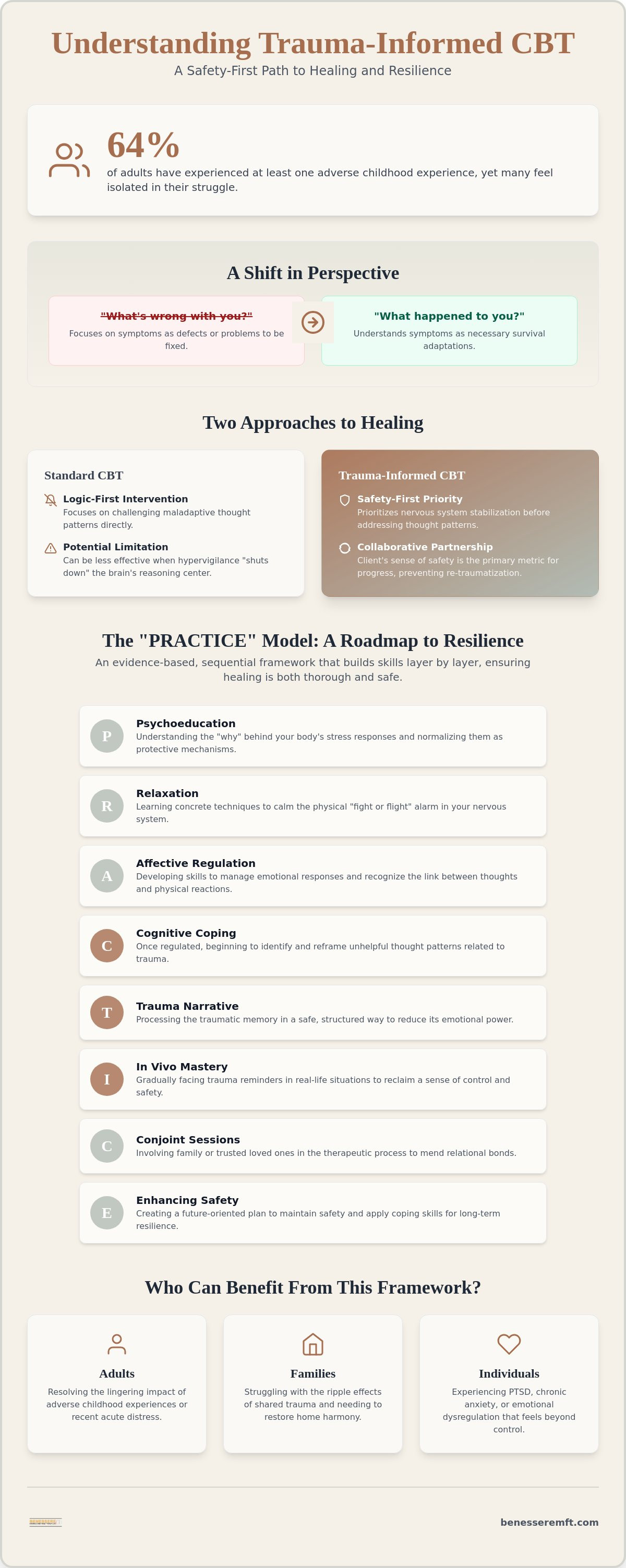
Trauma informed cbt is a clinical framework that recognizes how distressing life events reshape the brain and the body's stress response systems. While traditional cognitive behavioral therapy focuses on identifying and challenging maladaptive thought patterns, the trauma-informed model acknowledges that a person cannot simply "think" their way out of a physiological state of alarm. This approach is rooted in the principles of trauma-informed care, which shifts the therapeutic focus from treating symptoms as defects to understanding them as necessary survival adaptations. It's a restorative philosophy that asks "what happened to you?" instead of "what's wrong with you?"
The primary goal is to provide a safety-first structure that prevents re-traumatization during the healing process. This is achieved through the PRACTICE model, an evidence-based sequence that guides the therapeutic journey. By integrating psychoeducation, relaxation techniques, and narrative processing, this framework ensures that every step taken is grounded in clinical precision and deep empathy. It creates a space where an individual's history is respected, but it no longer dictates their future.
The Key Differences Between Standard and Trauma-Informed Approaches
Standard CBT often relies on logic-first interventions to change behavior. However, when an individual exists in a state of chronic hypervigilance, the prefrontal cortex, the brain's center for reasoning, often shuts down to prioritize survival. Trauma informed cbt addresses this reality by prioritizing nervous system stabilization over cognitive debate. We use psychoeducation to normalize the body's responses, helping you understand that your anxiety or emotional "numbness" is actually a protective mechanism. The therapist-client relationship is structured as a collaborative partnership, where your sense of safety is the most important metric of progress.
Who Can Benefit from This Restorative Framework?
This approach is designed for anyone whose life has been disrupted by overwhelming experiences, whether those events occurred recently or decades ago. It's particularly effective for:
Adults seeking to resolve the lingering impact of adverse childhood experiences or recent acute distress that impacts current relationships.
Families in Roseville who are struggling with the ripple effects of shared trauma and need to restore home harmony.
Individuals experiencing the weight of PTSD, chronic anxiety, or emotional dysregulation that feels beyond their control.
By focusing on regulation before resolution, this framework provides the tools needed to reclaim agency over your life and your personal narrative. It offers a clear, methodical path toward resilience that respects your pace and your unique story.
The Core Components: How the "PRACTICE" Model Facilitates Healing
While the PRACTICE model was originally developed as a specialized framework for children and adolescents, its components have become the gold standard for trauma recovery across the entire lifespan. This methodical path toward resilience ensures that every stage of treatment builds upon a foundation of security. By integrating these specific steps, trauma informed cbt provides a structured roadmap that respects your pace while moving steadily toward restoration. It's a process that honors the complexity of your experience without allowing it to define your future.
The PRACTICE acronym serves as a methodical path toward resilience, offering a sequential framework that ensures healing is both thorough and safe. The components include Psychoeducation, Relaxation, Affective regulation, Cognitive coping, Trauma narrative, In vivo mastery, Conjoint sessions, and Enhancing safety. Each step is designed to layer skills upon one another, ensuring you're never asked to process a memory before you have the tools to manage the emotional response it might trigger.
Building the Foundation: Safety and Regulation Skills
Before any deep processing can occur, the nervous system must learn to feel safe in the present moment. This begins with psychoeducation and affective regulation. We help you understand why your body reacts with a "fight or flight" response to certain triggers and then provide concrete relaxation techniques to calm that physical alarm. You'll learn to recognize the invisible threads between your thoughts and your physiological reactions through cognitive coping. Within the safety of a clinical environment, affective expression allows you to identify and label complex emotions. This foundational work ensures you can remain grounded even when discussing difficult topics.
Processing and Integration: Reclaiming Your Narrative
The centerpiece of this approach is the trauma narrative. This is not about reliving the pain; it's about organizing a fragmented memory into a cohesive story of survival. By moving from "what happened to me" to "how I survived and grew," you reclaim your voice and your agency. This process is closely aligned with narrative therapy, where the goal is to rewrite your story with you as the empowered protagonist. In vivo mastery then allows you to gradually face triggers in a controlled, supportive way, proving to your nervous system that the danger has passed. If you're seeking a way to integrate these experiences into a life of purpose, our specialized trauma and PTSD treatment offers the structured support you need to move forward.
Trauma-Informed Care for Adults and Families in Roseville
While many clinical discussions focus on childhood interventions, the application of trauma informed cbt for adults is equally critical for lasting recovery. At Benessere MFT, we integrate these principles into our individual psychotherapy in Roseville to help clients navigate the complex layers of their personal history. Healing is never a one size fits all process; it is a tailored clinical intervention that respects the unique pace of your nervous system. By creating a collaborative environment, we ensure that the therapeutic process remains a safe harbor rather than a source of additional stress.
Trauma often acts as an invisible wedge between loved ones, disrupting the natural flow of connection and trust. Our family therapy in Roseville CA incorporates trauma-informed skillsets to help families understand these disruptions. In the later stages of healing, joint sessions between partners or parents and their children become a vital tool for reconciliation. These sessions provide a structured space to practice new communication skills and rebuild the relational bonds that trauma may have strained.
Addressing Complex Trauma in Adulthood
Adult trauma therapy often involves unlearning long-term coping mechanisms that were once necessary for survival but are now causing distress in current relationships. Unlike child-focused models, adult interventions must account for the responsibilities and histories that individuals carry into the room. This framework is particularly effective for managing depression symptoms that are frequently linked to unresolved trauma. By utilizing evidence-based skillsets, adults can begin to untangle their past from their present, allowing for a more grounded and intentional life.
Supporting the Family Unit through Recovery
Building a culture of safety within the home is a primary goal for families in Placer County seeking to move past shared or individual distressing events. We help caregivers and partners understand the physiological nature of a trauma response, which often reduces household conflict and increases empathy. When a non-offending caregiver or a supportive partner understands the "why" behind a loved one's hypervigilance, they can become active participants in the stabilization process. This collective approach ensures that the entire family unit moves toward resilience together, creating a sustainable environment for long-term growth.
What to Expect: Navigating the Path to Resilience Without Re-traumatization
Entering therapy after a distressing experience often comes with a significant fear: the worry that talking about the past will only pull you back into the pain. Trauma informed cbt is specifically designed to prevent this. The process is structured into four distinct phases that prioritize your stability and agency at every turn. You're always the expert on your own pace; the therapist's role is to provide the framework while you decide when it's safe to move forward.
Step 1: Assessment and Safety Planning. We begin by establishing a baseline of security. This involves identifying your current triggers and creating a concrete plan to ensure you feel safe both inside and outside the therapy room.
Step 2: Skill Building. Before we look back, we look at the present. You'll learn specific tools to manage the physical and emotional "storms" that trauma symptoms can trigger, ensuring your internal resources are strong.
Step 3: Gentle Exposure. Processing memories occurs only when you're stabilized. This exposure is gradual and controlled, allowing you to face distressing memories without being overwhelmed by them.
Step 4: Consolidation. The final phase focuses on integrating your experiences into a new, empowered identity and looking toward a future where you're no longer defined by what happened to you.
The Myth of "Reliving the Trauma"
A common misconception is that healing requires you to relive every agonizing detail of a distressing event. In reality, trauma informed cbt focuses on processing rather than just reliving. Processing involves looking at the experience through a lens of safety to reduce its emotional charge. Your therapist acts as a Wise Guide, monitoring your physiological state to ensure you stay within your "window of tolerance." Part of this work involves coping with trauma symptoms in real-time, integrating restorative techniques into every session to maintain your sense of equilibrium.
Timeline and Commitment
While every individual's journey is unique, a typical course of treatment often spans 12 to 20 sessions. Consistency is particularly vital during the early safety and stabilization phases, as it helps build the trust necessary for deeper work. You'll know the therapy is working when you notice a steady reduction in hypervigilance, improved sleep patterns, and a newfound ability to remain present in your daily life. If you're ready to begin this methodical journey toward recovery, you can learn more about our trauma and PTSD treatment options designed to support your long-term wellness.
Clinical Expertise Meets Deep Empathy: Trauma Recovery at Benessere MFT
Benessere MFT stands as the local authority for trauma therapy in Roseville because we understand that clinical excellence is incomplete without deep-seated empathy. Our practice is built on a commitment to evidence-based treatment that honors the complexity of your unique story. Every therapist on our team is mentored to balance scientific precision with the human warmth necessary for a restorative environment. By choosing trauma informed cbt at our practice, you're entering a collaborative space where your safety is our highest priority and your progress is guided by expert care. We don't just treat symptoms; we walk alongside you as you reconstruct a life of meaning and stability.
Our approach is rooted in the belief that the therapist-client relationship is the most vital tool for change. We've cultivated a team that functions as a group of Wise Guides, helping you navigate the often-confusing landscape of recovery with clarity and confidence. This high register of professional care ensures that you feel respected and understood, providing a steady foundation for the work of trauma informed cbt to take root. We're dedicated to maintaining a high standard of psychological literacy while remaining deeply accessible to those we serve.
Why a Personalized Approach Matters
We move beyond generic interventions to honor the individual resilience you already possess. Every person's nervous system responds to stress differently, which is why a "cookie-cutter" approach often falls short of creating lasting change. By tailoring our clinical protocols to your specific needs, we ensure that the therapy remains effective without becoming overwhelming. This integration of psychoeducation allows you to understand the "why" behind your reactions, providing a sense of clarity that is often the first step toward reclaiming agency. Our team is proud to serve Placer County, offering a level of specialized care that allows residents to find high-level clinical support right here at home.
Your Path Forward Starts Here
If you've spent years feeling stuck in the past, the idea of change can feel daunting. We invite you to step into a process that respects your pace and validates your experience. Whether you're seeking general support or specific PTSD treatment in Roseville CA, our goal is to help you build a future that feels secure and full of potential. You don't have to navigate this journey alone. Growth isn't just a clinical outcome; it's a human possibility that we're honored to facilitate every day. Your restorative future is within reach, and it begins with a single, courageous step toward healing.
Reclaiming Your Narrative and Restoring Inner Peace
Healing from trauma is a deliberate and structured process that prioritizes your sense of safety above all else. By understanding how trauma informed cbt bridges the gap between physiological regulation and cognitive clarity, you can begin to view your symptoms as survival mechanisms rather than defects. This framework offers more than just a reduction in hypervigilance; it provides a methodical path toward reclaiming your agency and rewriting your personal story with resilience at its core. You deserve a therapeutic space where scientific precision meets deep human warmth.
At Benessere MFT, we combine evidence-based clinical expertise with specialized trauma and PTSD training to offer a compassionate, collaborative care model. Our team is dedicated to providing the stabilization and tools you need to feel grounded in the present. Begin your restorative journey with a trauma-informed therapist in Roseville today. Your history is a significant part of your journey, but it doesn't have to be the final chapter of your story. There is a profound possibility for growth and restoration waiting for you.
Frequently Asked Questions about Trauma-Informed Healing
Is trauma-informed CBT only for people with a PTSD diagnosis?
No, this approach is beneficial for anyone experiencing emotional dysregulation, hypervigilance, or a sense of being "stuck" following distressing life events. You don't need a formal PTSD diagnosis to benefit from the stabilization and coping tools provided by this framework. Many individuals seek trauma informed cbt to address the lingering impact of past experiences that interfere with their current relationships and daily well-being.
How is trauma-focused CBT different from regular CBT?
The primary difference lies in the prioritization of nervous system regulation and physical safety. While standard CBT often focuses on identifying and challenging maladaptive thought patterns, the trauma-informed version acknowledges that logic-first interventions can fail when the body is in a state of alarm. We prioritize stabilization and safety planning before moving into the cognitive processing of distressing memories.
Will I have to talk about my trauma in the very first session?
You won't be expected to recount the details of your history during your initial appointments. The first sessions are dedicated to establishing a secure therapeutic relationship, conducting a comprehensive assessment, and building a baseline of safety. We only move into processing the trauma narrative once you feel grounded and have the necessary tools to manage emotional "storms."
Can trauma-informed CBT help with childhood trauma even if I am now an adult?
Yes, this framework is highly effective for adults who are navigating the long-term ripple effects of adverse childhood experiences. It helps you identify survival-based coping mechanisms that were once necessary but may now be causing distress in your adult life. By processing these early narratives, you can reclaim your agency and build more restorative relationships in the present.
How long does it take to see results from trauma-informed therapy?
While every individual's path is unique, many clients begin to notice a reduction in hypervigilance and improved emotional regulation within the first several weeks of consistent care. A typical course of trauma informed cbt often spans between 12 and 20 sessions. The focus during the early phases is on stabilization, which often provides immediate relief from acute distress.
Is this type of therapy available for families in the Roseville area?
Yes, Benessere MFT provides specialized trauma-informed care for both individuals and families in Roseville and the surrounding Placer County community. We understand how trauma impacts the entire family unit and offer a collaborative space to restore relational bonds. Our approach helps caregivers and partners understand trauma responses to foster a culture of safety within the home.
What happens if I feel overwhelmed during a session?
Your therapist acts as a Wise Guide, carefully monitoring your physiological state to ensure you stay within your "window of tolerance." If you begin to feel overwhelmed, we immediately shift to grounding techniques and relaxation exercises to restore your sense of equilibrium. You're always the expert on your own pace, and we never push beyond what your nervous system can safely handle.
Does Benessere MFT offer other types of evidence-based counseling?
Benessere MFT offers a comprehensive suite of restorative services, including individual psychotherapy, family therapy, and couples therapy. Each of our clinical interventions is grounded in evidence-based practices and tailored to meet the specific needs of our clients. We are committed to providing a safe, professional environment where complex emotions are handled with scientific precision and human warmth.



Thank you for explaining how trauma can influence thoughts, feelings, and relationships. The focus on developing coping skills before addressing difficult memories is particularly important. Cognitive Behavioral Trauma Therapy can help individuals recognize patterns that no longer serve them and gradually develop healthier ways to respond to everyday situations.