
What Is Psychoeducation in Therapy? A Guide to Personalized Mental Health Treatment

Updated: Jun 19
What if the most effective way to heal wasn't just to talk, but to truly understand the biological and psychological "why" behind your experiences? Many people begin their mental health journey feeling fundamentally broken, fearing that therapy might become a directionless process that offers little more than temporary relief. When you're seeking clarity on what is psychoeducation in therapy, you're actually looking for a bridge between feeling overwhelmed and feeling empowered. It's exhausting to navigate daily life when you lack a clear framework for your own reactions, yet this sense of uncertainty is a weight you don't have to carry alone.
Understanding these concepts changes the entire dynamic of your sessions, shifting the focus from passive observation to active empowerment. This approach transforms clinical concepts into a personalized map for your recovery, providing the concrete tools and clinical literacy required for lasting resilience. We'll explore how this collaborative process builds a sense of agency over your mental health and ensures your treatment plan is tailored specifically to your unique story.
Key Takeaways
Understand what is psychoeducation in therapy as a foundational pillar of evidence-based care that provides a clear, logical map for your recovery.
Learn how a shared clinical language between you and your therapist creates a personalized framework for understanding your specific story and reactions.
Discover how clinical literacy fosters lasting resilience by replacing feelings of shame with a restorative, health-based understanding of your experiences.
Gain insight into the mechanics of anxiety and trauma to validate your physical symptoms and improve your daily engagement with therapeutic tools.
See how an integrative approach to education empowers you to move from feeling directionless to having a clear sense of agency over your mental health.
Table of Contents
What Is Psychoeducation in Therapy? Defining the Collaborative Path
The Role of Psychoeducation in Personalized Mental Health Treatment
Practical Benefits: How Clinical Literacy Enhances Resilience
Psychoeducation in Practice: Addressing Anxiety, Trauma, and Family Conflict
The Benessere Approach: Integrative Psychoeducation in Roseville
What Is Psychoeducation in Therapy? Defining the Collaborative Path
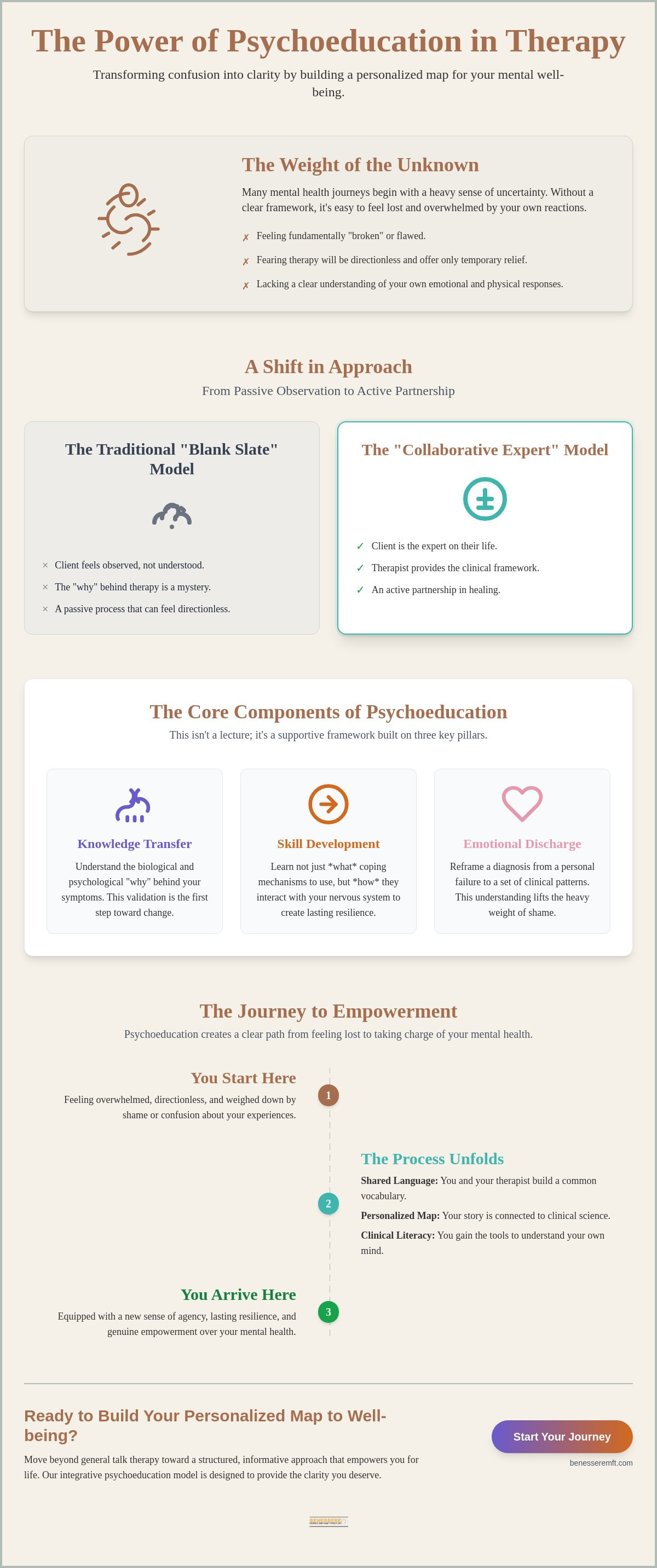
At its heart, Psychoeducation represents the systematic sharing of psychological knowledge between a practitioner and a client. It isn't a separate, optional feature of treatment. Rather, it's an essential pillar of evidence-based care. When exploring what is psychoeducation in therapy, it's helpful to view it as the process of translating complex clinical concepts into accessible, actionable insights. This approach ensures you aren't just experiencing therapy; you're understanding the mechanics of your own mental well-being.
Traditional models often positioned the therapist as a "blank slate" who observed silently, leaving the client to wonder about the logic behind the process. At Benessere, we move toward a "collaborative expert" model. We believe that you're the expert on your own life, while we provide the clinical framework to make sense of your experiences. This partnership fosters clinical literacy, which is vital when considering what is psychoeducation in therapy and how it applies to your growth. It's a form of personal empowerment that allows you to name your struggles, understand their origins, and participate actively in your healing process.
The Core Components of Psychoeducational Support
This supportive framework involves several layers of information. First, there's the transfer of knowledge regarding the biological and psychological roots of your symptoms. Understanding why your brain reacts to stress in a specific way can be incredibly validating. Second, it focuses on skill development. You aren't just told to practice a coping mechanism; you learn exactly how it interacts with your nervous system. Finally, it facilitates emotional discharge. When you understand a diagnosis as a set of clinical patterns rather than a personal failure, the weight of shame begins to lift.
Why Psychoeducation Is Not a One-Size-Fits-All Lecture
Effective education in a therapeutic setting is far more than a generic lecture. It requires a deep understanding of your unique history and the specific challenges you face. While general mental health facts are available online, personalized clinical insights are tailored to your specific story. Our therapists prioritize timing, ensuring that information is delivered when you're emotionally ready to integrate it into your life. This pacing respects your journey and prevents the educational process from becoming overwhelming.
The therapeutic relationship remains the foundation of this process. For education to feel restorative rather than cold or medical, it must happen within a safe, non-judgmental space. This ensures that the information you receive doesn't just fill your head with facts, but actually settles into your heart. It provides the clarity needed for genuine growth, turning clinical knowledge into a tool for lasting resilience.
The Role of Psychoeducation in Personalized Mental Health Treatment
Personalized care begins with the establishment of a shared language. Without a common vocabulary, the nuances of your internal experience can sometimes be lost in translation between your lived reality and clinical observation. When exploring what is psychoeducation in therapy, it's vital to recognize it as the bridge that connects these two worlds. It allows for a process known as collaborative case conceptualization. This is the moment where your unique story meets established clinical science, creating a specific map for your recovery that feels both accurate and deeply personal.
By integrating psychoeducation into your sessions, you're empowered to help fine-tune your own treatment goals. You aren't just a recipient of care; you're an active participant who understands the "why" behind every intervention. This transparency is what makes psychoeducation a powerful evidence-based therapeutic intervention. It ensures that the strategies we choose, whether for trauma or anxiety, are grounded in a logic you fully grasp. If you're ready to move beyond general talk therapy toward a more structured, informative approach, exploring our individual psychotherapy options can be a restorative first step.
Tailoring the Science to Your Unique Story
The beauty of this approach lies in its ability to de-stigmatize complex emotional states. Consider a high-functioning professional in Roseville struggling with persistent worry. Through psychoeducation, they learn how their neurobiology is actually trying to protect them, shifting the narrative from "What is wrong with me?" to "How is my brain attempting to keep me safe?" This shift is particularly profound in trauma work. We use data to validate that your reactions are normal responses to abnormal events. This perspective replaces the heavy burden of shame with the clarity of biological understanding, allowing you to view your symptoms with scientific precision and human warmth.
Building a Roadmap for Targeted Recovery
One of the greatest risks in long-term treatment is "therapy drift," where sessions become pleasant but lack a clear direction. Psychoeducation prevents this by keeping our work focused on specific, mechanism-based goals. When you understand the underlying mechanics of your condition, you gain the clinical literacy needed to track your own progress objectively. We integrate personalized feedback loops into this process, ensuring the educational material evolves as you grow. This methodical progression provides a sense of stability and confidence, ensuring that every session brings you closer to a state of lasting resilience and holistic health.
Practical Benefits: How Clinical Literacy Enhances Resilience
Clinical literacy isn't merely an academic exercise. It's a practical toolkit designed to bolster your resilience in the face of life’s inevitable stressors. When we examine what is psychoeducation in therapy, we see a shift from a shame-based identity to a health-based understanding. This transition is restorative. It allows you to view your struggles through a lens of biological normalization rather than personal failure. By understanding the "why" behind your reactions, you become more than a participant in a process. You become the hero of your own recovery journey, equipped with the agency to direct your path forward with scientific precision.
This commitment to scientific precision and personalized data is a standard of care increasingly found in other specialized health fields. For instance, Optima Physical Therapy integrates advanced AI-powered technology into their concierge physical therapy services to ensure that every aspect of a patient's physical recovery is as precisely tailored as their mental health treatment.
This clarity directly impacts treatment adherence. It's human nature to resist tasks that seem arbitrary. However, when you understand that a specific grounding exercise is designed to stimulate the vagus nerve and down-regulate a hyper-active amygdala, the exercise takes on new meaning. You aren't just following instructions; you're applying a known physiological lever to adjust your internal state. This level of insight is supported by the Clinical Practice Guidelines for Psychoeducation, which emphasize its role in improving outcomes across various clinical settings by fostering a collaborative therapeutic alliance.
Beyond immediate skill application, these benefits extend into the prevention of future crises. Clinical literacy provides you with a lens to recognize early warning signs before they escalate. This methodical insight allows for effective relapse prevention, where you learn to identify subtle shifts such as:
Physiological shifts: Noticing changes in sleep patterns, appetite, or chronic muscle tension.
Cognitive patterns: Identifying the return of specific ruminative loops or intrusive thoughts.
Emotional markers: Recognizing a decrease in your window of tolerance for minor daily stressors.
Reducing the Weight of Shame and Stigma
Education acts as a protective shield against societal misconceptions. When you understand that your mental health struggles have documented physiological roots, the internal narrative changes. Realizing that your experiences are shared by others with similar neurological patterns is profoundly validating. It normalizes your struggle, making it a manageable health condition rather than a permanent character flaw. This shift is essential for building the self-compassion required for deep, lasting healing.
Enhancing Communication in Relationships
Psychoeducation is also a powerful tool for relational health. It provides a shared language that helps you explain your needs to family members or partners without falling into defensiveness. In our work with marriage and family therapy Roseville CA, we use education to break generational cycles of misunderstanding. By bringing family members into the educational process, we build collective empathy. This shared understanding allows the family unit to support your growth while simultaneously healing the system as a whole. For parents looking to introduce these concepts to their children, you can explore Individual Therapy for Children through Balanced Minds Psychology & Wellness, where tools like the feelings wheel are used to build emotional literacy from a young age.
Psychoeducation in Practice: Addressing Anxiety, Trauma, and Family Conflict
Applying clinical knowledge to your daily life changes the texture of your recovery. When we look at what is psychoeducation in therapy through the lens of specific struggles, we see how information acts as an anchor. For those navigating anxiety, we often discuss the "amygdala hijack." This is the biological reality that during a panic attack, the emotional center of the brain effectively shuts down the logical center. Understanding this helps you stop blaming yourself for not being able to "think" your way out of fear. It validates that your body is reacting to a perceived threat with scientific precision, even if that threat is no longer present.
In the context of trauma, we focus on the reality that the body keeps the score. Physical symptoms like a racing heart or a tight chest are often stored survival responses rather than signs of current danger. For families in Roseville, we explore attachment styles to explain why certain arguments seem to repeat in a loop. By integrating this knowledge into narrative therapy, we help you rewrite your story from one of being "broken" to one of being a resilient survivor with a highly adaptive nervous system.
Neurobiology and Anxiety Management
For a high-stress professional, the fight-flight-freeze response can feel like a constant internal hum. Our approach to psychoeducation for anxiety provides immediate relief by explaining these biological triggers. Grounding techniques are often misunderstood as mere distractions. In reality, they are sophisticated tools that use sensory input to signal safety to the brain, effectively down-regulating the nervous system. If you're ready to master these tools, our Trauma and PTSD Treatment can help you regain control.
Trauma-Informed Education
Recovery from deep-seated distress requires staying within your "window of tolerance." This is the zone where you can process emotions without becoming completely overwhelmed or shut down. In trauma therapy Roseville, we teach you to distinguish between a memory and a flashback. A memory has a "time-stamp" that tells you it's in the past, while a flashback feels like it is happening right now. Trauma-informed psychoeducation is a restorative tool that creates a foundation of safety by demystifying your body's most intense reactions.
The Benessere Approach: Integrative Psychoeducation in Roseville
At Benessere, our commitment to evidence-based skillsets is matched only by our dedication to clinical transparency. We believe that you deserve to understand the roadmap of your own healing. When people ask what is psychoeducation in therapy at our practice, we describe it as a mentoring relationship. Our therapists in Roseville don't just deliver data; they guide you through the process of integrating that data into your daily life. This transparency builds a foundation of trust, ensuring you feel like a partner in your care rather than a passive observer of a clinical process.
The community in Roseville and throughout Placer County often faces unique pressures. Whether you're navigating the demands of a high-stakes professional environment or the complexities of modern family dynamics, these local stressors require a nuanced approach. We recognize these challenges and tailor our educational focus to meet them. By blending scientific precision with humanistic warmth, we ensure that the clinical information you receive feels relevant to your specific environment and community. It's about providing the right information at the right time to foster genuine growth.
A Safe Space for Scientific and Soulful Growth
We intentionally avoid the coldness of purely medical jargon in favor of restorative and accessible language that honors your experience. Every personalized mental health treatment plan we create is built around your tailored story. This ensures that the psychoeducational components of your care aren't just abstract facts; they're reflections of your own journey toward wellness. Our team is deeply invested in providing specialized clinical care that supports the long-term health of our neighbors, creating a safe space where complex emotions are handled with both expertise and empathy.
Taking the Next Step Toward Clinical Literacy
Preparing for your first session is a courageous step toward reclaiming your agency. You might consider asking your therapist how they integrate education into their specific modality or what frameworks they use to explain nervous system regulation. When you understand what is psychoeducation in therapy, you begin to see it as a tool for long-term independence. The goal is for you to become the ultimate expert in your own mental health. This clinical literacy provides a foundation that lasts far beyond your time in the therapy room, offering a sense of stability that carries you through future life transitions.
Growth is always possible, and resilience is a skill that can be cultivated through deep understanding. By exploring these concepts, you've already begun the work of building a more empowered relationship with your mind. We invite you into this collaborative process, where your story is handled with the respect and clinical precision it deserves, leading toward a life of holistic health and quiet optimism.
Reclaiming Your Story with Knowledge and Resilience
The transition from feeling overwhelmed by your symptoms to understanding the biological logic behind them is a profound shift in any therapeutic journey. By exploring what is psychoeducation in therapy, you've seen how clinical literacy serves as a protective shield against shame and a roadmap for targeted recovery. This collaborative process ensures that your treatment is never directionless but rather a methodical progression toward lasting health. Whether you're navigating the complexities of trauma or seeking to break generational cycles in family conflict, the integration of scientific precision and human warmth provides the stability you need to grow.
At Benessere, we provide local expertise in Roseville, CA, utilizing evidence-based clinical skillsets within a trauma-informed and restorative framework. We believe that when you're equipped with the right tools and a clear framework for your reactions, you can move forward with a renewed sense of agency and quiet optimism. Begin your personalized path to healing at Benessere MFT today. Your story is unique, and it deserves to be handled with both professional expertise and deep-seated empathy. You don't have to navigate this path alone.
Frequently Asked Questions
Is psychoeducation the same as a lecture from my therapist?
Psychoeducation is a collaborative exchange rather than a one-sided lecture. While it involves sharing clinical information, the process is integrated into your personal story and current emotional state. It's an invitation to explore how scientific concepts apply to your lived experience, ensuring the information is restorative rather than overwhelming. We prioritize a dialogue that respects your pace and focuses on your unique needs.
How does understanding my brain actually help me feel less anxious?
Understanding your neurobiology helps reduce anxiety by providing a logical framework for physical sensations that feel out of control. When you recognize that a racing heart is a survival response from your autonomic nervous system, the fear of the sensation itself decreases. This clarity allows you to move from feeling "broken" to feeling biologically normal, which is a foundational step in your recovery journey.
Can psychoeducation be used in couples or family therapy?
Psychoeducation is highly effective in couples and family therapy because it establishes a shared language for the entire unit. By educating everyone on concepts like attachment styles or emotional regulation, family members can view each other’s behavior through a clinical lens rather than a personal one. This shift builds collective empathy and helps break generational patterns of conflict by normalizing the human struggle for connection.
Do I need a specific diagnosis to benefit from psychoeducation?
You don't need a formal clinical diagnosis to benefit from understanding how your mind and body interact. Everyone experiences stress, grief, or relational challenges that can be clarified through psychological literacy. Psychoeducation provides a framework for navigating the general human condition, helping you build resilience and agency regardless of whether you meet specific diagnostic criteria for a mental health condition.
How much of my therapy session will be spent on 'education'?
The amount of time dedicated to education depends entirely on your specific goals and your readiness to integrate new information. In some sessions, we might spend ten or fifteen minutes discussing a particular neurological mechanism, while in others, education happens subtly through brief, validating observations. We prioritize your emotional safety, ensuring that the educational component supports your processing rather than replacing it.
What happens if I find the clinical information overwhelming or scary?
If clinical information feels overwhelming, we immediately shift our focus to processing that emotional reaction within a safe space. The goal of what is psychoeducation in therapy is to empower you, not to cause further distress. We use a trauma-informed approach to ensure that any data shared is delivered in manageable, restorative portions that respect your current window of tolerance.
Is psychoeducation effective for trauma recovery?
Psychoeducation is a core component of trauma and PTSD treatment because it helps demystify intense survival responses that often feel nonsensical. Understanding that flashbacks or hypervigilance are adaptive reactions to past danger can significantly reduce the shame associated with trauma. This knowledge creates a foundation of safety, allowing you to engage more deeply with the somatic and narrative aspects of your healing process.
How do I know if a therapist in Roseville uses a psychoeducational approach?
You can identify a psychoeducational approach by looking for therapists who prioritize clinical transparency and collaborative goal setting. When discussing what is psychoeducation in therapy with a provider in Roseville, ask if they explain the logic behind their interventions. A therapist using this model will often share resources, explain psychological mechanisms, and invite you to become an active, informed participant in your own treatment planning.



Comments