
What to Do When You Feel Lost: A Gentle, Practical Guide

Updated: Oct 1
What to Do When You Feel Lost in Life | A Gentle, Practical Guide
What to Do When You Feel Lost: A Gentle, Practical Guide
What if feeling lost isn’t proof that you’ve failed, but a signal that something in your life needs attention? If you’re unsure what to do when you feel lost in life, even ordinary decisions can feel overwhelming. You may feel disconnected from your values, routines, or relationships, and worry that you should already know what comes next.
Uncertainty can be uncomfortable, but it doesn’t mean something is wrong with you or that you’ll feel this way forever. You don’t have to solve your whole life at once. Often, clarity begins by noticing what feels out of step and choosing one manageable action.
This guide explores what feeling lost may be signaling and offers practical ways to reconnect with what matters, regain a sense of agency, and test possible next steps. It also considers when professional support might help. Individual psychotherapy can provide a collaborative space to make sense of uncertainty and explore your options at your own pace, without assuming there’s one right path forward; if you are looking for dedicated support to foster emotional awareness and growth, check out SEDA Counselling & Psychotherapy.
Table of Contents
What It Can Mean to Feel Lost in Life, and Why It Does Not Define You
Feeling lost can be unsettling, especially when you believe you should already know what comes next. The experience is subjective: it may involve unclear direction, disconnection from what matters to you, or difficulty making choices. It isn’t, by itself, a mental health diagnosis or proof that you’re failing. Changes, competing expectations, ongoing stress, or needs that have gone unmet may all play a part, and the reasons differ from one person to another.
For some, uncertainty raises questions about meaning, identity, or purpose. Reading about existential crises may offer one framework for considering those questions, but you don’t need a label to take your feelings seriously. You can begin by noticing what has changed or what feels difficult without deciding immediately what it means.
How feeling directionless can show up in everyday life
You might find yourself postponing decisions, feeling less motivated, or struggling to picture what the next few months could look like. You may still go to work, care for family, and keep up with responsibilities while privately feeling uncertain about your direction. These are possible experiences, not a checklist; feeling this way looks different for everyone.
Why uncertainty does not mean you have failed
Priorities and identities can shift as relationships, responsibilities, health, and circumstances change. A direction that once felt right may no longer fit, or you may be balancing your preferences with expectations from people and communities that matter to you. That tension doesn’t require blaming anyone. It can be a reason to pause and ask what feels chosen and what feels driven by obligation.
Temporary uncertainty is an experience you’re having, not a definition of who you are. Rather than demanding a complete answer, get curious about what the feeling might be communicating. Are you tired, missing connection, or wanting more room for a value you’ve set aside? You don’t need to know yet. If you’re considering what to do when you feel lost in life, start with a gentler question: what would I like to understand better about how things feel right now?
Why You Might Feel Lost: Stress, Change, and Disconnection
There may not be one clear reason you’re feeling uncertain. Stress, shifts in relationships or responsibilities, distance from supportive people, and less time for meaningful activities can all affect how connected you feel to your direction. These are possibilities to reflect on, not explanations you need to diagnose in yourself. More than one may be present, and sometimes the reasons become clearer only with time.
When much of your attention goes toward immediate demands, it can be harder to consider longer-term hopes. A busy stretch at work, caring for someone, or managing a difficult situation may narrow your focus to what needs doing today. That response can be understandable, even if it leaves little room to ask what you want next. Reconnecting with someone you trust or an activity that feels meaningful may offer a different perspective without requiring you to have a plan.
When a life change disrupts your sense of direction
A role change, loss, relationship shift, or new responsibility can unsettle routines and expectations that once organized everyday life. Even a change you chose may involve grief for what has ended, alongside uncertainty about what comes after. If a transition is part of your experience, four steps to finding your path may offer a structured starting point. You can also read more about coping with life transitions as you consider what support or adjustments might help.
When emotional distress may be part of the picture
Persistent low mood, anxiety, or trauma-related distress can affect motivation, concentration, and the ability to imagine future possibilities. Feeling lost alone doesn’t establish depression, anxiety, or trauma; similar uncertainty can arise in many circumstances. The meaning of distress depends on its context, how long it lasts, and how it affects daily life. Noticing these patterns can help you decide whether reflection, connection, or professional support may be useful.
For some Roseville residents, individual psychotherapy can provide a collaborative setting to explore uncertainty and possible next steps. It isn’t necessary for everyone, but it may be an option if you’d like support in understanding what you’re experiencing.
How to Find Direction Again: Small Steps That Make Choices Easier
You don’t need a complete life plan before taking a useful step. If you’re asking what to do when you feel lost in life, try a brief process: pause, notice what’s happening, identify what matters, choose one small experiment, then review what you learned. This isn’t a test you can pass or fail. It’s a way to gather information while keeping choices manageable.
Start with what you know, not a complete life plan
Take a quiet moment to notice what feels draining, important, or uncertain right now. Write down needs and values in plain language, such as “more time to rest,” “meaningful work,” or “closer friendships.” You don’t need a fixed purpose statement. Choose one question to explore, such as “What helps me feel connected?” rather than trying to resolve every part of your life at once.
Choose one manageable action and learn from it
A small experiment is a limited, low-pressure action that helps clarify what you prefer or need. If connection matters, arrange a brief conversation with someone supportive. If curiosity is missing, try an activity that interests you. Keep the step reversible, especially if you’re overwhelmed. A direction-finding exercise can also help you consider what you want to move toward without requiring an immediate major decision.
Afterward, notice what the experience was like. Did it feel meaningful, draining, calming, or different from what you expected? Treat the answer as information, not a verdict about your ability or future. If the action didn’t fit, that’s useful to know too.
Then adjust. Choose a next step that respects your current energy and circumstances, or give yourself more time before deciding. Direction often becomes clearer through small choices and reflection, rather than pressure to make one perfect move.
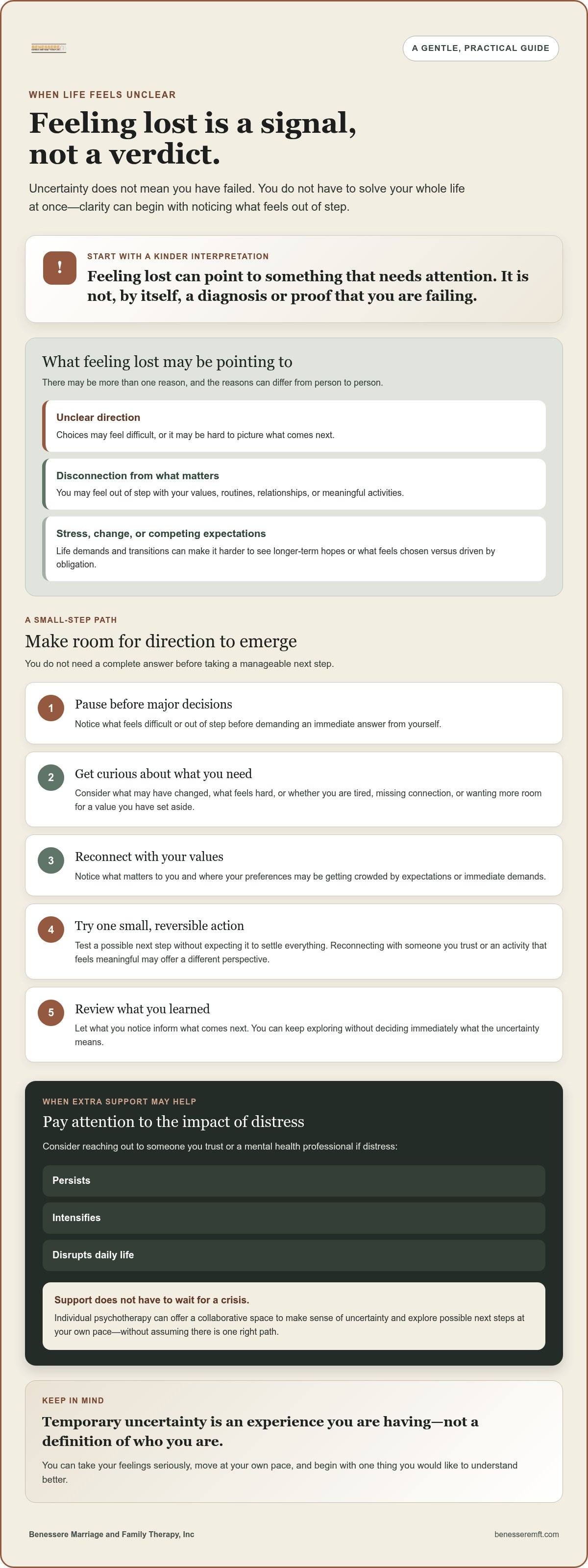
What to Do When You Feel Lost in Life: Start With One Small Step
To make the process concrete, set aside a little time to write two short lists: what has been taking energy lately, and what has helped you feel engaged or supported. Look for one need or value that stands out. Choose a low-pressure action connected to it, such as asking someone you trust for a conversation or making room for an activity you miss. Afterward, note what felt useful and what didn’t. The goal is to learn, not to force a life-changing answer.
When Feeling Lost Calls for More Support
Consider seeking additional support if distress persists, grows more intense, or begins to interfere with sleep, relationships, work, or everyday responsibilities. You don’t need to wait until you’re in crisis to talk with a professional. Support can be useful while you’re still functioning, especially if you’re unsure how to make sense of what you’re experiencing.
How therapy can help you explore uncertainty
Therapy can offer a collaborative setting to identify what’s weighing on you, explore your values and patterns, and consider realistic next steps. A therapist may use evidence-based psychotherapy and psychoeducation to help you better understand your experiences. To see how evidence-based care can support people working through life challenges, visit Sora Counselling. This process isn’t a judgment, and it can’t guarantee a particular answer or outcome. The pace and focus can be shaped around your circumstances.
If you’re considering what to do when you feel lost in life, you might ask yourself whether it would help to explore your concerns with someone trained to listen and work with you. For readers in Roseville, Benessere Marriage and Family Therapy, Inc provides individual psychotherapy tailored to each client’s circumstances. Learn more about individual psychotherapy in Roseville.
How to decide whether professional support fits
Reflect on how the uncertainty is affecting your daily life. Are sleep, relationships, work, or responsibilities becoming harder to manage? You don’t need to diagnose yourself or meet a particular threshold to ask for help. If you contact a therapist, consider asking about their approach, how they think about fit, and what an initial conversation involves. Their answers can help you decide whether you feel comfortable taking another step.
If you’re in the United States and in immediate danger or thinking about harming yourself, call 911. You can also call or text 988 to reach the Suicide & Crisis Lifeline. If you’re supporting someone else in immediate danger, contact emergency services. Crisis-resource information can change, so verify current contact details and local availability before publication.
A Gentle Next Step: Making Room for Clarity and Support
Uncertainty can be explored without treating it as a verdict about your future. You may not know the whole direction yet, and that doesn’t mean you’re standing still. For now, clarity might mean understanding one need more fully or noticing that a particular choice deserves more time.
Bring the next step down to a manageable size. Ask yourself, “What feels most important for me to understand right now?” Choose one action that fits your current capacity, such as setting aside time to reflect or reaching out to someone you trust. Then notice what shifted, even slightly, and what remains unclear. Both are useful information.
Build a next step that respects your pace
You don’t need to follow a rigid self-improvement plan or make a major decision before you feel ready. Your next step might be rest, a conversation, or revisiting a choice after you’ve had time to think. Review what the step was like and whether it brought you closer to a need or value. If it didn’t fit, adjust. Progress can include support, pauses, and changing your mind as you learn more.
Explore individualized support in Roseville
For people who would like professional support, Benessere Marriage and Family Therapy, Inc offers individual psychotherapy in Roseville, California. Care is tailored to each client’s story and needs, creating a collaborative setting to explore concerns and consider possible next steps. Therapy may be one option among several; you can decide whether it feels appropriate for you.
To learn more, explore individual psychotherapy options.
Let Your Next Step Be Small and Meaningful
Feeling uncertain doesn’t determine where your life is headed. Stress, change, or disconnection may affect your sense of direction, but you can approach those feelings with curiosity rather than judgment. If you’re considering what to do when you feel lost in life, begin with one question about what matters now, then choose a manageable action and notice what you learn. You don’t have to make every decision at once.
Support can also be part of finding your footing. A trusted person may help you feel less alone, while a therapist can offer a collaborative space to explore concerns and possible next steps. Benessere Marriage and Family Therapy, Inc offers individual psychotherapy in Roseville, with interventions tailored to each client’s story and needs. Therapy isn’t necessary for everyone, but it may be an option if individualized support feels helpful.
If you’re ready to explore whether individualized support fits your needs, contact Benessere Marriage and Family Therapy, Inc.
Frequently Asked Questions
Is it normal to feel lost in life?
Yes, feeling uncertain or directionless can happen during change, stress, or periods of reflection, and it doesn’t by itself mean something is wrong with you. People experience it differently, and there’s no single timeline for finding clarity. Notice whether the feeling is affecting your well-being or daily routines. If it persists, becomes more distressing, or interferes with everyday life, consider speaking with someone you trust or a qualified mental health professional.
What should I do first when I feel lost?
Start with one small observation instead of trying to solve your whole future. Write down what feels difficult, what matters to you, and what support you have. Then choose one manageable action connected to a need or value, such as making time to rest or contacting someone supportive. An action doesn’t need to produce an immediate answer to be useful. Review what you learned and adjust gently.
Why do I feel lost even when my life seems fine?
Your outward circumstances don’t always reflect your internal experience. Stress, unmet needs, changing values, disconnection, or emotional distress may contribute, but there isn’t one explanation that fits everyone. Feeling lost doesn’t mean you’re ungrateful or failing. Give yourself room to notice what feels missing without judging yourself for it. If the feeling is affecting your well-being or making daily life harder, consider talking with someone you trust or seeking professional support.
How long does feeling lost in life last?
There’s no fixed duration for feeling lost. For some people, uncertainty shifts as circumstances change or they make time to reflect; for others, it may continue or become more distressing. Rather than setting a deadline for clarity, notice whether the feeling is affecting your sleep, relationships, work, or daily responsibilities. If it persists or feels difficult to manage, speaking with a mental health professional may help you explore what’s contributing and consider possible next steps.
Can therapy help when you feel lost in life?
Therapy can provide a collaborative space to explore what feels unclear, notice recurring patterns, and consider next steps that fit your circumstances. It doesn’t promise a ready-made life plan, and you don’t need a diagnosis to ask about support. In Roseville, Benessere Marriage and Family Therapy, Inc offers individual psychotherapy tailored to each client’s story and needs. You can ask a prospective therapist about their approach and discuss whether it feels appropriate for you.
When should I seek professional help for feeling lost?
Consider reaching out when uncertainty or distress persists, intensifies, or makes relationships and daily responsibilities harder to manage. You don’t have to wait until things feel unbearable. A trusted person may be a useful first contact, and a qualified mental health professional can help you explore what’s happening. If you’re in immediate danger in the United States, call 911. If you’re in crisis, call or text 988. Verify current crisis-resource details before relying on them.



Comments